Finding Something Old and Something New in Byatt's Possession
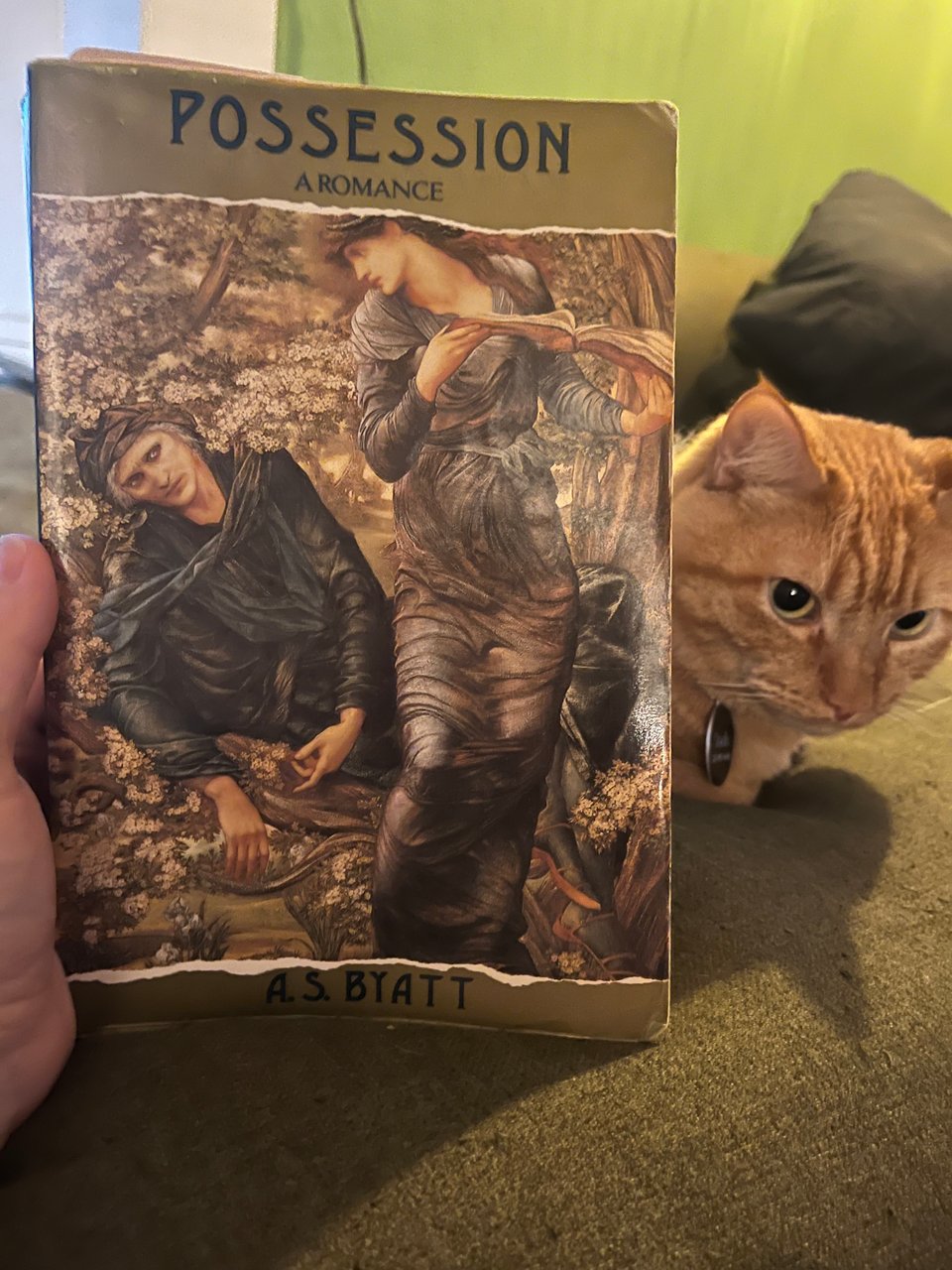
I first read Possession by A. S. Byatt many years ago for my college Victorian Literature class. I remember finding the book immersive and its central mystery a bit intoxicating. It was one of those novels I fell into and didn’t feel quite like required reading.
Possession was published in the early 90s — the 1990s, and perhaps an odd choice to include a late 20th-century novel on a Victorian Lit syllabus. Possession is a dense 500-page, and for being 35 years old, it holds up remarkably well. It’s a literary mystery, a fictional archive, an experiment in poetics, and, as its title asserts, a Romance. Possession is not a love story in the way most people understand romance, but a capital-R Romance in an Old French, Sir Walter Scott kind of sense. Byatt asserts the genre not just in the title, but also in the epigraph, by quoting Nathaniel Hawthorne’s The House of Seven Gables: “The point of view in which this tale comes under the Romance definition lies in the attempt to connect a bygone time with the very present that is flitting away from us.”
If writing this type of Romance was Byatt’s goal, she succeeded wildly. I can forgive her for some of the less realistic moments, including the almost silly climax involving an DIY grave exhumation.
Intrigued yet? Okay, the plot: Possession is about two literature scholars who discover a secret relationship between the two Victorian poets they each study. They find letters hidden away in a dusty bedroom, and they decide to wait on sharing their discovery with their bosses and colleagues. But this discovery is very juicy! It would shatter the field, cause media frenzy, force biographies to be rewritten and poems reexamined, not to mention how money and copyright will get in the way of the scholarship. This is where the novel gets a bit silly and a bit fun.
As the scholars learn more about this secret, the story of the two poets unfolds through entirely fictional — yet plausible — poetry, journal entries, and letters with tone, voice, and vocabulary straight from the 19th Century. It’s an astonishing achievement.
A. S. Byatt was a literature professor and wrote a scholarly monograph on Wordsworth and Coolridge. It’s obvious that her professional background informed Possession. While there are some exaggerations and stereotypes, Byatt creates a sprawling cast of professors, post-docs, editors, and eccentric rich men who fancy themselves armchair experts. (I’m only disappointed the cast doesn’t include a librarian or archivist.)
She accurately rendered multiple generations of literary scholars, with their different 20th Century theoretical camps. Feminist, textual, historicist, and psychoanalytic approaches are all represented. No wonder my professor included it on our Victorian Lit syllabus. It’s something a guide to 20th Century theory with an airport thriller plot. Well, an airport thriller for theory nerds, I guess.
So what brought me back to this unusual novel published over 30 years ago? Possession has been on my mind for a few months. I saw a staff recommendation for it at First Light Books back in the spring. Then it came to mind this fall when I was reading Katabasis by R. F. Kuang. Kuang’s novel is set (when not in Hell) at a fictional Cambridge of the 1980s, the same era as the modern timeline in Possession.
Most significantly, it was mentioned in Lisa Tuttle’s My Death, and in her introduction to Tuttle’s novella, thriller/horror writer Amy Gentry drew some connections between the two books. Both novels feature women writers and the women biographers/scholars studying them with feminist intent. Both ask interesting questions about the role of the biographer/scholar and how much right we have to writers’ private lives.
My Death is a quick, compact experience. It’s a fast-moving novella that I finished in a day. Possession, at times, moves slowly. It’s a 500-page book with long portions written in challenging Victorian poetry and prose. It can be dense and difficult. Yet, these two works are such interesting companions, and I’m grateful Tuttle’s book pointed me back to Possession. I can see a lively conversation between Katabasis, My Death, and Possession, especially around women’s experiences as artists and scholars.
Possession is a strange book, a challenging book, and a remarkable and rewarding one. I’m glad I went back to it.

