Tessa Gratton Newsletter #48: make way for bastards
In November of 1998 I read King Lear for the first time. It was for my college comp class senior year of high school.
In general, I’m opposed to reading Shakespeare. It’s meant to be experienced via performance. A solid show can make anybody understand the language, the angst, the romance that are part of all of these plays, whereas reading it can be very dull, boring, and even incomprehensible. I already felt this way when I was a senior in high school, but you read what you’re told to read if you want to ace a class.
So I read it. And I despised it. It was a sexist mess and everybody was terrible, esp the king, or in the case of the “lead” woman, milquetoast is the nicest thing I can say about Cordelia. However, one of the terrible characters really got to me. Edmund, the bastard.
(Just watch this 2-minute clip of Riz Ahmed performing Edmund’s famous bastard speech and you’ll get it. Apologies for promoing somebody involved in the recent HP audio production. -__-)
I wrote my paper on Edmund and it was the first A my college comp teacher gave me that year.
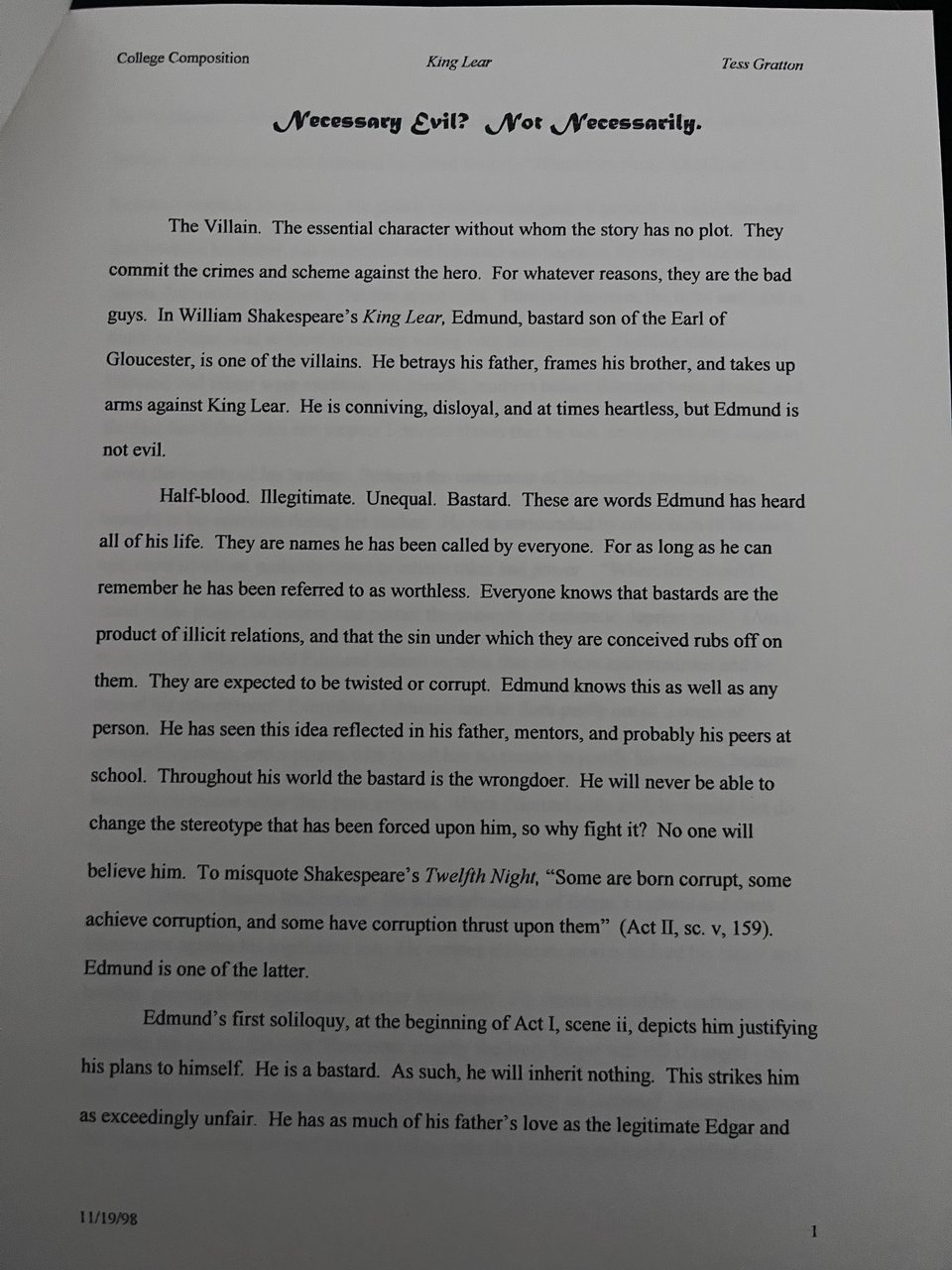
My teacher said at the end, “I like it! I don’t necessarily agree with all your arguments…but it’s interesting to read given your use of question and answer and a confident tone.” She also included examples of what she didn’t agree with, which was one of the first times I remember really understanding nuanced positive critique.
This is all to say that 1) I’ve always been a villain stan, especially bastards, and if there’s a bastard in a book/movie I will go to great lengths to assume they’ve never done anything wrong in their lives. And 2) even after hating King Lear there were parts of it that stuck with me for years.
Very early on in my writing career I knew that in addition to fantasy, I wanted to use fairy tale tropes and retellings to do some of my work. Very much including Shakespeare. It was a fun exercise for me to ponder the ways I could take Shakespeare and retell it for YA, usually latching on to the queer and potentially queer slippages in my favorite plays. I thought about King Lear a lot, or rather, Edmund. He slips in and out of so many relationships and spaces despite where he’s forcibly situated it’s easy to read him as queered regardless of his personal identity. And I thought if it was a YA Edmund I would want a less terrible ending and a transformative romance—but the relationships Edmund has in the play are as toxic as everything else in it. Edmund has an affair with both older sisters in the play, at least emotionally with one, and almost certainly physical with the other (and her husband?). The only sister he doesn’t mess with is the youngest, the perfect poor angel Cordelia. Probably just because she’s shipped off to France for 90% of the play. I liked the idea of dual POV Edmund and Cordelia as a dramatic, bittersweet coming-of-age King Lear retelling, themed around bucking the destiny of your parentage and traditions, and considered plenty of angles. But I always stalled out on one thing: I didn’t understand anything about Cordelia’s behavior. I didn’t get her.
Yes, obviously you can make up whatever when you’re writing a book, even a retelling, but I wanted it to be resonant with the play or what’s the point of a retelling. So I repeatedly put this unviable project down.
King Lear is about a very old king with three daughters and no sons, and because he’s starting to go senile and has always been a tool, he gathers his court and tells his daughters that whichever one of them loves him the most will inherit. It goes about as well as expected! The eldest are like “I love you more than I love my husband and my life!” “I love you as much as my sister, but in addition to loving you more than my husband and my life I also love you more than the stars in the sky!” so then the youngest, Cordelia, who actually does love her father, is upset and just says “I love you as much as a daughter should love her father.” And King Lear goes apeshit because he also loves her the most, but how dare she not perform for him, he was so ready to make her queen, etc, but she’s betrayed him! Woe! Woe is he! And he packs her off with her suitor, the King of France, and we don’t see her again until she reappears in Act V to die in his arms.
***Major side note: in that scene, the King of France says arguably the most romantic line in all of Shakespeare, and yes I’m serious. When King Lear is like “do you still want this betraying bitch now that she doesn’t have a dowry or a title or anything?” The King of France simply says, “She is her own dowry.” SWOON CITY, RIGHT???***
Anyway, the two older sisters vie for the throne, being meaner and meaner to Dad, who deserves it frankly, and further proof of how evil the sisters are comes in the form of their both being barren. Which leads to the side plot: Edmund the bastard, who is pissed that even though he’s older and better at everything than his legitimate bro, he gets nothing, so he decides to cause mayhem for the fun of it, and also to reap the financial rewards of lying, backstabbing, manipulating, and being otherwise super sexy.
I got that, but I didn’t get Cordelia, ok?
In June 2014, my fourth book, The Strange Maid published. It was the second of three New Asgard novels. The third book was finished, in copy edits, and we’d sent in a proposal for my option book. In July I was in a parking lot in Lake Tahoe when my agent called. I assumed she was calling to let me know what my editor thought about the option.
Reader, that is not why she called.
There had been warning signs, I suppose. In 2012 when we were designing the package for book 1, The Lost Sun, the Penguin/Random House merger happened and the new person in charge hated the title, the gorgeous painted cover, and we pivoted to a series of worse and worse covers, less support, and my editor of 4 years was let go as part of the changes. OK! That all happens. My new editor was great, but the launch of the series did not make a ripple. That happens, too! As we moved on to book 3, it just…felt off. I was ready to start again with a new project after the series completed.
Of course, the series never completed at PRH. My agent was calling to tell me PRH was cancelling the third book entirely.
I was devastated and shocked. I knew that kind of thing happened, thanks to being a reader of several cancelled series in my youth, but it never happened in YA during the post-Twilight bubble…right??! It was me. It was my fault. I would have to tell my family who were so proud of me that I was a failure, and then my readers, my friends and acquaintances. It felt like being left at the altar, I repeatedly expressed.
And somewhere about 2-3 weeks after this news, I was wallowing and angry and this thought hit me like lightning: this is what Cordelia felt like.
LMAO, right? It’s very melodramatic— BUT! Cordelia was doing her best, what she thought she was supposed to do, was being true to herself and her beloved father, she was acting with integrity. Then the rug was pulled out from under her. She was left with nothing, devastated. She lost her father, her inheritance, her livelihood (marriage), and if it weren’t for the King of Swoon, probably her life right then.
I’m happy to relate that after that July devastation, it didn’t take long for me to get back to work. I sent my agent a pitch for YA King Lear a month later:

The short version of the rest of the story is that the book this eventually became didn’t sell for 2 years, at the end of 2 years in which I couldn’t sell anything. But what sold I’m proud of and still love.
We went out with a partial to a very small group of editors that winter, and got great and sometimes frustrating feedback, and during all this time I was also working on what would become Strange Grace and delving into King Lear on every possible level, trying to figure out how to keep digging and excavate what I needed. I was obsessed. I loved it. I needed to make it me. Mine.
Shifting to adult didn’t take very long, given a lot of the violence and themes of aging parents and fertility and the bleakness of so much of the story. I added more and more points of view, usually just because I was playing, I was exploring everybody’s relationships. I made a million 9-boxes and relationshapes*TM.
The other decision I made that really shaped what The Queens of Innis Lear would be, besides making it an adult multi-pov generational family drama instead of YA romance, was the choice to make the three daughters of Lear Black North African coded.
One of my favorite things about several BBC and Royal Shakespeare Company productions of Shakespeare is their colorblind casting. In a play it’s something you can just do: Hamlet played by an actor of South Asian descent but his mother and the ghost of his father are white. Ophelia is white but Polonius is Black. They just come on stage and start acting and you get carried away in the drama. But in a book you have to explain that shit. I wanted to do it.
I was setting my book on what is essentially fantasy-Ireland, so plausibly everybody is pretty white. But I was not and continue not being interested in defaulting to white in my stories. Sometimes the book or story requires it for a variety of reasons, but if it doesn’t, then it shouldn’t. More importantly, I was framing The Queens of Innis Lear as a feminist retelling of the play, and my feminism is intersectional. If it’s not intersectional at the very least, then it’s probably reinforcing all the White Feminist problems I have always had with Second Wave and the white radical feminist ideologies of the 80s and 90s that led to TERFs.
Choosing to make the three daughters of Lear in my book half-Learish/white, half-Fifth Kingdom/North African unlocked so many things for me, creatively and thematically, and it allowed me to expand the world in a meaningful, intersectional, anti-colonial way—not just to Aremoria (King of Swoon’s country) but beyond for politics and relationships spanning generations and continents.
The book grew so far beyond my first little imaginings as a teen in 1998, obsessed with the bastard and confused about the golden daughter’s motivations and why anybody would like this play.
The Queens of Innis Lear sold to Miriam Weinberg at Tor in 2016 and we went through rounds and rounds of revisions, because it was complex and terrible and wonderful. It was a very deep and satisfying editorial experience for me, and about a year in, right as we were doing another re-organization of the entire timeline of flashback povs, my mom was diagnosed with Stage IV cancer.
To be honest, this story doesn’t have a cohesive ending because I don’t remember very much of the rest. Not in detail. I remember calling my editor to tell her I needed to slow down for a few weeks and get my bearing, and the exact moment I was explaining why I was driving the clover leaf exit from I-70 onto 435 North to get Natalie at the airport and I was like “hang on sorry I can’t talk and make this entrance ramp at the same time.” I remember giving my mom an early copy and she said she loved when I mentioned Mars (king of swoon)’s gambeson had dried brown blood on it because she worked in a dialysis center for a while and blood always dried brown on the linoleum floor.
I still don’t know why anybody loves King Lear, and a lot of people I love, respect, and otherwise think highly of do. Including my very clever, knowledgable, excellent agent! But I appreciate parts of it more. If you want to watch it (don’t read it!) I recommend the 2007 Ian McKellan production directed by the fantastic Trevor Nunn for the RSC and filmed for PBS in 2008. Sir Ian came closer than anybody ever has to making me hate the king a little less. He’s still the worst though.
I wrote a little about The Queens of Innis Lear earlier this year in a newsletter about trying to love writing again, instead of just liking it. Because QUEENS was the last time I remember actively loving every part of the process, despite the setbacks and struggles, I loved being obsessed and enmeshed, and I want to find bits of that again. I didn’t realize it was such a luxury to sink into a book so completely. But in the past 6 years I’ve never not been working on 2-3 books at a time, plus anticipating the need to sell something new ASAP, not to mention pandemic lockdown rewiring and also grief miasma.
I’d never say this to my past self, but in some ways having the third book of the New Asgard series cancelled was a blessing, because without that experience I might never have written The Queens of Innis Lear, which is such an iconic career moment for me, regardless of what anybody else thinks of it. And without QUEENS I’d never have written its companion Lady Hotspur, which is the retelling of my favorite Shakespeare play, packed with messy, intense queers of all shapes, but especially lesbian knights and femboy witches, and the ending is a reclamation of queer joy and queer narrative voice.
Queens—along with Strange Grace, which I wrote during the same two fallow years, sold in 2016 as well, and published 3 weeks before Mom died—represents to me the end of an era of both my career and my life. I’m still figuring out what this new era means to me.
I hope you enjoyed this retrospective that isn’t remotely The Mercy Makers adjacent. The third book of The Moon Heresies trilogy has a complete draft and is with my editor and I’m super duper glad to talk about anything else.
Thanks for reading!
Tessa