TEETH: who read The Lord of the Rings?*
Welcome, superb hobbits of the internet (that’s you), to the TEETH newsletter! This is a (sort of, but actually not really) weekly transmission about our explorations in the very secret land of Tabletop Roleplaying-Games.
What appears within this letter is written and compiled by veteran game critic and designer, Jim Rossignol, and former Mojang alumni and famed illustrator, Marsh Davies. Why not come and join us over on the TEETH Discord! Free tooth emojis for everyone!
Christmas is over
The Lord of the Rings
Christmas is over
I hope you all had a very pleasant festive season, if festivity is your bag. I (Marsh!) did, venturing to Britain for many overdue catch-ups with family and friends—including several nice cups of tea with Jim himself. More importantly for the development of Gold Teeth, the United States border personnel kindly permitted me to return again afterwards, and I am now back at my desk in snowbound Michigan, ready to kick the book into its final shape and fill the remaining white space with aquatic grisliness.
Separated from my desktop publishing and illustration apparatus, and waylayed by family responsibilities, there's not a lot of gratifyingly visible progress to show for the last couple of months, but Jim and I have managed to write a large quantity of silly and/or unpleasant things to fill the Punchbowl. The question remains as to how I will fit them all in without making the book nonviably fat. The other question is whether there will be an operable postal service between the nations of the world by the time we come to send Gold Teeth out. As predicted, international events have continued to be very stupid, trending yet stupider. It's really hard to say what the state of the tariffs will be by May, let alone what NATO's implosion means more generally for the distribution of books about make-believe pirates and the aquatic hogs who love them. So. Well. Good luck, everyone!
THE LORD OF THE RINGS
I (Marsh!) reread The Lord of the Rings over Christmas, for the first time in thirty years. It's good, would you believe? I am now desperate to play The One Ring at some point soon. However, there was also a lot I had not recollected, or had been overwritten by the film versions. Here's a list of things that struck me:
Gandalf is an arsehole
I refer you to my shitpost on this issue.
Pippin is no fool and Sam is (mostly) no comedy bumpkin
Pippin is instead wilful and spiky—he doesn't take shit from Frodo or Gandalf, even though the latter is unrelentingly rude to him. His only moment of true error is dropping a pebble into a well in Moria, but this is not the culmination of a cavalcade of gurning fuckheaded prattishness as it is in Peter Jackson's films. While the hobbits' jovial interactions do act as a sort of pressure relief from the terror of being pursued by the Black Riders, there is none of the insipid "second breakfast" clowning or slapstick. Though Sam is still the butt of a few jokes and his homespun wisdom does indeed have the whiff of parochialism, he is the hardiest and most physically capable of the hobbits from the outset, with the keenest perception and greatest instinctive valour.
Nor doth Gimli goof
Meanwhile, in my view, Gimli is desecrated by Jackson's films—a complete fool rendered with a deeply unfunny broadness that stops just shy of farting and burping for comic effect. In the book, he is proud, but much of this is well-founded in the difficult politics between dwarves and elves and his position as the sole representative of his people. A section where the Fellowship negotiates their entry to Lothlórien demonstrates this: as a matter of diplomatic necessity, he cannot consent to be singled out and suffer the humiliation of being blindfolded. He is correct to insist upon this, and Legolas is rightly admonished by Aragorn for not eagerly accommodating a compromise in which all the party members are blindfolded out of solidarity. In a further disgrace, Jackson has Gimli become tongue-tied before Galadriel, rather than, as in the book, disarm her with an elegant and deeply personal dedication to friendship between their people. It's genuinely beautiful and artful. Apparently, Jackson read that and thought, "Little beard man funny, ha ha. Burp! Ha ha."
Tom Bombadil is fine, actually
I was braced to do no more than endure Bombadil: it seems accepted that he is a grating presence in the book. I did not find this so. True enough, he exists in juxtaposition to the panicked flight to and from Bree, and the terror of the Barrows, but that makes him all the weirder and sadder, I think: he is a vestige of some more innocent spirit whose dominion is now shrunk to a small tract, engulfed by wilderness. As Jim pointed out to me as I embarked on this re-read, it's remarkable just how desolate Middle Earth is: the Shire is itself an oasis in a civilisational desert, littered with ruins of more glorious ages. It is an empty and melancholic place. Bombadil's prancing and hey dol-ing is absurd, but its very incongruity is tinged with sinister connotations. It's also a pretty slender section of the book! I offer this further controversy: Treebeard is way sillier and more annoying.
That said, I could do without all the singing
I am aware that the songs are a learned evocation of epic, oral and folkloric traditions, but in no way would I tolerate someone breaking out into a twenty stanza poem or song in the middle of a conversation. It's like the guy who turns up to a party, stops the playlist and starts strumming Wonderwall on his guitar. Except it's about elves. Unforgivable.
The tone of this book is completely nuts
I try to imagine reading this in 1954: the breadth of its tonal changes must have been absolutely bewildering. It has since become such a singular cultural artefact now, and the idiom of the 1950s itself feels so quaint, that these shifts are compressed, or at least not widely remarked upon—but there remains an aching gulf in the language alone between sections. The hobbits chat in readily accessible English among themselves, albeit with a chirpy "I say, old chap, pass me that lembas nosh, there's a good fellow" patter that roots it in both time and class, while conversations with or among the Men instantly slip into the knotty lyricism of ancient poetics. This more ornate language is, of course, expertly informed by Tolkien's studies, and often very beautiful—but dense. Moving back and forth between these modes, I find a bit maddening, if I'm honest. When the orcs are given their first extended speaking roles, in what is suggested to be a second language for them, they talk in strangely modern English, full of educated affectation and idiom (Grishnákh says of the Nazgûl: "they're the apple of the Great Eye"), and with barely any suggestion of accent or pidgin or unusual grammatical inflection. It's a striking choice, and I honestly don't know what it means! I am at least grateful that they aren't all cockneys. Maybe it's stupid to find this inconsistent (akin to complaining that the eagles could have flown them all to Mount Doom), but when Tolkien otherwise fully imagines entire linguistic lineages, completely swollen with history and meaning, I think it invites you to look for significance everywhere.
"Not all orcs"
Much has been written about race in fantasy fiction and roleplaying, and I was expecting LotR to conform to pretty digital and naive ideas of good and evil peoples. But there is tension, even here, in the notion that orcs are evil things incapable of morality: a pair of orcs who believe Frodo to have been left for dead by Sam consider this to be callous—a "regular elvish trick". And orc speech generally implies culture and learning that could not emerge from a crucible of pure evil. Moreover, there are many creatures in the world (huorns, for example, or deeper, ancient things) which are neither good nor evil, but operate entirely beyond moral consideration. I don't think the orcs bear much more scrutiny than this—they are otherwise cannon fodder by Tolkien's own admission—but it is merely notable that dehumanisation as a device is insufficient for the kind of sophisticated world Tolkien otherwise conjours and you feel him straining at the seams.
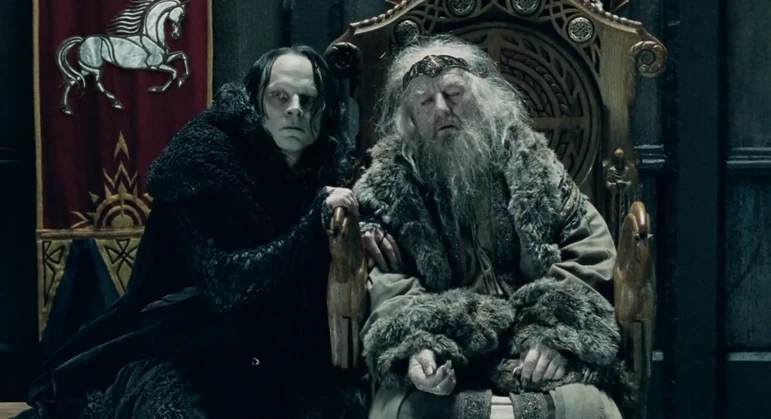
Grima Wormtongue bugs me
Tolkien is aware how this name sounds to modern ears and so its usage feels rather heavy-handed. Oh, is this a bad guy, maybe? Do you think? Someone who uses his "tongue" to "worm" into the mind of Theoden, perhaps even "grimily"? But what bugs me more is that in using the name this way, Tolkien is also obscuring the roots of the name in Icelandic saga, where "wormtongue" is more of a positive attribute: Gunnlaugr Ormstunga gets the epithet Wormtongue by being a badass poet who readily trash-talks people in improvised verse. As a scholar of sagas, Tolkien would know this well, so why intentionally collapse the original meaning with a modern (mis)reading?
Perplexingly smol Saruman
Christopher Lee looms large over the film versions, and rightly so, but Saruman's little more than a road bump in the book—he's largely an off-screen threat, who manifests in Fangorn only as a slightly nonsensical diversion from Gandalf's resurrection, and then disappears again. The eventual confrontation outside Orthanc is superb—a clever representation of a kind of insidious linguistic magic—but the films benefit from giving him a much larger visible role, earlier in events, than Tolkien imagined.
Tolkien does psychic damage well
I don't know if Tolkien had read any Lovecraft when he came to compose LotR—a cursory search online suggests there is no evidence for this—but they share an enthusiasm for describing horror beyond human perception or understanding. Tolkien is better at it—so good that, had he not also been excellent at so many other forms of writing, he would surely be hailed as the pre-eminent star of horror. The way Tolkien describes the Nazgûl offers very little of the physical grotesquerie of the films. Instead, before it is even recognised, a shadow briefly eclipsing the moon paralyses Frodo and Sam with an unspeakable, maddening dread that crushes them to the ground. So much is unseen, and perhaps beyond description, its significance played out only in the psyche of those who witness it. But this is clearly not abdication on Tolkien's part, but carefully selected emphasis on things outside the material world. He is, in any case, perfectly capable of rendering stunning description of supernatural things:
A long-tilted valley, a deep gulf of shadow, ran back far into the mountains. Upon the further side, some way within the valley's arms, high on a rocky seat upon the black knees of the Ephel Dúath, stood the walls and tower of Minas Morgul. All was dark about it, earth and sky, but it was lit with light. Not the imprisoned moonlight welling through the marble walls of Minas Ithil long ago, Tower of the Moon, fair and radiant in the hollow of the hills. Paler indeed than the moon ailing in some slow eclipse was the light of it now, wavering and blowing like a noisome exhalation of decay, a corpse-light, a light that illuminated nothing.
Cor. Yeah.
The landscape is intimate as well as epic
Something we lose in all the sweeping shots of New Zealand is how the landscape feels to touch, to be inside. Tolkien is all about this: the smells, the sounds, the textures, the closeness of the air or its turbulence. Instead of aerial views he gives us telescopic vision, our heroes scouring the horizon and picking out distant things, foreboding and obscure. The world is large, and its scenery astonishing—and much like New Zealand in that regard—but Tolkien ensures you are always in it, looking up, and very, very small.
Merry looked out in wonder upon this strange country, of which he had heard many tales upon their long road. It was a skyless world, in which his eye, though dim gulfs of shadowy air, saw only ever-mounting slopes, great walls of stone behind great walls, and frowning precipices wreathed with mist. He sat for a moment half dreaming, listening to the noise of water, the whisper of dark trees, the crack of stone, and the vast waiting silence that brooded behind all sound. He loved mountains, or he had loved the thought of them marching on the edge of stories brought from far away; but now he was borne down by the insupportable weight of Middle-earth. He longed to shut out the immensity in a quiet room by a fire.
The Paths of the Dead is undercooked sidequest padding
"I shall not tread the Paths of the Dead," said Aragorn, for some reason only now mentioning this thing he feared most but was apparently inevitable. "No, actually I shall after all."
"Please don't," wept Eowyn, who had fallen in love with him two seconds ago.
"No, for real, I am," said grim-faced Aragorn, grimly. Then he trod the Paths of the Dead and it was, like, totally fine?
—
All of which has me chomping at the bit to play something Middle-Earth set—and in fact, it has placed an idea in my mind for a campaign... But there are other things to be finished first: I must resist the Precious a little longer!
-Marsh
*Jim’s Postscript Note: So I can now reveal that this newsletter title is a naughty trick question, because I too re-read Lord Of The Rings over the holidaytime! Partly as prep for running The One Ring RPG, partly inspired by Jess Of The Shire’s astonishing summarisation of The Silmarillion from last summer, and partly provoked by Gareth Hanrahan’s amazing writing in previews of his The One Ring expansion, Hands Of The White Wizard. Yeah, as Marsh says, playing that particular fantasy TTRPG seems inevitable now, not least when we have a new member of the regular group — wizardly author, Will Wiles — who also loves a (The) Hobbit. We’ll let you know how we get on with it later in the year, no doubt.
In the meantime, though, we know you’re here for the mutated pirates and other things, so we’ll be talking about that at length. Next time will be a long, meandering essay about what else has been influencing and inspiring us of late, and we’ll also be talking about the creation of GOLD TEETH generally, with some updates about the book.
So: More soon!
-
Interesting take. I don't agree with everything you said, but I follow your reasoning, and I found your analysis fascinating. Personally I never found Bombadil annoying, more extraneous to the greater narrative.
To my mind Jackson's greatest misstep was leaving off the Scouring of the Shire (I know, I know... Return of the King had too many endings already). In this omission, he seemed to miss one of the main thrusts of the novel: that the common, simple, salt-of-the-earth types had become the true heroes, marking the beginning of the Fourth Age.
-
Yes, definitely agree on Scouring — it's the moral conclusion of the book!
-
Dammit, I will NOT reread Tolkien! I already decided I'd wait until late 2027, the 50th anniversary of the first time I saw the Hobbit cartoon ... Another way in which Tolkien and Lovecraft are oddly similar is that they're both good with landscapes and conveying a sense of place -- check out the opening bits of Colour Out of Space or Dunwich Horror to see how Lovecraft grounds the story in the landscape.
Add a comment: