TEETH: British System Agnosticism
Welcome, favoured adventure-folk, to the TEETH newsletter! This is a (not at all) weekly transmission about our explorations in the very secret land of Tabletop Roleplaying-Games.
What appears within this letter is written and compiled by veteran game critic and designer, Jim Rossignol, and former Mojang alumni and famed illustrator, Marsh Davies. Why not come and join us over on the TEETH Discord! Free tooth emojis for everyone!
Hello, you.
Links
System-Agnostic Mysteries with Sarah Cole.
Hello, you.
I am going to be doing a regular reminder in this spot between now and shipping that you can still pre-order GOLD TEETH, our grisly game of much-cursed pirates. The open porthole between now and then is narrowing, so get aboard if you want to engorge yourself on an all-you-can-eat buffet of seafaring metaphor and buffoonery!
We’ll probably save an update on book progress for the Kickstarter backers, but we can say that work continues apace, and that this might be the best book on pirates. It’s certainly the best one we’ve ever made.
Meanwhile other projects are unfolding. It'll be a while before there's anything to talk about there, but I am extremely excited about the next couple of years on a personal, creative sort of level, which makes a nice change after the disaster of last year. (During which I was very poorly indeed. Okay at the moment, you will hopefully be pleased to learn.)
I've also been stretching my conversational legs a bit to try and talk to more people across games, with a return to writing about videogames over at Jank, and two articles about TTRPG things in the latest Wyrd Science (issue 8), which is available right now.
Jank, in case you had somehow missed it, is a new patron-funded videogames reporting project from Graham Smith, Brendy Caldwell, and Jon Hicks, two of whom you are likely to have encountered via Rock, Paper, Shotgun. Hell, if you followed Marsh and I from videogames land to the newsletter then there's a solid chance you knew us from there too. So you will understand when I say it was rewarding indeed to pull out my reporter's spiral notebook and talk to the main lad from Hunt Showdown, Dennis Schwarz, about the long saga of their game. Hunt has been a particular favourite of mine for nearly seven years now, and I feel it's criminally under-valued as just a great game, but also an exemplar of design and cautious, brilliant experimentation.
Meanwhile, over at Wyrd Science, an actual print magazine about tabletop hobbies that you can subscribe to, I got to talk to the lovely Doomsong team about their miraculously horrible Doomsong books, which was a rare pleasure. We haven't said enough about Doomsong, which is one of the most creative games to have joined my shelves in the past couple of years. If you can get hold of it and the campaign books, I would recommend doing so. Perhaps reading my discussion of it over in Wyrd Science might convince you!
That issue also contains my first ever face-to-face (video-to-video, to be honest, but close enough) conversation with John Harper, the creator of Blades in The Dark. We talked about Deep Cuts and related matters. It was great! Since TEETH itself took Blades for its inspiration, you can imagine how thrilling this was for me to have this talk. Harper is incredibly articulate and insightful about games, which made for one of the most rewarding articles I have ever had the pleasure of writing.
So maybe pick it up. Wyrd Science is never a disappointment.
Finally, I have greatly enjoyed reading Darkened Hill & Dale and TERMINUS. So much so that we've got an adventure from Patchwork Fez' work set up to drop the next time we have a one-shot. This made me think I was time to see what makes their creator tick, and to learn how these glorious system-agonistic supernatural mysteries came to be. You can read all about that below.
Love,
Jim (writing newsletters) & Marsh (editing GOLD TEETH)
LINKS!
This piece about Dragonlance brings back some mildly embarrassing memories, but also offers some modern grown-up thoughts. "The 2024 revision of D&D, with its emphasis on streamlined characters and accessible storytelling, is in many ways the logical endpoint of the Dragonlance tradition: a game optimized for producing satisfying narrative experiences at the cost of some of the friction and unpredictability that made the original game so distinctive. Dragonlance did not cause this alone. But it pointed the way. And the hobby followed, largely without stopping to ask where it was going."
To be totally clear, April Fools' stuff is stupid and can get in the bin. But Games Workshop still won.
How's about this for your Warhammer scenery? (Instagram link, apologies.)
You probably saw: rolling a d20 in space.
Kieron did some very important research which indicated that just 5% of games played online are 5e compatible!
Other research this week led us to read about the Pirahã language and what the hell: "Pirahã can be whistled, hummed, or encoded in music. In fact, Keren Everett believes that current research on the language misses much of its meaning by paying little attention to the language's prosody. Consonants and vowels may be omitted altogether and the meaning conveyed solely through variations in pitch, stress, and rhythm. She says that mothers teach their children the language through constantly singing the same musical patterns." The claims for this language gets wilder still: "Being concerned that, because of this cultural gap, they were being cheated in trade, the Pirahã people asked Daniel Everett to teach them basic numeracy skills. After eight months of enthusiastic but fruitless daily study with Everett, the Pirahã concluded that they were incapable of learning the material and discontinued the lessons. Not a single Pirahã had learned to count up to ten or even to add 1 + 1." The philosopher of language buried inside me is spinning around violently.
Also in research this week also led us to the tale of why you should not store your gunpowder beneath the church tower: "destroyed on 6 November 1856 by an explosion after lightning struck gunpowder stored in the cellars of its bell tower." To be clear: it’s because God will blow it up.
Believing In The Agnostic: On Designing Mystery Adventures with Sarah Cole
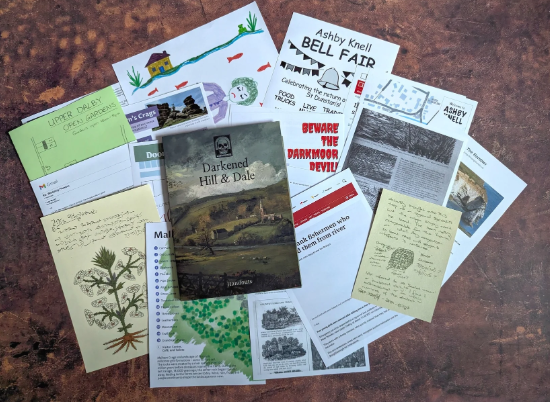
Patchwork Fez's Darkened Hill & Dale and Terminus are a couple of the most rewarding and intriguing adventure books that the postman has fought through time and space to bring me. They are also lavish packages filled with cool bits and pieces to hand to your players, and then ALSO glaringly British. If all this is not enough to hook you, the TEETH audience, then we are at loss as to what else will lure you in. Perhaps an interview where Patchwork Fez's Sarah Cole explained how these glorious things came to be?
JR: Let's start with the easy (?) question: why system agnostic mysteries? What's the goal or the appeal of writing them?
SC: To be honest, I think my initial motivation for writing system-agnostic scenarios was that I really didn’t fancy getting to grips with licensing and IP for any of the systems and properties I was already familiar with!
Back in January 2024, I spent a remarkably productive five-hour flight dreaming up around 30 seeds for scenario ideas. I felt pretty energised about developing some of them into a themed collection (which would become Darkened Hill & Dale) but the mere thought of having to read through the various licensing texts, navigate any associated content restrictions, potentially learn a new system, or initiate negotiations with an IP owner was the mental equivalent of swapping out a watering can for a colander.
I could do all of that, but it was going to slow me down, and I needed to ride the wave of novelty and interest I was experiencing to get the project started before my ADHD pitched me back into the ocean of other potential projects, and this one disappeared into the murky depths of my old notebooks.
The more I thought about it, though, the more a system-agnostic approach appealed anyway. I wasn’t sure why I hadn’t considered it before, or why they weren’t more common. Did I own any? I wasn’t sure that I did, despite having shelves and shelves of TTRPG books.
Folks play all sorts of things, many of which I’ve never even heard of, so why not try to write something that might work for multiple systems? It’d be an interesting challenge from a design perspective, and it’d be even more interesting to see how the same scenario ran in different systems.
I heard someone advise against writing anything system-agnostic, because it’ll never show up in search results for a GM looking for material for their favourite system and struggle to find an audience. Happily, I really didn’t care if only two people were interested in Darkened Hill & Dale – I just wanted to write it and put it out into the world, because I thought it was interesting and I’m a sucker for an experiment.
Two years later, now that I’ve published Darkened Hill & Dale and TERMINUS, I think my understanding of the aims and appeal of writing system-agnostic material has matured a bit. In all of my work, be it TTRPG-related or something else entirely, I prefer to create things that are flexible, usable, and, where possible, have the capacity to be built upon in the future. I think system-agnostic scenarios broadly align with that.
In terms of appeal, I’ve found that writing system-agnostic material provides a number of additional design challenges that you wouldn’t find when writing a system-specific scenario.
JR: Do you have any advice for people looking to write mysteries of their own?
SC: There’s whole books about how to write good mysteries but, in my experience, there’s a couple of key things.
In terms of narrative structure, writing mystery/investigative scenarios for TTRPGs isn’t the same as writing traditional fiction in the same genre. Unless your scenario is running on very rigid rails, you can’t be sure that characters are going to arrive at locations in a particular order – or at all, if they wander off on an unexpected tangent. You also can’t be sure that they’re going to find any clues you set up for them, because players may fail rolls or just not ask the right questions. Ensuring that characters are in the right place at the right time for key events can also be difficult to manage.
So, there needs to be some flexibility in how players can reach a conclusion, and in the pacing of the investigation. A fair amount of classic detective fiction relies on the timing of events, but you probably can’t, so be aware of that. Consider how you’re distributing physical clues; you don’t have to follow the 'three clue rule', which often gets mentioned, but you might want fallback options to help GMs point wandering players in the right direction.
In terms of content, think about how the setting impacts the ways characters can interact with the narrative. If you’re setting your scenario in modern Britain and your player characters are academics, they probably won’t have access to guns or any kind of combat skills. That has an impact on what kind of threats they’re going to be able to deal with; if they face a violent creature, how might they survive it?
Try to align the mystery with your chosen system, if you have one. Some systems are geared towards investigation, others towards exploration, combat, survival, etc. Writing an investigative scenario for a system that doesn’t have any investigative skills might make things tricky, but it could be an interesting challenge.
If you’re writing system-agnostic scenarios, you’ll have to consider how you want to account for all the unknowns. Let’s say you’re also writing a supernatural-tinged investigative horror scenario. If you want the player characters to already be aware of the supernatural, or to have a particular profession, you’re going to have to specify that in the scenario. The adventure hook might be difficult, too; something like Delta Green specifies that it’s the player character’s job to investigate weird goings-on, but why are the characters getting involved in your mystery and not just walking away? Do you want to write it for characters with investigative jobs, or are they members of the public caught up in the opening events?
And how do you want to address skill checks? You can’t be sure that characters have any kind of mental wellbeing or stress stat, for example, so you’ll need to write around that kind of check and let the GM make the call on what and when players need to roll. If the characters might have magic powers, do you want to account for that?
Technical design aside, I think my key advice is to make the core of mystery about people. Magic widgets and twisty intrigues are all well and good, but more memorable scenarios tend to feature a cast of fully fleshed-out characters. They add colour to the world of the scenario, and can be great sources of tension and stakes.
Specificity is also good in terms of setting for system-agnostic scenarios. In the absence of specified skill checks and stats and such, the aim of the scenario is to provide GMs with a fully realised narrative and setting, rich in texture and atmosphere. If it’s all vague, then it’s less of a scenario and more of a general concept.
JR: So I can see a bunch of systems I might want to run these with, but do you have any favourites? Do you have a system in mind when you write this stuff? Many of the agnostic adventures I own have some implied genetics just beneath the surface.
SC: I think it’s very difficult, if not impossible, to write a system-agnostic scenario that’s completely free from the creator’s taste in systems. From the other side, some systems just won’t be a good fit for a particular scenario, even if it is 100% system-agnostic.
I haven’t played as many TTRPGs as I’d like – I own a lot of them, but buying games and playing games are totally different hobbies. I think the game I’ve played most often is Delta Green, and I’m pretty comfortable in any D100 investigative horror system. I’ve probably listened to a lot of actual plays in that vein too, although I try to listen more broadly.
I think that’s probably not entirely surprising to anyone who’s read my work. I do try to write my scenarios to allow for other styles of system, but I’m writing investigative horror, so it’s probably unavoidable that I’ll mentally fall back to the things I’m most familiar with if I’m not careful.
I’m not sure that’s entirely a bad thing in small quantities, because I am writing in a genre, and there are sometimes mechanics that seem to be prevalent in certain genres.
Do we have a term for that? Mechanical tropes, rather than narrative ones?
Anyway, regardless of how many accommodations I try to put into a scenario, some systems are either inescapably entwined with their intended settings or, even if they’re in the right genre, simply don’t have mechanics that really mesh with the tone or intended experience of the scenario.
You could, for example, try to play my scenarios in Dungeons & Dragons – I’m just not sure that you should. I don’t see how it’d work without substantial modifications to the scenarios and/or or the system, and really, what’s the point? I think the result would probably be mediocre at best.
As an actual example, when someone playtested TERMINUS for me, they chose to run it in Agents of the O.D.D.. It’s billed as 'a game of conscripted cryptids, shaky psychics, burned spies, and other investigators of the paranormal', so it sounds like it should work with TERMINUS. The GM reported that everyone seemed to have fun in the session, but that the system was a bad fit for the scenario. TERMINUS involves investigating strange goings-on in a Tube station, but characters in Agents of the O.D.D. only have three stats to roll against, rather than any skills that might be investigation-related. As such, the GM found himself working around the system, trying to balance delivering the mystery against the fact that he could only ask them to roll on one related stat. That’s not a fault of the system or the scenario – it’s just a mismatch.
At the end of the day, you’ve got the freedom to play these scenarios in any system you like, but you’ll probably have a better time if you pick one that’s broadly aligned with the tone and genre of the scenario.
JR: Can you talk a bit about the inspiration for the adventures in Darkened Hill & Dale? A garden centre? (I mean, I get it: there is an incredible rural garden centre near me with abandoned buildings and dead trees surrounding it, and I picture it as a perfect venue for supernatural happenings.)
SC: The inspiration for the scenarios in Darkened Hill & Dale was: going outside.
Well, ok, there’s a bit more to it than that, but you can barely leave your house without running into something potentially weird.
Yesterday I witnessed a village’s rubber duck race (from a safe distance), walked along a beach with sand as black as night, and picked up a semi-indecipherable book of poetry from 1882 that’s illustrated with daffodils and skulls.
I like to take the everyday, the mundane, and put a weird or horrible spin on it. Why are there so many people at this little duck race? Why don’t I leave any footprints in this inky sand? Was my garden full of daffodils before I started reading this poem?
I grew up in the east Midlands, in the countryside near Melton Mowbray, and there’s a lot of my childhood in Darkened Hill & Dale. If you’re familiar with the area, the place names in the scenarios may sound rather familiar, if not quite right.
My mother was a keen gardener, and I spent (what felt like) an eternity in various garden centres; I entertained myself by imagining how to fortify the sites and utilise the gardening tools in the event of a zombie invasion, and suspect the traumatic boredom of wandering through endless, verdant polytunnels may have had some influence on the scenario Roses Turned Red.
Several of the scenarios have similar reference points, like the peculiarly intense 'Open Gardens' weekends in my childhood village, and the murky river at the bottom of the hill.
When my partner complimented me on the creepiness of the 'Fatstock' festival, I had to tell him that I didn’t invent it at all – although I don’t think they practice supernatural cannibalism. There really is an annual Young Farmers' dinner after the Fatstock market every December. I know about it because I used to drive my Dad to the dinner every year, despite the fact he’s not young and has never been a farmer…
In some cases I did go out and look for a bit of inspiration or flavour. I took myself over to Ryhall, in Rutland, to take in their village fair. Besides the stall selling an ancient dollhouse and the esoteric game of 'bowl a pig', my personal highlight was a band of women, dressed in 1940s fashions, singing an upbeat cover of My Heart Will Go On. The tonal dissonance was quite something, and perfect for Darkened Hill & Dale.
I also hit the books. Well, one book, mainly – the 1977 Reader’s Digest 'Folklore, Myths and Legends of Britain', sometimes referred to as 'the bible of British folklore'. It’s expensive to get hold of these days but, as a bit of foreshadowing, I think my family’s had a copy since it was new. I have now claimed it.
When I was browsing its hallowed pages for little tidbits to fold into my scenarios, I came across the entry for Snave – a church that has only one service a year and is otherwise closed. I thought this was great, and borrowed the idea for the scenario called Fools’ Fire. But wouldn’t it be neat, I thought, if that church was on an isolated marsh, the village around it long gone?
It turned out that such a church actually exists – St Thomas à Becket – and is only a couple of miles from Snave, on Romney Marsh. I visited, and it’s exactly as unsettling as you’d imagine.
This happened quite a bit while I was writing Darkened Hill & Dale, and I came to the conclusion that inventing anything spooky or weird is almost impossible in this country because it’s probably already a real thing.
The morning after writing about a cliff full of human bones for Fools’ Fire, for example, the BBC front page featured the story 'The beach where people keep finding human bones'. After writing Death Knell, I’ve seen a whole array of churches replacing their lost bells. None of this is troubling. At all.
Anyway, I ended up making a whole little web page listing all the references (and not-references) that I’m aware of in Darkened Hill & Dale.
JR: I think we share a love of setting stories in Britain, and I am always surprised how rare that choice has been in TTRPGs: why are your books set in the UK?
SC: They’re set in the UK in no small part because you’re right – TTRPGs set in the UK are surprisingly rare, and it was annoying me.
Mild irritation – the great motivator!
I think the genesis of me getting into writing TTRPGs at all was that I wanted to play a Delta Green scenario set in the UK but couldn’t find one that appealed in the very limited pool of existing material. The easiest solution – or so it seemed at the time – was to write something myself.
I still find it surprising that there’s such relatively slim pickings for material set in the UK, and it’s even worse if you want something set in modern Britain!
Not that I don’t love some historic or pseudo-historic UK scenarios, but it’s nice to have an option with indoor plumbing sometimes.
So there’s that aspect – throwing material into the surprisingly cavernous void where British TTRPG materials should be – but I also just like writing stuff set in the UK. I’ve already talked about this in relation to Darkened Hill & Dale, but it’s often a deeply strange place and up to its armpits in folklore. It’s an endless seam of inspirational material.
Also, despite the many problems this country has, I’m incredibly fond of Britain’s chaotic landscapes, absurd social etiquette, and other day-to-day nonsense. I love trying to capture the atmosphere of little moments, communities, and places, and highlight just how weird a lot of it really is.
JR: Can you talk a bit about TERMINUS? I suppose it's hard not to have these thoughts when you use the tube, but I am not sure I have ever encountered a book that gets the vibe this correct?
SC: The origin point of TERMINUS wasn’t actually the Tube, unlikely as it seems. I was thinking about space and geometry, and the idea of moving just so, however unwittingly, and finding yourself somewhere else. When I tried to think of somewhere with an unreasonably complicated layout that lots of people traverse, Tottenham Court Road promptly appeared in my mind as if it were the only objectively correct solution.
The first version of TERMINUS was written back in 2020, as a direct response to the aforementioned annoyance about a lack of UK-based Delta Green scenarios, and the fact that I couldn’t think of anything to get my partner for Christmas that year – so I wrote him a Delta Green scenario set in London as a gift.
It’s undergone a complete rewrite between that version and the published version that is TERMINUS. That’s partially because I needed to properly overhaul it into system-neutrality, but also the first edition was set in the future; I’d optimistically written 'post-Covid, in December 2021, busy with Christmas shoppers', when the Elizabeth line didn’t really open until May 2022 and Covid was very much still having a visible impact on London crowds.
I wanted TERMINUS to be authentic in terms of tone and content – for readers and players who aren’t familiar with Tottenham Court Road station to feel like they are, and for people who are already familiar with it to go 'Oh yes, I recognise this’.
I think I’ve broadly achieved that, and I suspect much of that’s down to the fact that TERMINUS is very adjacent to reality. A lot of things in it are true, and some happened to tie into the narrative I’d invented so seamlessly that it was sometime spooky. It was only during the rewrite that I learnt about the proposed connecting tunnel that was cut to save money, and that St Patrick’s church had undergone a major refurbishment around the same time. Oh, and archaeologists really did dig up ~13,000 pickle jars from vaulted cellars when expanding the station.
Enough of the scenario is true that you can use published reports from Crossrail as player handouts; one of their maps even references 'Unsubstantiated anecdotal reference to catacombs beneath Roman Catholic Church of St Patrick's, Soho' under as an 'unlocated element'.
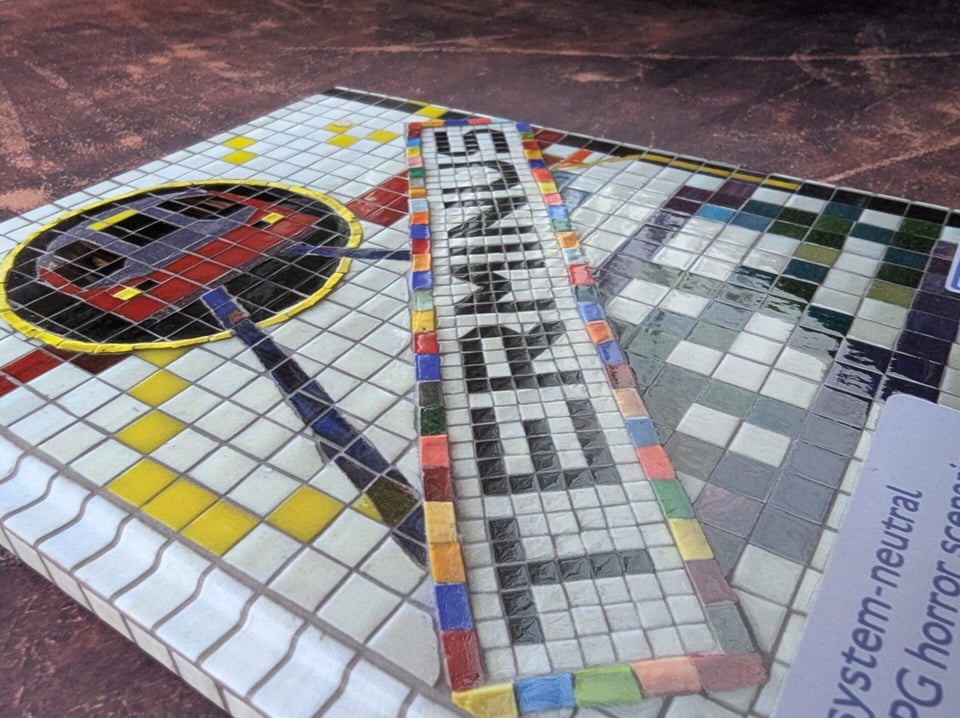
Tottenham Court Road station itself really is a maze – being a mishmash of spaces dating back to 1900. I couldn’t find an accurate, up-to-date map of the layout anywhere – every map I found seemed to contradict another one – so I ended up slogging around the whole place on a boiling hot summer’s day, breathing in the dirt-yellow air of the Central line platforms and sketching the layout to make my own map to accompany the scenario. The space is so complicated that working out how to present that map took several revisions and hours of work, and resulted two different versions, because I wasn’t sure either one on its own would be adequate.
The deeply weird 1980s mosaics by Sir Eduardo Paolozzi really help to round out the strangeness of the station. Why is there a man running from a tusked face? Why is there a terrified-looking deer? When will I stop having nightmares about the abstracted giant face on the westbound Central line platform?
I didn’t really think about it in these terms when writing TERMINUS – because I don’t have an inner monologue, and don’t have line of sight on most of my own thought processes – but Tube stations are inherently liminal (in the architecture sense). They’re between-places. We’re always entering Tube stations with the express intent of leaving them to go somewhere else. The corridors and platforms carry us along to our destinations as surely as the trains do – past the weird adverts for teeth and blood-red sunsets, and onwards into the dark. Sometimes we have to wait for a train and loiter there, but we’re travelling, moving towards a time when we won’t be. There’s a trust there, I think – in the place, in the process. To betray that, and fill the familiar paths with horrors, might be particularly jarring.
Anyway, just a thought.
JR: Do you have any TTRPG recommendations for our readers? Where would you shine a spotlight?
SC: A good question. My to-read shelves groan under the weight of things I could probably recommend.
If you really like your modern(ish) British horror, take a look at In Dark and Lonely Waters, by Kev Walsh. It’s for Call of Cthulhu (released through the Miskatonic Repository) and 'explores class struggle, poverty, and social division' in northern England in 1986.
I haven’t played it, but enjoyed reading The Terror Beneath, by Scott Malthouse. It’s another investigative horror scenario, this written for GUMSHOE and set in an alternate 20th century Britain. It’s got an specific folk horror vibe, and is inspired by the works of Arthur Machen.
If you’re interested in more system-agnostic scenarios, take a look at Ex Stasis Games, who’ve published a couple of scenario collections. Midwinter Ghost Stories is a more traditionally spooky set, while Do Not Adjust Your Set is based on urban legends.
I’d recommend TEETH, which I really enjoyed as a bit of pre-Regency comedy/fantasy/horror set in northern England, but I suppose that might be gauche, given the authorship of this blog?
JR: Oh no, that's fine. We flattery is why we're here. That and the drugs and the money.
So thanks for your time! (I’ve been to that church, it’s great.)
[But that's not all! There's some growing community support for Patchwork Fez games here.]
More soooooooooooooooooooon!
Add a comment: