🌱 After Women Deliver: What we heard, What we are holding
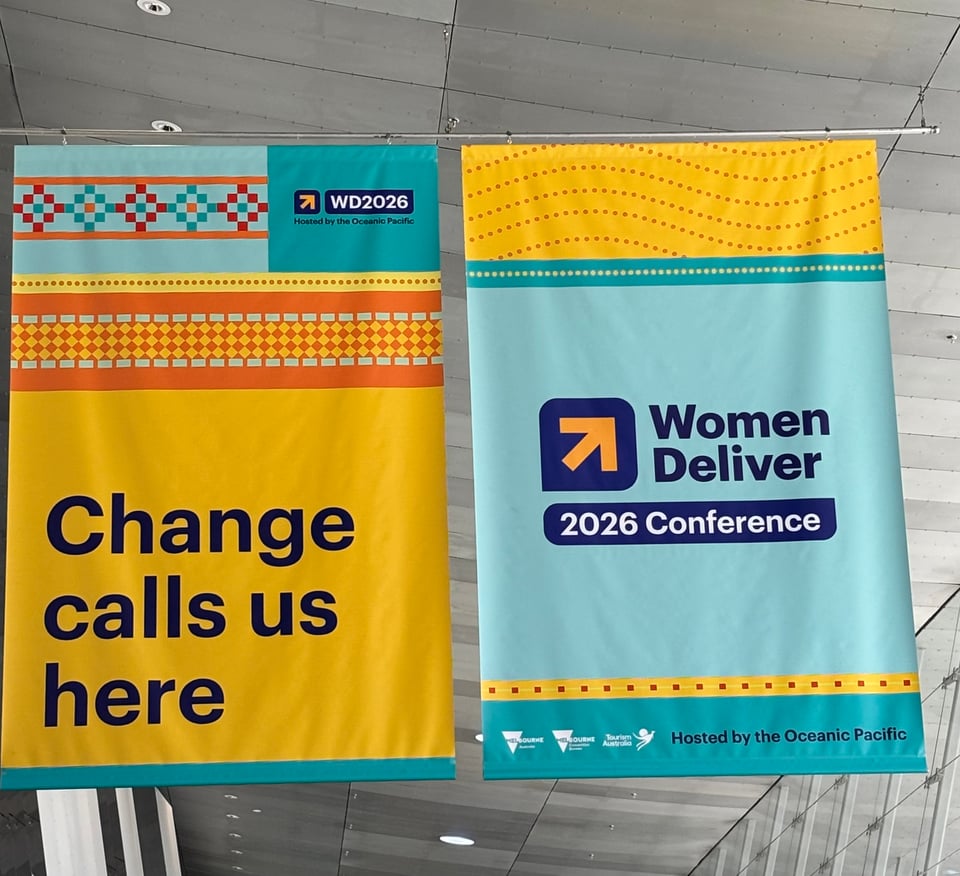
First, the love.
Over the last week at Women Deliver, I found myself returning again and again to something very simple, yet foundational: the love that exists within this work.
It becomes immediately visible in the moments between sessions, when you see someone you haven’t seen in months or years and instinctively move towards them. There is rarely enough time to fill the space of all that has passed, what has been built, what has been lost, what has been carried, but the recognition is immediate. So we hug. We laugh. We express joy, relief, and gratitude in quick bursts, knowing that the work continues and that the moments to pause together are fleeting.
We walk together to the next session, often linking arms, finding ways to extend conversations beyond their allotted time. Sometimes those conversations are strategic, sometimes reflective, and sometimes they hold grief. All of them, in their own way, sustain us. Because as humans committed to this work, we are all carrying something. For many, that weight is significant, shaped by the realities of the contexts in which they organise and live.
For me, being at Women Deliver was not only about sharing Substratum. It was about listening, observing, and paying attention to what is being named across movements, and equally, what is not.
What follows are some of the threads that stayed with me.
What we observed
1. Infrastructure is still a major gap
At the Strategy Day on Resourcing the Global Movement to End Sexual and Gender-Based Violence (hosted by The Accelerator for GBV Prevention, me too. International, Justice for Migrant Women, FreeFrom, and The Equality Institute), one reflection stayed with me:
If we are still talking about infrastructure in the same way as we were three years ago, we are missing the opportunity.
There was a call to:
have the audacity of hope, and
seize the opportunity to build something new
And a critical distinction emerged:
We often treat ideology as infrastructure.
But ideology alone cannot hold tension within movements.
Infrastructure can, if it is designed with and for movements.
Infrastructure, in this framing, is not administrative.
It is what holds trust and accountability when pressure increases.
2. Care is everywhere, and yet missing where it matters most
Discussions on care were everywhere at Women Deliver.
It appeared in conversations about communities, activists, healing, and resilience. We counted more than 20 sessions in which care was explicitly part of the discussion (care for caregivers, care for communities, care in crisis…).
And yet, very few of those conversations addressed care as organisational infrastructure.
Care was present as value, as practice, as aspiration, but rarely as something that is resourced, structured, and embedded in how organisations function day-to-day.
This gap matters. Because when care is not built into organisational structure, it becomes invisible labour. It becomes something carried by individuals rather than held collectively. And over time, that invisibility has consequences.
From a Substratum perspective, this continues to sharpen one of our core areas of inquiry: what it means to treat care not as sentiment, but as an integral part of organisational infrastructure. This is something we are actively researching and will continue to share as the work evolves, particularly as we begin to shape the conditions for the first phase of our youth movement cohort.
3. Movements are sustaining care, but without resourcing
This tension became even clearer during the launch of Urgent Action Fund’s report, Putting Out Fires Till We Burn Out. Several reflections from that conversation stayed with me:
Trust was described as the currency of organising, and care as what sustains it.
There was a recognition that collective care is already movement work, but that we are not funding the conditions that make that care possible. People cannot run on extraction forever.
Instead, care practices often emerge only once movements are already under pressure, rather than being resourced in advance. Without structure, care remains reactive and, in many cases, extractive.
And
Care without structure becomes invisible labour.
This is the contradiction many movements live with: they are expected to sustain people, communities, and resistance without the infrastructure to sustain that care.
4. The narratives we hold, and the ones we avoid
There were also moments at Women Deliver that asked us to confront the broader narratives shaping our work.
In the panel “Women Are Not Negotiable: Conflict, Power, and Accountability,” Laila Alodaat offered a framing that was difficult to sit with yet necessary:
What if the global crises we consume as “international news” were happening in our own communities?
What if the daily televised ‘international’ violence we witness, genocide, displacement, and extraction, were local?
What would that reveal about who we consider fully human?
This reflection was not easy to sit with, but it was important. It reminded me that the conditions movements are navigating are not abstract. They are deeply material and deeply uneven.
5. What was missing
For all the richness of what was shared, what felt more difficult to find were spaces to collectively imagine what comes next.
There was analysis, urgency, and a clear articulation of the challenges we face. But fewer spaces held the question of how we build differently from here. Not only how we respond to what is breaking, but how we create the conditions for something new to emerge.
6. Where Substratum sits in this moment
It is in this space that Substratum sits.
Substratum has not been formally launched, and I am not sure that it ever will be in the traditional sense. The work itself does not lend to a single moment of arrival. It is, by design, something that evolves in practice, shaped by listening, experimentation, and ongoing dialogue with youth movements.
What I shared at Women Deliver were early pieces of this work: the intention to build an experimentation space to explore shared infrastructure and pooled reserves, and to create spaces where youth-led movements can engage in praxis and experiment with systems that are often under-resourced or entirely absent.
What stood out in those conversations was not only interest, but a sense of recognition. Many of the people I spoke with have been navigating these same questions in their own organisations for years.
There was a shared understanding that continuing to operate within the same structural constraints while expecting different outcomes will only deepen the strain on movements already under pressure.
What feels necessary in this moment are spaces that allow for experimentation without immediate pressure to scale or prove, where failure is a valid outcome. Spaces where youth movements can test, adapt, and learn together. Spaces where infrastructure is not imposed, but co-imagined and potentially co-created.
Substratum is attempting to build one such space, slowly and with intention.
7. What we are holding, and an invitation
As I process all the interactions, conversations, and observations from Women Deliver, here is what I will be taking forward:
That infrastructure must evolve if it is to meet the realities movements face.
That care must be made visible and structural if it is to be sustained.
That trust, while relational, is also shaped by the systems that hold it.
And that movements need not only resources, but space—space to think, to imagine, and to build in ways that are not immediately constrained by urgency.
We are still in the early stages of this work. Substratum is still carried forward by volunteer time and collective commitment. There is still more that we do not know than what we do.
But what feels grounded is that this is not work being shaped in isolation. It is emerging through conversation, shared reflection, and a willingness to try again, to experiment, and to fail, even in a time that feels both constricting and risky.
If this resonates with you, whether as a movement partner, a funder, or someone thinking about infrastructure in your own context, I would welcome the opportunity to continue the conversation.
In community,
Uma
→ Book a conversation: https://calendly.com/umamishra

Add a comment: