Making Our Inquiry Public: Research, Practice and the Questions Shaping Substratum
As Substratum's first year draws to a close, we share two research contributions, welcome Dana Zhang, and introduce our evolving Practice & Inquiry space.
Hello friends,
What does it take to make the infrastructure sustaining movements visible, understandable and open to reimagining?
This question has been at the heart of The Substratum Initiative since its earliest conversations, and it continues to shape how we approach our first phase of movement-rooted experimentation.
🌱 In Brief: What We Are Sharing (TL;DR)
As we approach the close of our first year, we are making more of Substratum's research and evolving thinking publicly accessible. In this newsletter, we share:
The Five Domains of Organisational Infrastructure — An evolving framework for understanding the interconnected foundations that sustain organisational and movement life.
Care as Organisational Infrastructure — Our first academic research offering, developed with The Better Org, examining the relationship between care, institutional power and the reproduction of harm.
Welcoming Dana Zhang — Introducing our Research, Learning & Methodology Partner, who is helping deepen how we learn from movement-rooted experimentation.
We have also launched Practice & Inquiry, a dedicated space that brings together our research, frameworks, and emerging questions.
From Inquiry to Practice
Over the past few months, we have begun moving more deeply into this work alongside four youth-led movement organisations participating in our first Youth Movement Cohort. Our initial shared inquiry centres on Monitoring, Evaluation, Accountability and Learning (MEAL), approached not simply as a set of reporting requirements, but as part of the knowledge infrastructure through which movements understand their work, make decisions and sustain organisational memory.
As these conversations and Experimentation Spaces unfold, we are paying closer attention to questions of autonomy, participation, collective responsibility and the conditions under which shared approaches might be useful. We are also beginning to distinguish more carefully between the infrastructure that movements might want to develop collectively and the practices, knowledge and decisions they may wish to retain within their own organisations.
Alongside this practical experimentation, we have been developing the research and methodological foundations of Substratum's work. So we are excited to share two recent contributions to that evolving inquiry and introduce the growing learning ecology that will help us carry this learning ecology forward.
🌱 The Five Domains of Organisational Infrastructure
What do we mean by organisational infrastructure?
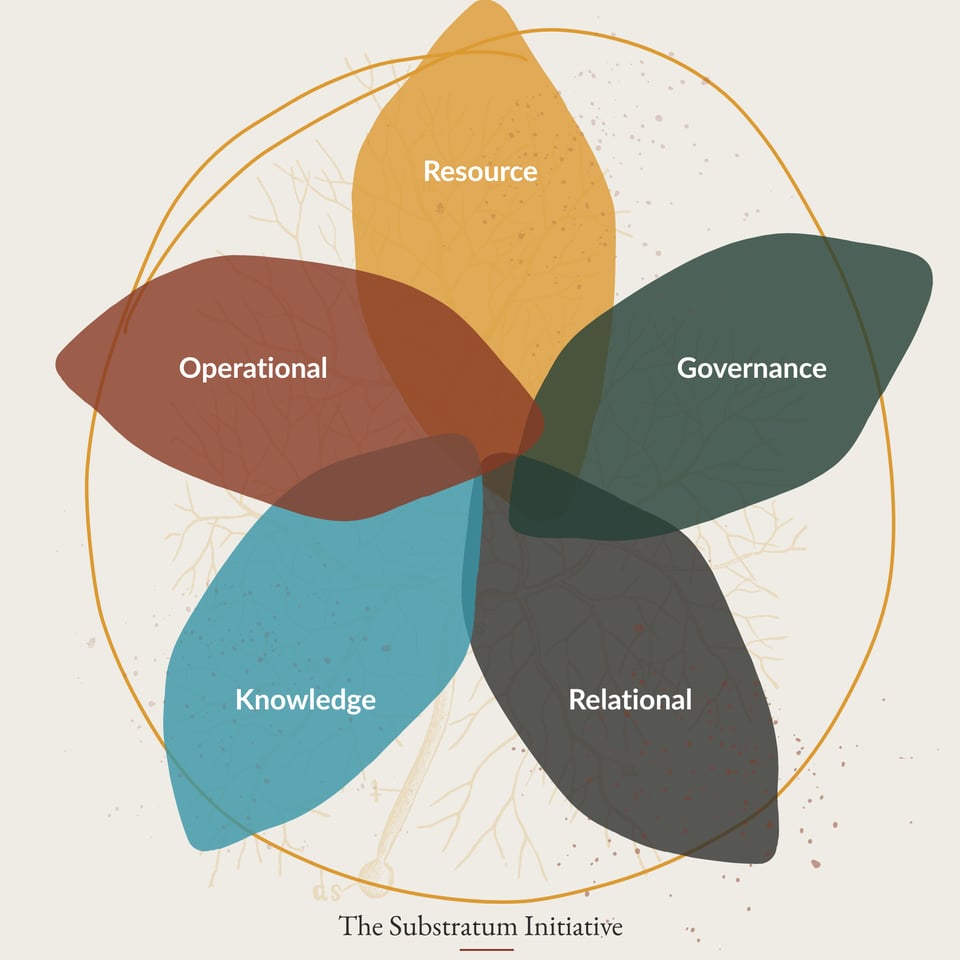
At Substratum, we have been developing the Five Domains of Organisational Infrastructure as a working framework to articulate the interconnected foundations that enable organisations and movements to organise, adapt and endure.
First presented publicly at the Interdisciplinary Social Sciences Conference in Galway, Ireland, in July 2026, the framework has continued to evolve through our methodological development, organisational inquiry and engagement with existing infrastructure scholarship.
The framework identifies five interconnected domains:
Resource · Operational · Governance · Knowledge · Relational
Rather than treating these domains as separate organisational functions, the framework invites us to examine how they shape and influence one another. Decisions about resources affect operational capacity and the distribution of labour; governance arrangements influence whose knowledge informs decisions; and relational practices shape how organisations navigate conflict, sustain trust and distribute responsibility.
This interconnected understanding also requires us to recognise that infrastructure is not neutral. Arrangements that enable organisational continuity and collective action can simultaneously reproduce exclusion, obscure labour or shift risk onto those least resourced to carry it.
We are sharing the Five Domains not as a universal definition or fixed organisational model, but as an evolving analytical lens for examining what infrastructure does, whom it serves, and how it might be organised differently.
Explore the Five Domains of Organisational Infrastructure →
🌱 Care as Organisational Infrastructure
Can care reproduce the harm it seeks to address?
Our second contribution takes us into a more critical examination of organisational life and the relationship between care, institutional power and the structures through which organisations sustain themselves.
Developed collaboratively by Uma Mishra-Newbery of The Substratum Initiative and Tina Ajuonuma of The Better Org, Care as Organisational Infrastructure: Global Crisis, Institutional Power, and the Reproduction of Harm was first presented at the Interdisciplinary Social Sciences Conference in Galway in July 2026.
This work marks Substratum's first academic research offering and reflects our commitment to bringing practitioner experience, movement knowledge and critical scholarship into conversation.
The inquiry distinguishes between care as everyday practice, care as a formal organisational programme, and care as infrastructure embedded in governance, resource allocation, accountability, institutional design and decision-making.
This distinction opens important questions about what happens when organisations formalise their commitments to care without necessarily transforming the conditions that produce harm. Wellbeing programmes may coexist with harmful working arrangements, responsibility for care may remain unequally distributed, and institutional commitments intended to support people can sometimes reinforce existing hierarchies rather than challenge them.
The Galway presentation opened a much larger research inquiry rather than offering a completed analysis. We are now developing the academic paper, including a more explicit examination of structural inequalities and institutional power, while exploring how this work might contribute to conversations across movement organising, philanthropy, organisational practice and critical scholarship.
Explore the Care Research and Conference Presentation →
🌱 Growing Our Learning Ecology: Welcoming Dana Zhang
As we make more of our thinking publicly accessible, we are also strengthening our capacity to learn critically and collectively from the experimentation itself.
In October, we were delighted to welcome Dana Zhang as Substratum's Research, Learning & Methodology Partner.

Dana brings extensive experience across feminist and LGBTQI+ movement organising, transnational networks, research and organisational leadership. Much of Dana's work has explored what movements need not only to grow, but to sustain themselves, care for their people, hold on to collective knowledge and navigate changing political realities. These experiences and perspectives resonate deeply with the questions at the heart of Substratum.
Dana will work alongside Substratum to shape and deepen how we approach research and learning across the Youth Movement Cohort, Experimentation Spaces and wider ecosystem conversations. This includes examining emerging patterns and tensions, strengthening our learning methodology, and considering how the knowledge generated through movement practice might inform the questions, decisions and directions of Substratum's work.
We are particularly interested in ensuring that learning is not reduced to documentation or the production of findings. Instead, we want to create conditions in which reflection can inform decisions, challenge assumptions and support meaningful adaptation, while remaining attentive to whose knowledge is recognised, how it is shared and who benefits from its use.
Dana's arrival represents an important step in building this capacity and bringing different movement histories, ways of knowing and methodological perspectives into dialogue.
🌱 Introducing Practice & Inquiry: A Space for Evolving Work
We have also created a dedicated Practice & Inquiry space on the Substratum website to share the research, frameworks and questions emerging through our work.
More than a home for publications, this space reflects our commitment to keeping research and practice in dialogue, allowing movement experience to challenge our assumptions, deepen our inquiry and inform how infrastructure is understood and organised.
Our first phase of experimentation remains intentionally bounded to four youth-led movement organisations, and our capacity for wider exchange is still developing. While these resources are currently available in English, we hope to expand accessibility through human translation as resources allow.
We invite you to explore this evolving space, engage critically with the ideas and consider how they might connect with your own work.
Visit Substratum's Practice & Inquiry →
Looking Towards the Close of Our First Year
As we approach the end of Substratum's first year, we are beginning to reflect on what we have established, what movement practice is asking us to reconsider, and what questions we want to carry into 2027.
This first year has involved substantial work to build the organisational, relational and methodological foundations for experimentation. We have moved from listening, design and relationship-building into a more active process of inquiry alongside participating movements, while beginning to make some of our intellectual contributions publicly available.
Much remains unresolved, and we do not see this as a weakness of the experimentation. We are increasingly interested in how the questions that emerge through practice can help us examine the limits of our assumptions, understand the conditions under which different approaches become meaningful and remain accountable to the movements whose experiences inform this work.
In December or January, we hope to share a short reflection on this first year, including some of the questions and tensions emerging from our initial experimentation and the directions we are considering for the year ahead.
For now, we invite you to explore these new contributions, engage with the questions they raise and share where you see connections with your own work and experience.
We are grateful to the youth-led movements, collaborators, advisors, funders, researchers and wider community of practitioners who continue to accompany, question and contribute to this evolving initiative. Your engagement helps us keep the inquiry open, grounded and connected to the wider struggles for justice and liberation that give this work its purpose.
With care and curiosity,
The Substratum Initiative

Add a comment: