Chai urbanism as third places
Chai stalls, small streetside commerce & Mumbai's vibrancy through Diya Joukani's streetwear reels

I walked into this interview of Mumbai-based streetwear designer Diya Joukani in Ssense magazine, That Cool Girl from India, and it immediately set me off to her instagram with reels of her walking through some Bombay neighbourhoods (suburbs) while flaunting her self-designed outfits.
So if you look at Diya’s videos, reels, pieces, sketches, clips the streets of Mumbai are replete with third places. In fact, these small business, streetside commerce units are the very things that urbanist Jane Jacobs wrote about all those years ago. For the uninitiated, third places are “places outside of the home (the first place) and the workplace (the second place) where people go to converse with others and connect with their community”.
And Diya’s (@diyajoukani) clips are based entirely in these third places. Cinematically, these videos are reminiscent of some of the best form of street cinema: Jim Jarmusch’s Night on Earth (1991), Martin Scorsese’s Mean Streets (1973), some of Noah Baumbach’s movies and most recently, subway takes with Kareem Rahma.
What do most newyorkers or non-newyorkers think of Rahma’s subway takes? They’re quintessential New York — cataloguing the funny, spiffy, sometimes deliberate, put on ways of New Yorkers as they take rides inside one of the most frequented forms of transport in the city. That’s precisely what Diya’s videos do.
These films, too, show life as it’s lived on the streets, and by that I mean how we interact with one another on the streets of our cities, how we find ourselves at random searching for a friend or that neighbour or a cat and find ourselves on the streets (by design or otherwise) more than inside a house or an office or a coffee house. This is the energy of Diya’s clips. Random, casual, confident. The vibe (sans a forced aesthetic) can in Gen Z’s lingo be summarized thus so: “that one unemployed friend on a Wednesday afternoon”.

Think Friends and Seinfeld but people lounging on the streetside and yapping. That’s the precise vibe that Indian cities have on any given day, season — men playing carrom, men playing cards, women having chai, swapping gossip, palming deals, kids kidding around on the streets, small businesses running side by side, dirt flying off into your eye, someone getting their ears cleaned, someone getting a snack of jhalmuri, cobblers, bag repair stalls, people scrolling on their phone while the pan sizzles with butter for an incumbent pavbhaji.
Shopkeepers, neighbours, autorickshaws, streetside snack stalls that provide an round the clock economy that in turn doubles up as an informal web of supervision and sociability. I call this chai economy, chai urbanism. Places that are centered around small chai stalls. Each time you see a small area in Delhi being set up as a commercial hub, the first business to arrive their is the chai stall. Rest of commerce usually bubbles up around that single chai stall.
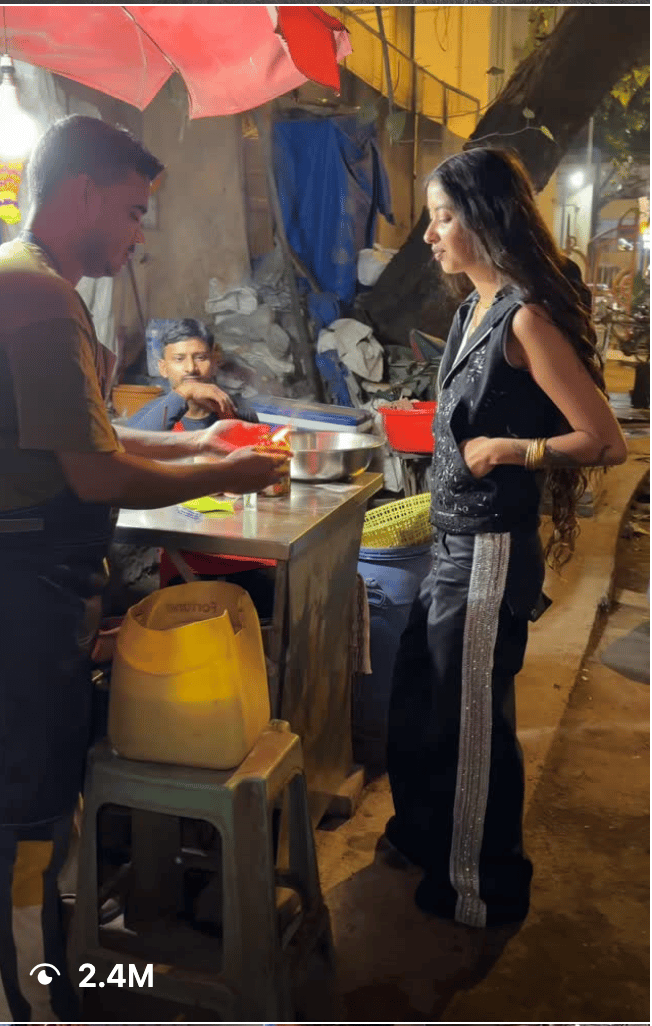
Subscribe nowDiya’s clips capture all of these everyday nuggets of urban Indian street life. We see her walk into a forklift, ride a horse, pretend to repair a motorbike, sip on chai, serve dosas, sip on coconut water, high five an autorick driver, all amid the people and all while commerce carries on in the background. My take? The din and hubub of the city would’ve made a better background track than Frank Ocean’s Nights.
The noise of metal clanging against metal, the smell of sulphuric smoke arising from the cast iron pan of the dosa stall, the taste of dust mingled in the flavoured streetside chai Diya sips on every now and then. These are all engines of street life, that generate a rhythm to Diya’s gait, give a bounce to her step.
Encounters with these businesses provide a much needed background to these pieces, bringing to them a sense of continuity, context and unmissable harmony. Speaking about how these businesses have bloomed after her videos, Diya says:
In between cuts we see her break off into a smile, a casual hello to the autorickshaw driver, or the pandit walking a cow. Implicit in those interactions is the Jacobsian trust of a “city street, formed over time from many, many little public sidewalk contacts" (The Death and Life of Great American Cities). The people, Diya and her camera — completely in sync. A music seems to emerge.
Through these vignettes on Instagram, Diya seems to be making the same argument as Jacobs — that these dense, mixed-use, walkable neighbourhoods create a safer, more vibrant city than large-scale redevelopment helped reshape urban policy in other places.
In reels after reels we see her walking through these alleys, which she’s probably grown up around, sipping on coconut water, drinking chai or skateboarding next to an autorickshaw. In that, each one of her videos can be seen as a separate sidequest within a video game. A slowness of pace inhabits these places, which makes them so much more vibrant and full of life. You can pause anywhere, have a bite of the streetside vadapav and continue on your quest.
In my 2020 essay for the LA Review of Books, Chai Stories from the Pandemic, I’d brought out how chai stalls in various parts of the city make up for an invisible net of community making. Here I write about my experience of having the beverage in Pune:
The lemony, minty Sulaimani tea in Pune would become my go-to option on evenings after filing my stories as a reporter with a leading national daily in 2015. On rainy days, I would ask the chai waala to add a dash of black pepper to it. That extra bit was enough to make me forget life’s worries, albeit momentarily, and take in the views of the beautiful city before me.
Drinking tea while waiting for the bank to open, drinking tea while getting your bike repaired, drinking tea while waiting for your friend to arrive so you can both drink tea together — its a running, yet pretty much invisible, leitmotif that threads through our social lives in India. So seeing Diya make more and more clips with chic companionships over chai, is an electric vision.
Another thing that immediately drew me to her reels is the fact that she takes streetwear to where it belongs — THE STREETS. Often we’ve seen streetwear willfully dissociate and morph into something bigger, more bogus and unlike itself, but that I can easily envision myself wearing Diya’s jackets and jeans as I navigate my way through these narrow alleys and wide streets of Bandra.

There’s also an insouciance to the way she performs in these clips (as the Atlantic would call it) making them seem so funky while also being very thoughtful about the community they represent. She shows up in both commercial and residential areas, businesses owners want to be seen in her videos. These are places with mingled uses, busy for much of the day and so also livelier, safer, bringing an automatic, operatic rhythm to the reels.
International creators have commented under her clips, saying “wow this is the India I want to see!” and it makes me giggle, because no tourist guide will take you to these alleys and busy lanes. These places are mundane and so regular, and in showcasing them Diya has uplifted their everydayness. These are spaces that feel used, safe and active — places with a heart, and equally with a fine music of their own.
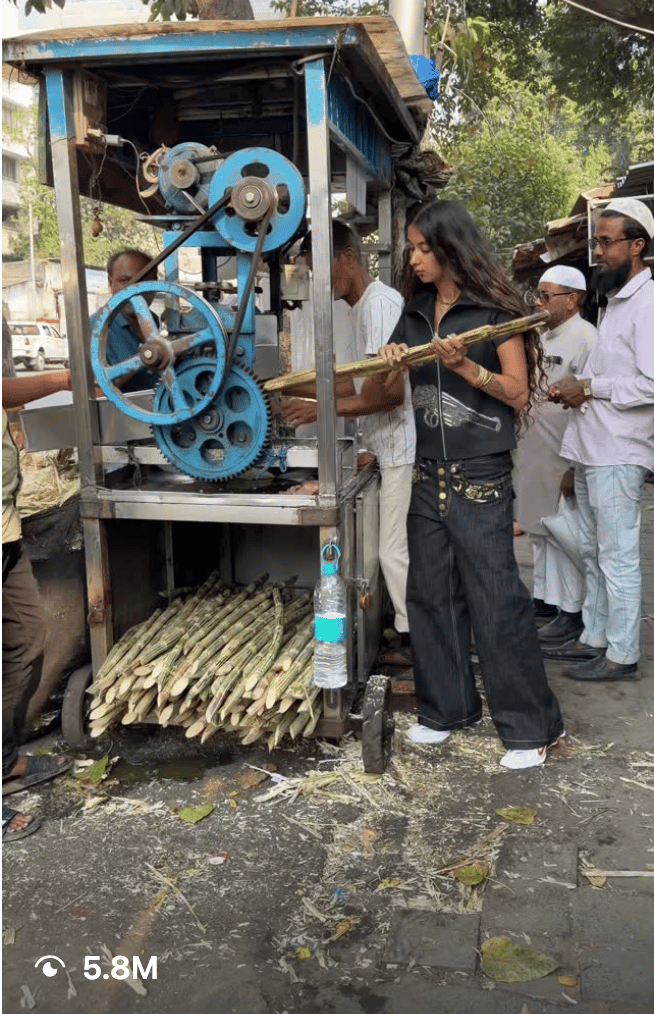
Each of her interactions with these small business owners, ranging from sugarcane juice vendors, to food stall owners, to mechanics to chai-walas could easily come off as tetchy, supercilious or vainglorious. But she’s too cool for school and closes off each interaction by giving a high-five or a namaste or a smile to the proprietor. These (serendipitous) encounters makes their relations feel more of the returning kinds rather than one-off things. And she does return to these spots, the people which creates a familiarity.
A streetsmartness with people, a suavness and confidence in her own creations, a sense of belonging and a sensibility about what works where — these are what make these clips so convincing, moving even anthropologically sound. I, for one, don’t remember feeling so stirred by a seemingly nonchalant Insta brand campaign before.
As I wrote in my 2020 LARB essay, chai, much like these small streetside businesses in India mean more than what they might appear to be:
On Delhi’s pale winter days, coming back from home, I would disembark the train and take a cab ride in the crisp misty air. Held by the black charm of the dark at the window, the day slowly coming to its own, I would cherish the taste of the cup. As the cab honked its way to my rented flat, the night music drifting across my mind, I would thank an unknown force for the silversmith of the morning, my cup of chai.
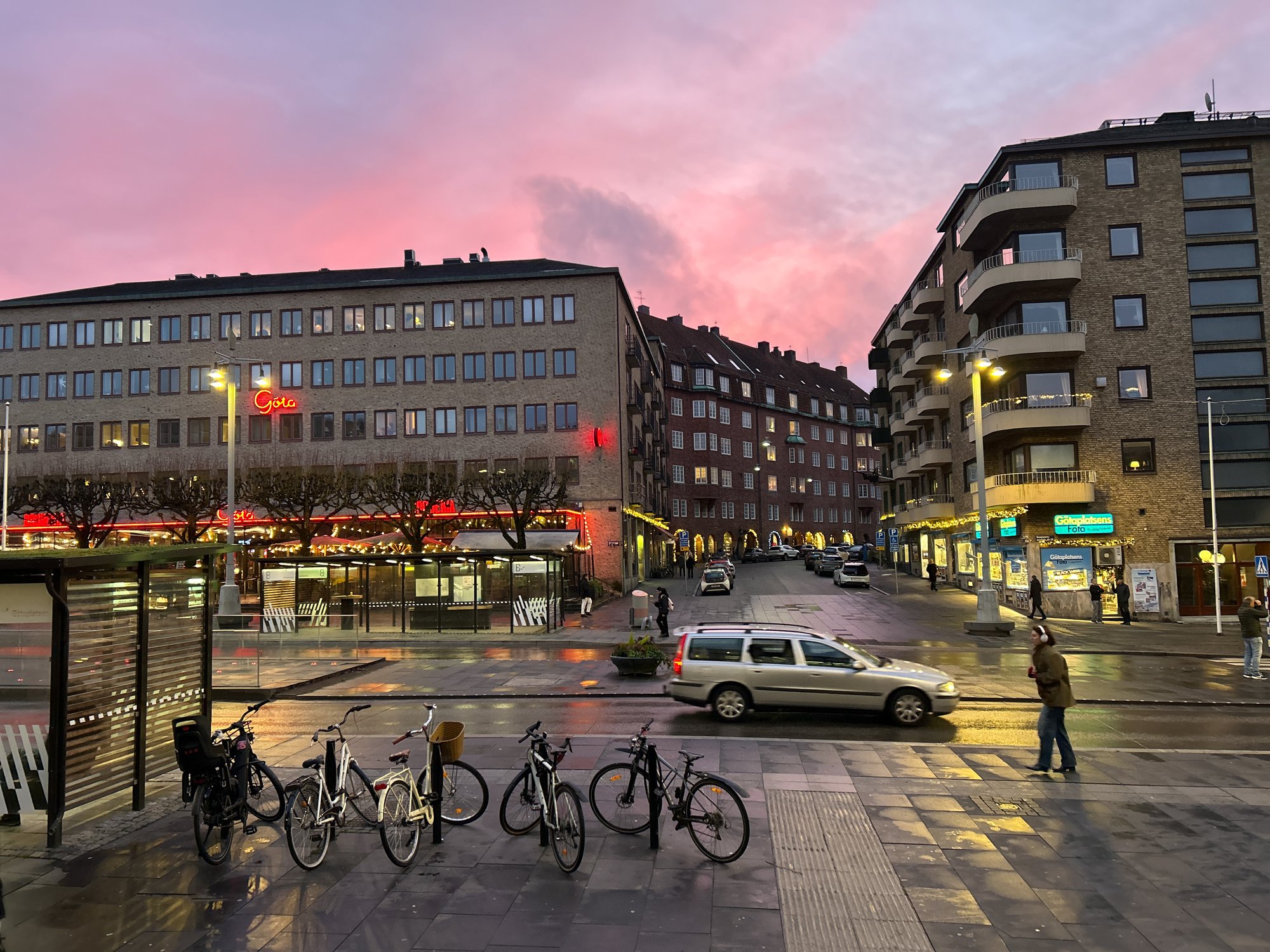
We keep talking about the lack of third places in Western cities, and these videos show a version of these places that need not be so deliberate. Summer is around the corner as the football field in front of our place in Gothenburg readies for a couple of EU-level young adult football league games. Last year we watched many of these matches while craving for a snack, some chai or perhaps an ice cream or two. Diya’s videos show how we could imagine third places that are not gentrified, that provide a sense of continuity while not completely succumbing to commercial interests.

Closing off with a couple of pieces about third places from recent mainstream and literary media:
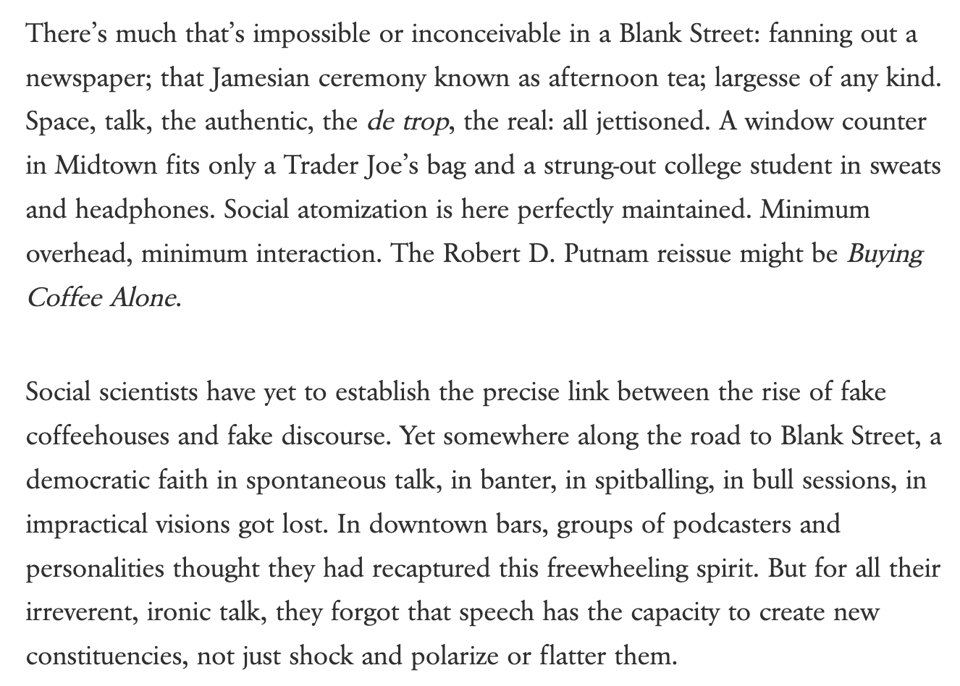
A Blank Generation; Noelle Bodick for the Drift Mag
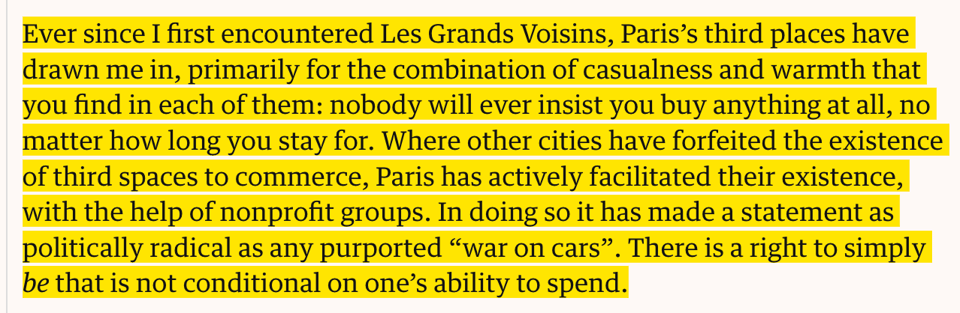
Progressive Paris has many weapons to fight the far right, but the best? Spaces where you can simply hang out; Alexander Hurst for The Guardian


Add a comment: