Ageless and cunning: Hokusai in Copenhagen
notes on floating worlds
Earlier this year I was in Copenhagen and decided spontaneously to go to Designmuseum Danmark. The exhibit included a showing of 40 woodblock prints by the most influential Japanese artist Katsushika Hokusai, created during the Edo period. These were prints I had read extensively about over the years and was now mesmerized seeing them in paper and wood before my bare eyes.
I wanted to make more of this short trip so put myself up on a Rachel Cohen-esque assignment. After spending a while looking at each set, I sat nearby and wrote down my thoughts on my phone. I’d have liked to spend an entire day at the exhibit, but didn’t have the luxury. These distracted, hurried resultant notes read less like I’d have wanted them to — more critical analysis, less personal analysis — but after all these weeks, I found them interesting enough to read through and hence this post.
Hokusai is said to have produced an immense volume of works over his lifetime — more than 30,000 items — paintings, sketches, woodblock prints, picture books, erotic illustrations. What I don’t get enough of in these woodblocks are their vast, flat spaces. The stretched out natural landscape, etched with their simplified lines, displaying a rather quotidian subject. These ageless, adrift prints, did they emerge from boredom?
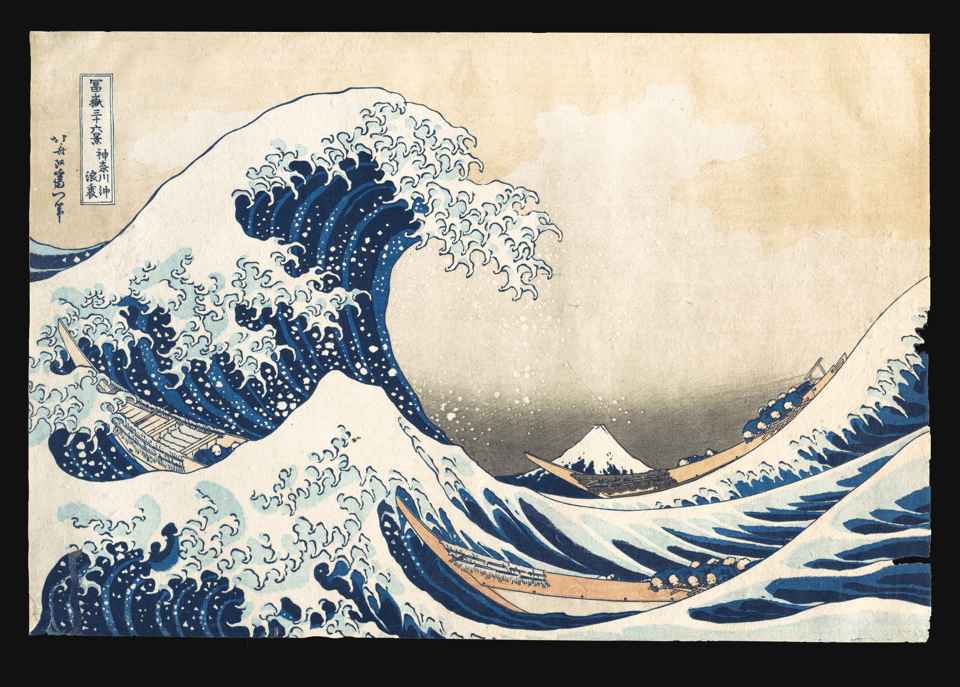
Hokusai’s The Wave People around me, potter about, reading so intently into the world of his prints. Whenever in a museum, I have this incessant, near-constant feeling that everybody else knows more about the artist, the style, the history of these paintings so much better than I. Here are a couple of Chinese students, seated on the bench right in the centre of this hall, staring intently, exchanging incipient, hushed notes with one another. Here is a professor couple, the age of my parents, who seem to be taking in so much more from these paintings than me. Exhibit after exhibit, country after country, in every museum why does this interminable feeling of insufficiency chase me around?
Ben Lerner’s Leaving the Atocha Station museum sections are some of the best literature I’ve read in the last few years. If I start crying here there aren’t even any museum guards to ponder over my plight? What would Lerner write then? Fellow museum-goers will instantly want to pull out of my orbit and head over to any other section.
Hokusai’s most famous work, The Wave, isn’t showing here but I might’ve found another favourite — Ejiri in Suruga Province. It says here that it’s the 10th image in his series of “Thirty-Six Views of Mount Fuji” and it was made in the 1830s. In this visage it feels almost photographic. A wind washes off a rural landscape. A hairline, winding path cuts through a marsh. It looks like an everyday sight. Traveler’s hats blow off into the breeze, as do their papers and young leaves from trees around. All of this with the Mt Fuji in the background, standing tall but almost absent if you don’t notice.
The first few minutes after arriving into a museum, my mind takes time to adjust to the visuals before my eyes. These are not photographs of the here and now, instant captures of a present moment. These are deliberately etched, written, painted, crafted artistic glimpses that might’ve been worked upon for hours, days. This isn’t a photographic development of a painting either. It’s original work in its native form. The mind feels like its stagnating, but then gears shift, a window opens and things clicks into place.
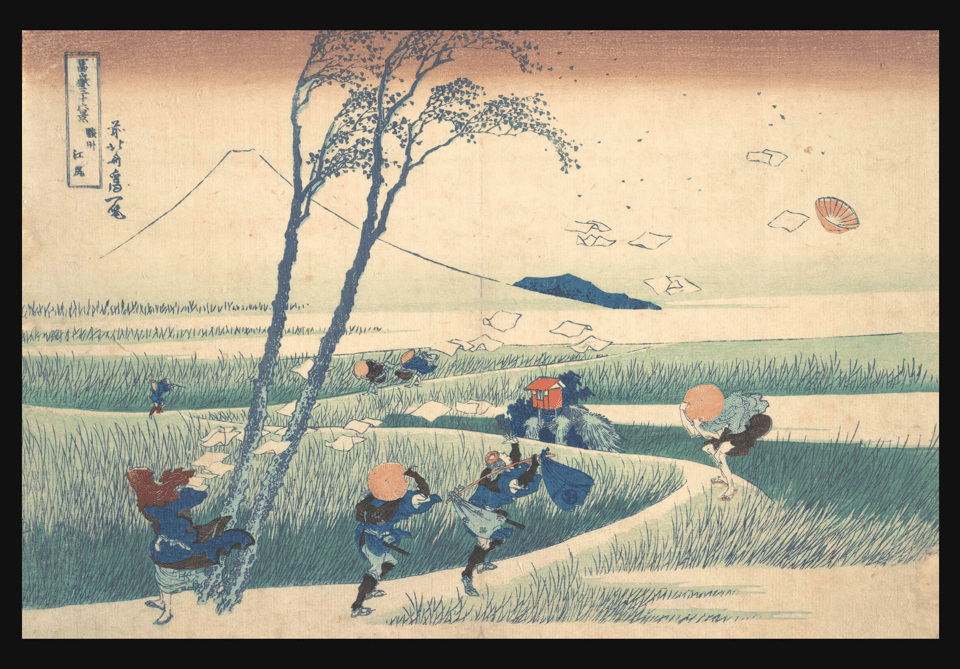
Ejiri in Suruga Province These woodblock prints are also called Ukiyo-e meaning pictures of the floating world. They were produced en masse and were thought of as vulgar and of no importance to the Japanese society back then. How would these paintings have been received and read worldwide had they not been discovered by French critics and travelers? There’s so much meaning to them while I stare at them now, but meaning has also accrued in their journey through centuries and geographies.
I take a handful of photos of these paintings, post some of them rather reluctantly to my instagram with a trite caption and immediately delete them from my phone. It’s better not to have meaningful art sit in the cervices of my phone’s garish gallery. I’d much rather find these on the internet again; until then, these woodprints will blow in the breeze through the crowded lanes of my memory, adrift, waiting for a painter to capture and paint them down into a woodblock.
Read my latest column for Psyche: Journaling to remember
Thank you for reading! Please click here to read my archive of over 265 essays.


Add a comment: