Blood Runs Deep review: How easy is it to run on Roll20?
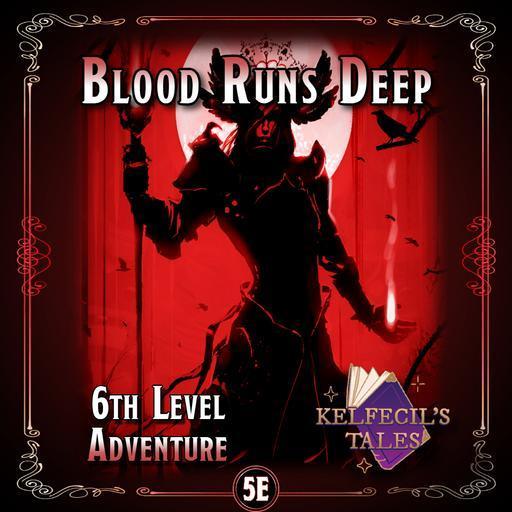
Blood Runs Deep is a new adventure from Kelfecil’s Tales, released in October 2026 on his Patreon and on Roll20. It is perfect for those who crave a few sessions of slaying vampires and cultists, my party included. As of writing this, you can buy it for $8.49 on Roll20 or subscribe to their patreon for $7.50 per month and get access to their massive library of adventures. Its expected duration is 5-7 hours, our group went way beyond that so expect lots of content. While we thoroughly enjoyed the campaign, with some climactic moments, preparing and running it proved more difficult than I had hoped. For a Roll20 adventure, that isn’t what plug and play promises.
Disclosure: I make adventures myself, so I’m reading this as a creator too.
How We Came To This Campaign
Halloween rolled around and we needed a spooky adventure to match. No one had anything prepared, so I went to Roll20 and searched for a campaign. This one had a great hook, a detailed store page, no AI, collaborations with artists in the D&D sphere, and was all set up to go straight into my existing campaign.
One part I was personally thankful for was the adventure hooks and the ability to modify the factions, names and so on to fit into my existing world. I was especially fortunate, as there were nearly 1:1 comparable factions. The hooks gave the players a wealth of opportunities to choose how they approached the adventure, even the possibility of playing a rival vampire group!
My party set off as four cultists of an evil deity that hates the undead, out to cause chaos. They chose to all be siblings, and we stuck to the recommended 6th level. They collaborated on their backstories while I went to work converting the rest of the notes to work in my world, changing names while skim reading. I thought that would be most of my work. I was wrong.
What’s Included?
Blood Runs Deep includes three highly detailed maps by Ori the Cartographer, five monsters with art by Retrograde Minis, magic items with art by Arcane Affinity, and a story with a prologue, three acts, an epilogue and an aftermath to cover all bases. All of it is ported to Roll20 by Stanisław "Valdrenik" Zduńczyk. It is wonderful to see such collaborations on an unofficial 5e adventure.
The art in the adventure was strong and enhanced the experience. Combined with Roll20’s dynamic lighting, it was perfect for Halloween horror. Additionally, the notes inside the campaign are well organised, so searching takes a quick scan and you can open exactly what you need.
The adventure does make use of Roll20’s pins, but I found them rarely beneficial compared with having the same note in the adventure. They also point to locations that do not fit what is described on the second map, which was jarring.
Session Night
Our adventure began. We fired up a horror theme playlist I had made the day before and ran through the prologue, which was an excellent way to get the party engaged, uncovering the mystery of what happened to the team that came before them. The transition was a bit strange, as the ending of the prologue closely matches the start of the first act: same topics, but strangely different points.
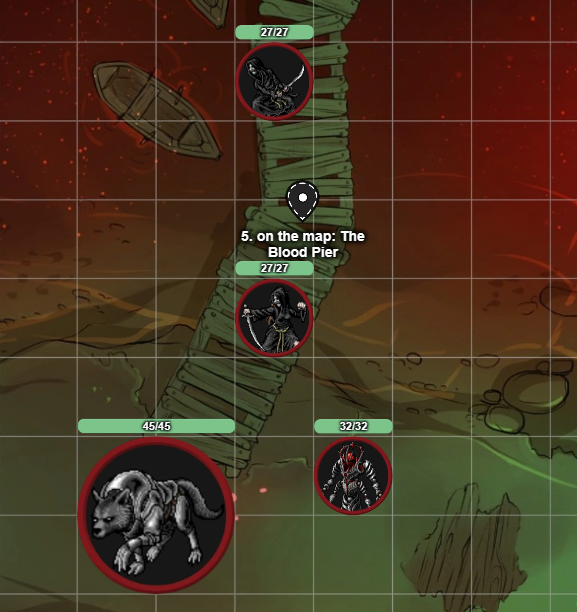
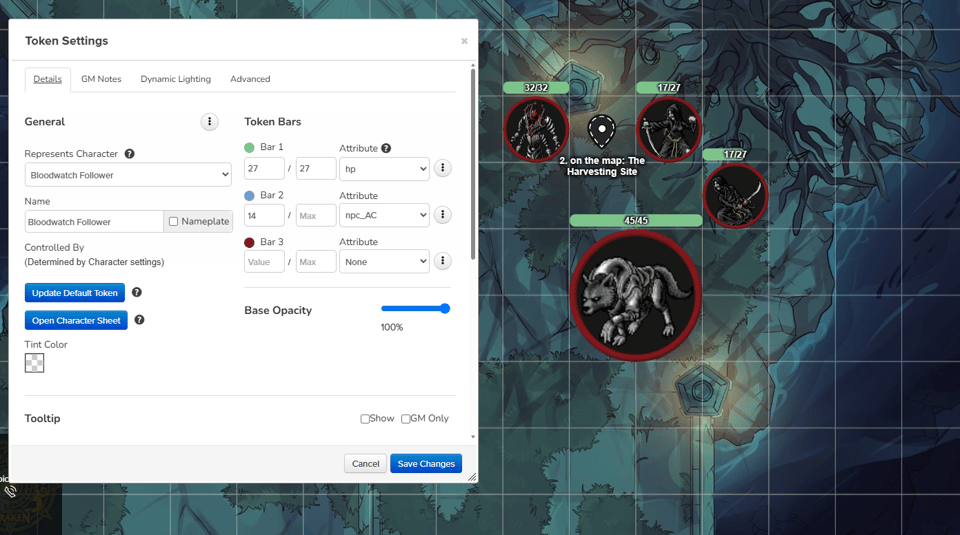
Then things started to go wrong. We began combat, the vampires attempted a ritual sacrifice, and the party did their best to stop it. It was going well until the first hit landed on an enemy and I realised something terrible: every token had its HP linked. I called for a pause so I could fix and replace every token on the map so they didn’t share HP. This was the case for every monster.
For a new DM on Roll20, this mistake is bound to happen, but if you are creating commercial products, I expect it not to. We rolled on. The first combat was exciting: a captive was sacrificed as the ritual grew in power, and the party saved the other. More hacking and slashing through vampires and their horrific creations followed as the party came to understand that the ritual existed in multiple areas.
The Ritual
The start of the mystery works really well. Players learn of a ritual that spans the entire adventure and has localised points to disrupt. It provides a challenge with long-term consequences and benefits, implemented on a track that makes it easy for the DM to see how it is progressing, although I found the effects rather minor, both in impact and in feedback to the players.
The players do struggle to identify the purpose of the ritual until the epilogue. The ritual has many effects, so its main goal isn’t clear, and my players saw it as just empowering the enemies as it went on. This may change depending on the party, but I noticed before running it that this was likely to be a problem because the main effect lacks focus.
The campaign approaches skill checks well, and I tried to keep to the same approach for any that I had to come up with on the spot. They work on degrees of success: a player may fail a check, but that doesn’t mean they can no longer follow the tracks in the mud; they simply gain fewer clues. A player who succeeds finds extra information, and on a great success, usually by 5 or more over the DC, they get a bonus to a future skill check.
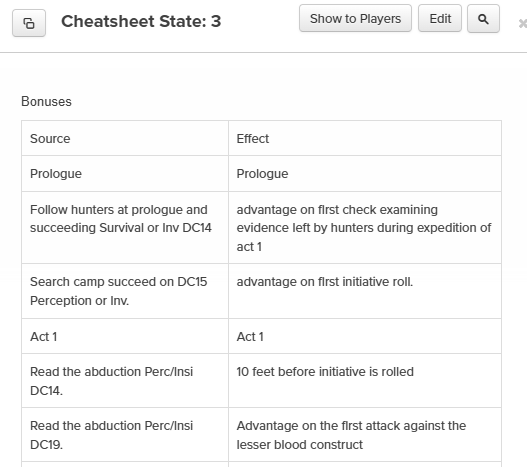
These bonuses applied to specific future events, so I had to write each one down and remember to tell the players when it applied, whether advantage or some other benefit. A cheat sheet would have made this much simpler. I do like the system, and it will be going into my own adventures.
The Combat
There were eight encounters in total: six standard, a mini boss and a main boss. I would say two could be cut for a much nicer flow. My players said it was quite combat-heavy, and I could tell they just wanted to clear out the last two camps and get on with the story.
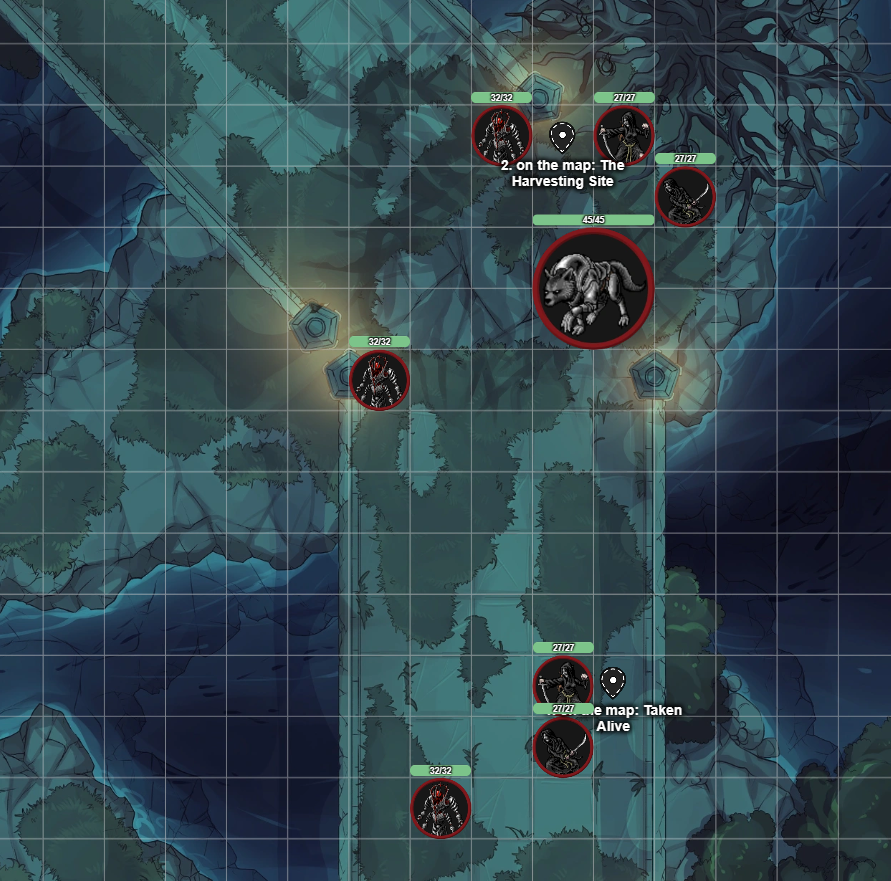
In some instances the encounter placements did not match the text. You’d be told that the vampiric creations lead while the vampires sit at the back, but on the map it’s the other way around.
Any creature with proficiency had its stats shown in a strange format. From my checks, this came from a token mod that is not explained anywhere.

The first two maps had a host of issues, with descriptions that conflicted with the visuals. The notes mention four lanterns on the bridge when seven are present, and because all of them are lit, one monster’s ability, which requires darkness, is locked off. The notes also call for making the enemies feel less static by making them look active, but in some locations I found this hard because the work they were doing made no sense when they could see their allies being slaughtered. No exaggeration: sometimes there were 30 feet between two monsters from separate encounters.
The Magic Items
Arcane Affinity made wonderful magic items for this adventure, which changed how the entire combat felt. The party kept the first item to the end, and it was crucial to their success and led to one of the most memorable moments in our years of playing. The unfortunate part is that the magic item art is nowhere in the module; you can only see it on the store page. Additionally, the first item is ammunition for a weapon that is not part of standard D&D. That would be fine, but there is no way to obtain the weapon in the module and no statistics for it either. I changed it into a crossbow bolt, which would likely work best for your party as well if you intend to run it.
The Boss Fights
The mini boss as written was my favourite encounter. His ability to hit multiple targets made for a cinematic fight. Vampire regeneration also made its first showcase, and my players did not expect him to stand again after being struck down. As their backs turned, he took out the second-to-last party member, and they narrowly avoided a TPK. I commend the adventure for this: it is not easy, and players had to be tactical in fights.
The final boss was written rather weakly, in my opinion. Her ability and combat style made an interesting puzzle, but the phases were rather simple. Phases 2 and 3 did nearly the same thing, and part of that was one of the most loathed choices in gaming, gaining health, along with other effects that are challenging but not interesting or unique.
The dialogue and read-aloud boxes for the final boss were also quite weak. For a story with great narrative elements, I was disappointed, especially after remembering one of Kelfecil’s older modules from a few years ago, Starlight Knight, which I played in and which had memorable, fun and interesting characters who did not feel like one-liners. The worst line was her saying something close to “blood remembers those who have the power to control it”, which on its own did not give her much character.
I spent quite a bit of time redoing the final boss to make it more climactic, fun and memorable.
The Verdict
The adventure took us quite a while longer than the module says, but my party is known for exceeding times. We spent nearly 20 hours, so if you have a group that loves roleplay, you can enjoy this for a long time.
It would be perfect for a group that wants a combat-heavy adventure and is moderately experienced with 5e, as it is not easy.
The adventure has a number of technical problems. Stat rolls use base modifiers where the monsters are likely meant to be proficient, many creature placements contradict the text, and others seem completely random.
If you’re willing to work through and fix these issues, it has a great premise and theme to explore, with hooks that can easily capture any party. If you are looking for what Roll20 campaigns are meant to be, which is plug and play, it falls short of that by quite a lot.
Add a comment: