
007: Porous Ideologies and the Radical Potential of Weird Fiction
by Jonny Pickering, STP editor
The first issue of Seize The Press Magazine came out in February 2022. I’ve spent those four years actively and consciously thinking about our ethos as a mag and the kinds of stories we want to publish and why. We’re an anticapitalist magazine, and that’s a principle that guides our outlook on fiction, its role in the world, and what it’s capable of. As well, of course, as our own personal tastes (which I’ve come to believe are fundamentally intertwined with our outlook).
So what does that mean for the kind of stories we publish? One of the most common misunderstandings is that we want stories where the plot revolves around or features direct representation of or allusion to capitalist oppression and/or resistance against it. Not that those kinds of stories are hard no’s (go read Nika Murphy’s “Brick City, Stick City, Straw City” for proof of that), just that on its own it doesn’t capture the essence of fundamentally challenging the cultural hegemony of capital that we’re interested in. After all, we’ve seen how versatile modern capitalism is in its ability to repackage nominally anticapitalist and anti-imperialist stories and sell them back to us as consumer products, even when those stories are good and seem genuinely subversive. It’s perhaps more apparent in film and TV (just because that’s a bigger and more generalised market) and here I’m thinking particularly of Andor’s messy depiction of revolutionary anti-fascist violence, put out by none other than massive media conglomerate The Walt Disney Company. Similarly, one of my favourite episodes of Black Mirror is series one’s “Fifty Million Merits”, in which a man spends the episode mounting a fundamental challenge to the dystopian system he lives under, only for his resistance to be subsumed and incorporated back into the very system he was challenging. Fast forward several years, Black Mirror is now commissioned by Netflix, who are all too happy for a defanged franchise to stream episodes featuring metanarrative in-universe criticism of…Netflix. Fifty Million Merits in action.
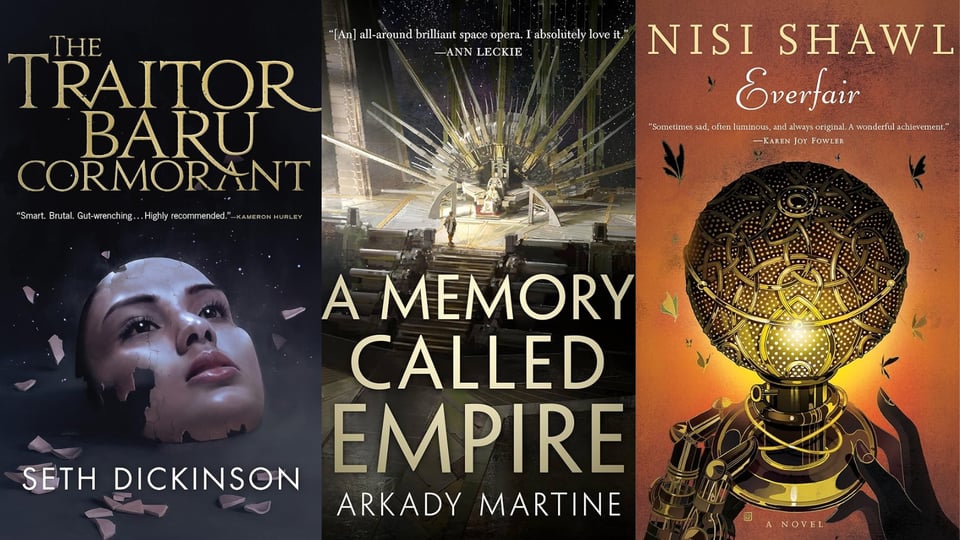
However, even in the much smaller niche of people reading speculative literature, the move has been towards, if not specifically anticapitalism, then at least towards values that challenge its traditional underpinnings - racism, sexism, homophobia; and, most notably within SFF, challenging empire and the ideology of imperialism. If we take Tor as perhaps the most notable example, they’ve released a spate of books like this in the past 10-15 years. The Traitor Baru Cormorant; A Memory Called Empire; Everfair; to name just a few. Tor is an imprint of Macmillan, one of the ‘Big Five’ i.e. one of the biggest publishing enterprises in the world. These kinds of books aren’t entirely new of course; there’s a long history of anti-imperialism in SFF - we can go back as far as the anti-colonial satire in Jonathan Swift’s Gulliver’s Travels if we really want to, right through to Ursula Le Guin, and even (and slightly oddly) Robert Heinlein’s The Moon is a Harsh Mistress. The difference now, I think, is that marketing departments are deliberately pitching their products to us in these terms. The point isn’t that Andor, or Black Mirror, or modern anti-imperialist SFF novels are bad (I actually like lots of them!), but that the big capitalist companies producing them find them so safe and non-threatening that they’ll openly pander to their customers’ left-leaning values as a sales technique. How many people read The Poppy War and then went and blew up a pipeline? How many people even read How To Blow Up a Pipeline and then went and blew up a pipeline?
All this to say that, even when it’s good, this isn’t the kind of fiction we see as best placed to inform a radical view of the world. And before I go any further, I should make clear that when it comes to doing something about real injustice in the real world, reading fiction isn’t a substitute for real tangible action (Newsletter 005: The Author as Misguided Activist: Why We Don’t Publish Moralising Stories). So what does it mean for us as an anticapitalist publisher and the kind of fiction we look for?
Well, the impetus for this newsletter was me finally getting round to reading Zach Gillan’s essay on Reading Weird Fiction in an Age of Fascism in the Ancillary Review of Books, which got closer to articulating it than I’ve ever been able to. And to pillage some of Zach’s terminology, the kind of fiction I’ve been finding increasingly meaningful are stories that trouble and elide genre boundaries, insist on the inexplicable and unresolved, and unsettle the world for both character and reader.
Weird fiction.
I really encourage you to read the full thing, it’s really fucking good and in order to get my point across fully I’d only have to repeat everything he says anyway. But to highlight a few key points, while ‘not arguing that reading is praxis, or a political act in and of itself, or that weird fiction is inherently radical’, he is interested in the question ‘what does it mean to read weird fiction as a radical? How might its forms and aesthetics model and inform a radical view of the world?’ He goes on to say:
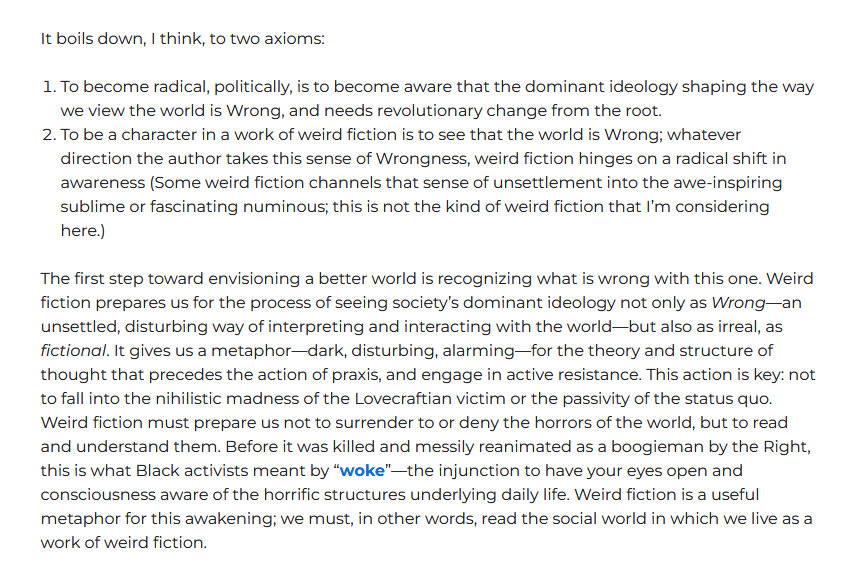
This blurry sense of Wrongness with the world is what we’re increasingly looking for; a radicalism not of content, but of form. A great example of this I think is from STP Issue #13, “Stunning with a Captive Bolt”, a story with no outwardly speculative element, but a story nonetheless suffused with a sense of Wrongness throughout. A metaphor for the irrealism of our own fictionally constructed systems.
The idea of unresolved narratives has always been a big part of Seize The Press Magazine, informed by our outlook that the role of art and fiction is not to provide answers, catharsis, or a readily reproducible moral guide, but to raise questions, unsettle, and act as sites of ideological porosity, ‘crisis points’, ‘thin places’, ‘where the contradictions of ideology become so apparent that weird fictions of seeing through the illusion of reality…are increasingly rampant’. These thin places have become increasingly apparent to us in the modern age - I’m thinking about how insane it made me feel to listen to the British government telling me activists vandalising Israeli weapons factories were terrorists while it facilitated a genocide, or American politicians framing their belligerent attack on Iran as a defensive war. I don’t need a work of fiction to give me the illusion of resolving that intractable Wrongness. Instead, in weird fiction I can see a metaphor for encountering that Wrongness, for attempting to grapple with it and not going insane. This isn’t a state that should be all that unfamiliar to us. After all, as Zach writes, ‘what is weird fiction if not a character’s realization that their received information about the world itself is wrong?’ and ‘what are radicals if not used to living in a seemingly endless state of noncathartic dread?’
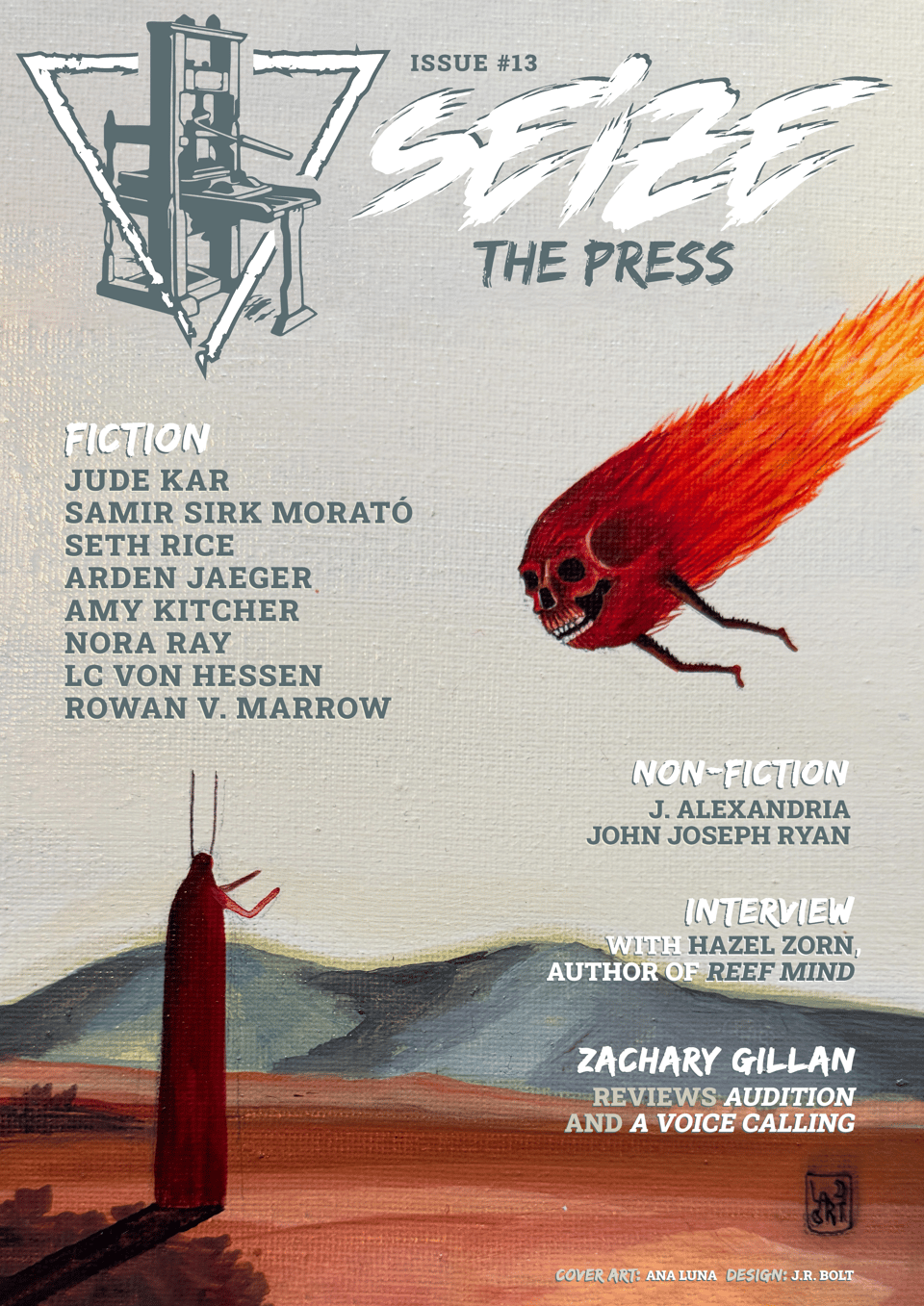
Look out for STP #14 coming soon! You can subscribe to the magazine and support independent weird fiction from the margins on our Patreon. Issue #13 is currently out and has a bunch of great stuff in there, including the aforementioned “Stunning with a Captive Bolt” by Seth Rice.
Until next time, stay safe.
Subscribe to the STP newsletter

