
006: Amélie, Sartre, and catching time by the tail

by Jonny Pickering, STP editor
I went to a twenty-fifth anniversary showing of Amélie at the cinema last weekend, the first time I’d seen it since I was fifteen. My first viewing was in secondary school French class, when our teacher let us watch it as an end-of-term treat, to a predictable cacophony of teenage laughter at the orgasm scene. My memory was of an enjoyable film, definitely better than verb conjugation but a bit twee; but on a rewatch as an adult I was struck by how sincere it felt, its celebration of living for others, and the depiction of experiencing the extraordinary in the mundane.

It would be very easy to watch Amélie as a wish-fulfilment fantasy, of seeing in Amélie qualities we desire in ourselves, but that are ultimately quashed by the mundanity of our everyday lives. Isn’t Amélie simply quirky, unique? Doesn’t she just experience life in a fundamentally different way than everyone else? If that was the case, this would be an incredibly tragic and depressing film. Amélie is unique, but so is everyone around her in their own little ways. She finds great pleasure in skipping stones across the Canal Saint-Martin, but so does her mother in looking at the costumes of figure skaters on TV, and her father in the sensation of stripping wallpaper. Before we ever see Amélie on screen, the first person we’re introduced to is a man called Eugène Koler, who has just returned from the funeral of his friend Emile Maginot. We watch as Monsieur Koler erases his friend’s name from his address book, and the close up shot of his expression as he contemplates the death of his friend conveys so much about the heart of this film. We never see him again, but he exists. He is important. Every single character in Amélie is a person with a rich, unique inner life.
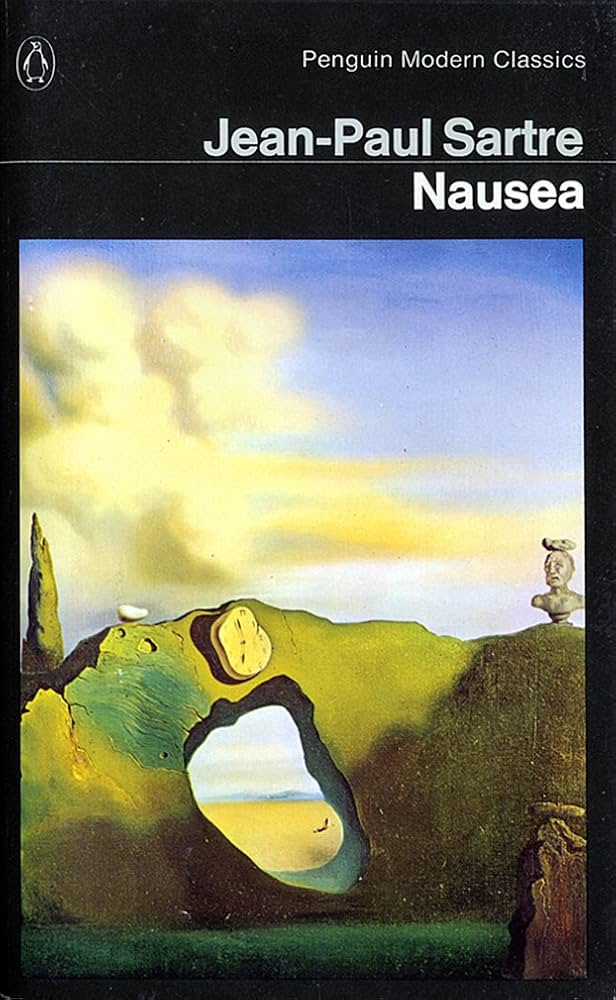
There’s a section of Jean-Paul Sarte’s existentialist novel Nausea where the narrator, Antoine Roquentin, muses on the tragedy of how we experience our lives. We crave meaning in our moment to moment existence, but it is only in the recounting of stories that our lives take on any semblance of adventure. And yet those stories so often begin in the most banal of circumstances. We imbue the beginning of a story, of a recounting, with a sense of possibility; a story is alive with promise, and yet they so often begin in the most banal of circumstances. As Roquentin writes, a person may recount to us:
‘I was out walking, I had left the village without noticing, I was thinking about my money troubles’. This sentence, taken simply for what it is, means that the fellow was absorbed, morose, miles away from an adventure, in exactly the sort of mood in which you let events go by without seeing them [but] for us, the fellow is already the hero of the story. His morose mood, his money troubles are much more precious than ours, they are all gilded by the light of future passions.
The beauty of Amélie is the joy we’re encouraged to take in these moments, to choose to live them rather than recount them, not to see in Amélie’s eccentricities qualities that are more precious than ours, but to recognise the preciousness of our own and of those around us and not let events go by without seeing them. This is encapsulated perfectly in the scene where Amélie returns Dominic Bretodeau’s childhood box, triggering in him a profound realisation of what is important in his life. He tells Amélie he has a daughter and grandson he has been estranged from for years. “Life is funny,” he says. “To a child, time always drags. Then suddenly you’re fifty years old.” When we’re introduced to Bretodeau, the narrator tells us that one of his eccentricities is to go out and buy a rotisserie chicken every Tuesday morning, and he takes particular delight in pulling apart and eating the oysters first. But he is alone in this, he has no one to share it with. It’s such a genuinely heartwarming moment at the end of the film when we see him reunited with his daughter and sharing a rotisserie chicken with his grandson.
It takes Roquentin a longer time to realise this (arguably he never fully grasps it), but on his journey of self-discovery he has a similar moment in a cafe where he watches a group of men playing cards together and writes that ‘in order to exist, they too have to join with others’. The thing that truly gives life meaning is not solitude or the pursuit of individualistic hedonism, but joining with others, in whatever way that means for us. For Roquentin, the only time he seems genuinely at peace is when he reconnects with his ex-girlfriend Anny towards the end of the novel; otherwise he mostly experiences existence as a kind of cosmic horror, unknowable and monstrous.
Amélie has spent much of her life feeling alone and isolated and much of the film is centred around her learning to overcome her fear of connection. Once she does, life is certainly not unknowable and monstrous, it’s deeply affecting and fulfilling. Roquentin encapsulates the heart of Amélie when he writes that ‘at certain moments my life could take on a rare and precious quality. There was no need for extraordinary circumstances’. Sometimes the extraordinary is skipping stones across a canal, or sharing a hot rotisserie chicken with your family. ‘I wanted the moments of my life to follow one another in an orderly fashion, like those of a life remembered,’ Roquentin writes. The trouble is, he concludes, ‘you might as well try to catch time by the tail’.
These moments are precious, not events to simply let go by. If there’s one thing my reflections on these two works have encouraged, it’s to try to catch time by the tail.
Issue #13 of Seize The Press Magazine is out now, with Issue #14 right around the corner. If you’d like to subscribe to the magazine and support our work, head on over to the Patreon. We’re also currently working on additional ways to support us outside of Patreon subscriptions.
Stay safe out there.
Sign up to the STP newsletter

