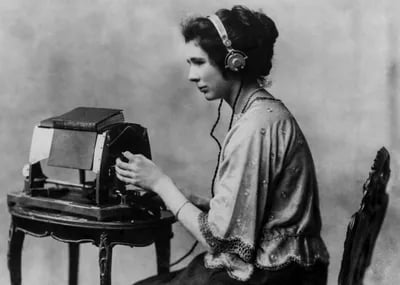
Every now and again, the French teacher at my school would click a Tricolore cassette tape into a chunky red tape recorder and inform the class that we were now going to listen to an ‘invisible film strip’.(1) It was, of course, just an audio recording in clear and slow French, from which we desperately tried to salvage meaning. There would have been no likelihood of any of us, at that time, making any connection between those tapes of conversational French and Walter Ruttmann’s 1930 experimental German radio programme, Weekend, described by its creator as ‘a photographic radio play’ (photographische Hörspiel) ‘yielding what amounts to a blind film’.(2) But in their different ways they both bring the promise of something that is neither one thing nor the other – not just audio, but not really film.
When I occasionally feel too unwell or sore to get up, but not too unwell for comfort, I too turn to an ‘invisible film strip’, that completely made-up category. I listen to a film. It must be a familiar film, something already seen. I choose one on my phone, connect it to my Bluetooth speaker, and leave them both by the bedside. In this limbo I have experienced many films. The sounds become unmoored from their visual ballast. In most films, dialogue drives, and of course this is usually the element that comes to the fore, but I particularly like how the untethered sound effects and music reveal themselves.
The three components of film sound – music, speech, and sound effects – carry the weight of the whole film, leaving huge, ambiguous gaps where the visuals would usually provide information. It’s neither one thing nor the other – not radio drama, but no longer really film.
In his seminal 1990 work Audio Vision: Sound on Screen, Michel Chion highlights some methods of audio-visual analysis equally suitable for students, teachers, and enthusiasts. One of these is masking, a method where you listen to a film’s sound in isolation, without looking at the image, or conversely turn the volume down and just watch the screen. As Chion says, ‘this gives you the opportunity to hear the sound as it is and not as the image transforms and disguises it’, although he adds the caveat that this method requires training, discipline, and humility.(3) When I use the masking method myself I find it brings a surprising freshness to familiar films, allowing me to access a new aural perspective. The film needs to be one I’ve seen at least once before, otherwise I’m completely adrift. However, I am fully aware that this is a niche activity and, I imagine, that the majority of film and music lovers would find it boring and pointless. But for me it is a rewarding glimpse into the works of the film, like being able to listen to individual pre-mixed tracks of a classic song, or following an orchestral score. It separates and defines the film’s sound, but also takes it into new territory as I rely on the strength of my visual memory which is surely conflating correctly remembered images with those that don’t belong.
I recall the comforting presence in childhood of televisions switched on in other rooms. Curiously, this is something I can rarely tolerate as an adult. Perhaps because programmes themselves now sound so different, and the acoustic qualities of the TV speakers and living spaces are themselves also different, and maybe even my sensory sensitivities have altered somewhat. But then it wasn’t a problem, and televisions of memory seemed to sound nicer than those of today. Probably less sub-bass than home-cinema systems, or less tinny than a phone or laptop. Moving images with sound weren’t found everywhere we went. Televisions were in living rooms, occasionally bedrooms, or in school libraries, locked in wooden cabinets, and the sounds from these boxes seems, to my memory, somehow warmer - loud enough to be a gentle lull in the next room, but rarely loud enough to disturb me. I remember the feeling of climbing the stairs at bedtime, hearing the theme of a post-watershed program rise through the landing. Sometimes it was comforting, sometimes unnerving. At best it was both, maybe Ron Grainer’s shimmering theme for Tales of the Unexpected (1979-88). Or think of Kevin in Time Bandits (Gilliam, 1981) overhearing his parents watching a game show both vacuous and scary, ‘Your Money or Your Life’. I recall listening outside the closed door as my parents laughed uproariously to comedy shows, trying to decipher the fun. The comforting sound of Saturday night light entertainment, a mash of applause, jaunty music and laughter, all combining with the aroma of bolognese sauce simmering in the kitchen to bring a feeling of weekend contentment. I have a special fondness for the sound of Italian films and TV, where overdubbing voices was the predominant practice, so that no matter where the location, every voice on every film sounded like it came from the same room. Even today I find this a particularly comforting sound, reminding me of long, happy days in Malta with family, at a time when Italian TV was the country’s dominant media. I couldn’t understand the language, but I absorbed on a sonic level the speech rhythms and recording textures. For me, The Film in the Other Room is a place to focus attention on sound, to mix history and analysis with memory and opinion, and perhaps return to viewing a film again with a fresh pair of ears, or at least a new tuning.
The Third Man (Reed, 1949) had a curious soundtrack release that I take great delight in. Anton Karas’s famous zither music for this classic is, of course, one of the most beloved film scores of all time. It evokes all the magic of Graham Greene’s story and Reed’s movie - the beautiful melancholy of postwar Vienna streets, the mysterious tunnels running below them, the ferris wheel turning above them. But for some curious reason, as yet still unknown to me, the soundtrack album that was released never fully separated the music tracks from the rest of the dialogue and sound effects, as is almost always the custom on a commercial soundtrack release. I can only speculate that the music - recorded as Karas improvised over the film footage - was mixed directly onto the same track as the dialogue and effects, and that there was no existing separate music track to use for the release, although plenty of other releases feature Karas playing the theme tune by itself. I’m fairly confident that today’s digital technology could easily extract the music from its audio surround, to hear in isolation, but to my knowledge no one has done this yet. I also feel that in doing so a great deal of this soundtrack album’s strange specificity would be lost. When you listen to the existing music cues you’re hearing them actually embedded in entire sections of the film. There are well known dialogue scenes between Joseph Cotton and Orson Welles, or Alida Valli, and pretty much the entirety of the tense chase scene through the Vienna sewers, all there with Karas’s zither music sewing them together. It’s a peculiar hybrid, and a peculiar listen, and the sort of thing that fascinates me. Among the many soundtrack albums I know, only a few contain sequences of dialogue, usually very short, and even fewer of them feature tracks with the entire audio mix of the film. Every time I listen to The Third Man album I get that strong sense of the film in the other room.
As I write this we’re approaching the centenary of talking pictures (not counting the many years of film and sound matching that existed before 1927). Film is inherently audio-visual, and - with few exceptions - usually meant to be. If I don’t look at the screen I can’t follow the film in the way that it is meant to be followed. But in a tired, convalescent state I am able to take a different route, one that doesn’t always make plot sense, but brings the details to my attention instead. I hear the footsteps in Cat People (Tourneur, 1942) echo with more resonance. I notice the detailed collage of the sounds of everyday life in Close Encounters of the Third Kind (Spielberg, 1977). I revel in the reverberant spaces of Citizen Kane (Welles, 1941) with newfound respect. I can appreciate the acting skills and the grain of the voices in dialogue-driven adaptations such as Educating Rita (Gilbert, 1983) or Persuasion (Michell, 1995). It doesn’t really work for all films, and intensely visually-propelled genres such as action movies can be an unsatisfying experience, unless you enjoy listening to random explosions (which I know some people do).
But I’m not trying to make people listen to films instead of watching them. Why would I bother to do that? I do, however, want to draw peoples’ attention to screen sound, and to share my passion and knowledge for this subject a bit more widely than I have already done within academia. I’d like to explore in a less pressured, slightly more idiosyncratic way, and write in a more personal way, than that world allowed, and to be accessed beyond academic journals and conferences. For a long time I researched film sound within a university setting. I specialised in the transition period, that overlap between silent and sound cinema when so many new developments were happening and cinema practices were thrown into creative disarray. My special area of interest was how the Dada and Surrealist filmmakers used these technologies (if you’re interested you can read that thesis here.) For years I was absorbed by that subject, but I’m also interested in sound use across all kinds of screen media, and all periods, and how each line of enquiry leads to another one. And, despite the title I’ve chosen, I don’t want to limit myself to cinema-release films, but allow myself to include screen work of all shapes and sizes - animation, videos, TV programmes, art pieces, underground and avant-garde films, even adverts. They just need to be of audio-visual interest to me. Although I do warn that I have never been of a very contemporary bent, having a lifelong tendency to look backwards while walking forwards. Rather than the typical roles of academic or film critic, I prefer the idea of being a professional listener. As a musician, composer and sound artist, I have spent my entire adult life working with sound and music, and listening hard is second nature to me.
And now, for reasons I’m not too sure of, I want to share some of this listening. I want to explore the history of onscreen sound, from the last days of silence to where I’m at now. If it catches my ear, I’ll listen and I’ll write. We’re living in an era that is more interested in sound than ever before, a listening age that has what has been termed an artistic ‘sonic turn’.(4) The irony is that many of us also live in a noisier world, experiencing daily overpacked soundscapes, constant noise pollution and a normalisation of dangerously loud volumes and affective sensory bombardment from both media and the environment, and commonly the solutions offered are to add more sound to mask this noise. Many people nowadays are highly audio-literate, reflected in the growing status of sound art, sound design, audio studies, field recordings, and soundscapes, but also in the increasing popularity of ambient music, white noise, noise-cancelling headphones, and earplugs, products all somewhat co-dependent on the pre-existence of a noisy environment to escape from.
For the most part, I don’t intend to write scholarly articles here, though I might put some in from time to time. It can be rewarding to explore things in rigorous depth, but that kind of writing doesn’t often reach many people and – unless you’re working full-time in academia – is highly labour intensive with small reward. Like the works I write about, my pieces will vary in length and depth. Some will be short, some may be long. Some might just be observations or comments, while others might have been researched in greater detail. I hope to explore unusual and inspiring uses of sound and music, and communicate with people who themselves share my interest in this subject. Above all, it is my personal journey and my personal choices, with all the idiosyncrasy that those bring. I’m not writing with the aim of being noticed, or of publishing an eventual book, but largely for the love of listening. Listening, and understanding this listening, so that I can re-understand what I watch and know. And for the love of lists of listening.
(1) In the 80s and 90s, Tricolore was the standard French course and textbook for UK secondary schools, teaching a whole generation how to navigate le métro via Bir Hakeim, order choucroute garnie in Alsace, and talk with confidence about le baby-foot.
(2) Walter Ruttmann, quoted in Andy Birtwistle, “Photographic Sound Art and the Silent Modernity of Walter Ruttmann’s Weekend (1930)” [available at https://www.schoolofsound.co.uk/read/photographic-sound-art-and-the-silent-modernity-of-walter-ruttmanns-weekend-1930/]
(3) Michel Chion, Audio-Vision: Sound on Screen, ed. and trans. Claudia Gorbman (New York: Columbia University Press, 1994), p. 187.
(4) Jim Drobnick, ‘Listening Awry,’ in Jim Drobnick, ed., Aural Cultures (Toronto: YYZ Books, 2004), p. 10.
You just read issue #1 of The Film In The Other Room. You can also browse the full archives of this newsletter.