Uses of the Cathartic- Part 3
When I started this essay series, the Home Secretary of the UK was Yvette Cooper. There's since been a cabinet shuffle in Kier Starmer's weird little world, and the new Home Secretary is Shabanna Mahmood. Like her predecessor, she remains committed to narrating Palestine Action as a terrorist group. Take a look at her tweet from September 7, 2025.
Description of the image: Shabanna Mahmood has retweeted the official UK Home office account with the caption "Supporting Palestine and supporting a proscribed terrorist group are not the same thing. An honour to visit Sir Mark and @metpoliceuk to see them at work policing protests yesterday." The Home Office post she retweeted read "Getting to work. Home Secretary @ShabanaMahmood met Commissioner Sir Mark Rowley at @metpoliceuk's Specialist Operations Control Room to observe public order operations...". This was accompanied by 3 images of Mahmood from three different angles, looking at screens that are presumably live feeds of police activity at the Lift the Ban protests.
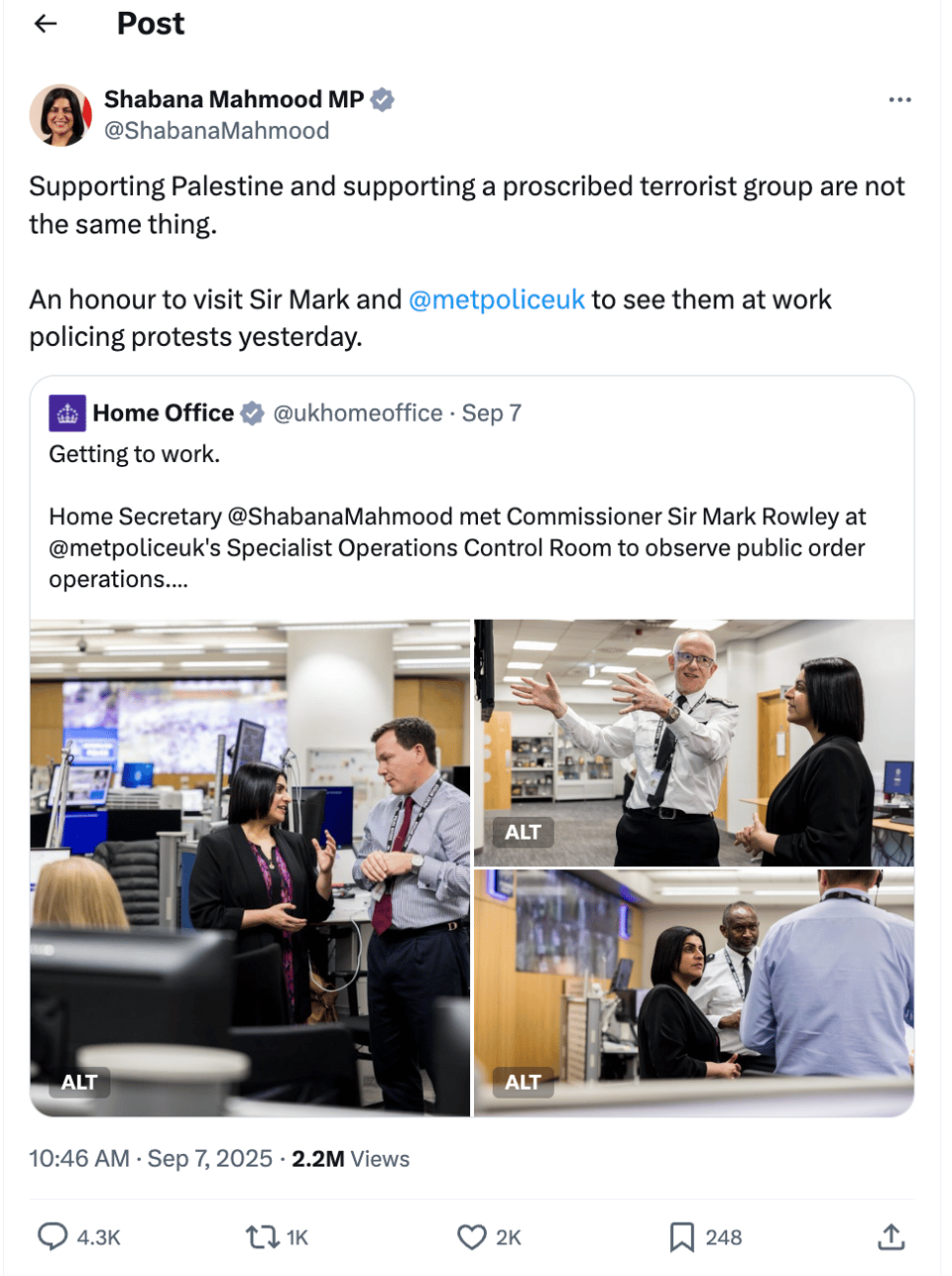
It's all a bit grim, isn't it, this image of public servant bureaucrats watching their colleagues brutalise anti-war protests? What makes the PR move here even more grim is that, unlike her predecessor Yvette Cooper, Mahmood was once an activist in support of ceasefire in Gaza. She participated in a die-in at a Birmingham Sainbury's in August 2014, to advocate for Sainsbury's to stop stocking Israeli-manufactured goods. This is all projection and speculation on my part, but I can just imagine Mahmood's inner dialogue as she watched the arrests unfolding that September afternoon. "There but for the grace of god go I," she might've thought. I imagine the relief she felt at getting off the path of direct action at the right time in history to be able to 180 her support of activism while still getting to make good money and be smug about the whole thing. The new Home Secretary who used to be a pro-Palestine activist maintains the stance that Palestine Action is a terrorist group because she must, in order to maintain the fiction that the United Kingdom's own colonial and imperialist exploits are justified as well.
The Lift the Ban protests wrack up the arrest records, community disruptions, displace people from their networks of support, and produce hyper-surveilled communities, while they get photo ops and put activist biometric and communications data into the hands of the state. I think risking arrest for a social cause is a good thing when it is meaningfully connected to the outcomes we are seeking. Moreover, the institutions of state power are always fighting their own PR battles as well, and they've gotten much better at it by studying us.
In the United States, where we saw the biggest protests in US history in support of the Black Lives Matter Movement, where they had genuine concrete demands to defund the police, and move that money into community services, the police have in fact gotten more money than they had before the protests. According to ABC news, every single city in the United States that decreased police budgets in response to the BLM protests increased said budgets the very next year by at least the same amount. At least 49 cities in the US gave their police record budget increases of more than 10%. (The New York Times has a pretty annoying piece about this too, where they frame it as a response to rising crime rates, so the whole thing ends up reading as exhausting copaganda. But it does give a lot of insight into what happened when the Defund the Police throttle eased up off of jackbooted thug necks.)
Further, the LA Times released bombshell reporting back in 2020 that the LAPD was increasing their spending on public relations in response to protests, and to manage optics after police murder civilians. Many major cities around the US are doing the same, with record spending on PR with these increased budgets. In Chicago, the police department had hired multiple videographers to capture the police being “good” around town, in one of the most over-policed cities in the country. Even more outrageous is that one of the jobs of the public relations department of the Chicago PD is “early strategic intervention with families of people killed by cops.” (Seriously, I highly recommend Alec’s Copaganda Newsletter if you want to spend some time getting angry and getting informed.) Think about that every time you see a cop on video trying to appear reasonable or thoughtful while arresting someone, getting haircuts at historically Black barbers, or playing chess with school children whose high schools they’re sent to surveil.
I think there are at least two lessons to learn from Shabanna Mahmood's past as a die-in protestor and backlash to Defund the Police which became Give Lots of Extra Money to the Police:
Mass uprisings that don’t focus on structural change are easily co-opted and neutralised by elites. The fact that we have these mass uprisings and bureaucrats can participate in them and then go back to doing their bureaucratic nonsense tells us that mass uprising can be absorbed by bureaucracy relatively easily when it is not accompanied by structural change. Mass uprising that does not result in structural change makes a path for those changes to be rolled back when the masses inevitable go back home, or worse, be easily absorbed and used for clout when opportunities for more power are presented to its participants with ambition.
If the Palestine Action protestors end up getting released from prison, or found not guilty for terrorism, we already know that the Lift the Ban protestors are going to credit their arrests for at least part of the success. And if the Palestine Action protestors end up not getting released from prison, or found guilty of terrorism, the same people will probably say that not enough people got arrested to make a real difference. Sadly, I think they will be wrong on both counts.
To be clear, the mass arrests have given a lot of morale to the Filton 24. In Lottie Heard's public statement after one year of being incarcerated without trial, they wrote "In the UK, thousands have been arrested for opposing a genocide. Hundreds have been incarcerated for their solidarity. If this year has taught me anything, it is that the struggles of Palestinian freedom, anti-colonial effort and abolition work are all inextricably linked. We cannot truly strive for one without tackling them all." That is powerful. Imagine sitting in jail as a freedom fighter, and knowing thousands of people are willing to risk arrest as well because they support your actions? That's beautiful and valuable.
But as I've said throughout this series, Palestine Action was not proscribed because Labour party politicians and legal bureaucrats don't know how outraged we are about genocide. Palestine Action was proscribed because the British empire needs other empires to succeed in order to maintain its colonial hold on power. The struggle we are in is not just a moral battle. We also need to think clearly and forcefully about the incentive structure that make it the "right" choice for a state to be complicit in a genocide overseas. For people who haven't thrown tens of thousands of dollars at taking college classes about political philosophy, the principle thing here is that empires have always needed allies to support their political projects. It is why all the NATO countries go into war immediately when one is attacked, but they don't wage war with each other. It's why we've been watching a year's long international debate about whether or not Ukraine should be made a formal NATO member. Political alliances come with political obligations. The UK government is happy to send arms to Israel not because because Kier Starmer doesn't hear us saying "never again" or "I oppose genocide". It's because the legal, financial, and militaristic incentive structure of having a colonial ally in the "only democracy in the Middle East" is too big to pass up as it currently stands. So, as Heard says in the letter, we cannot strive for decolonisation in Palestine without prison abolition in Israel's supporter states- our incentive structures everywhere must change in order to make supporting Israel's imperial project untenable. Mass arrests that justify increasing domestic police budgets in the future to quell whatever dissent we have about the next genocide actually seem to be serving, rather than undermining, the incentive structure of this imperial project in the long run.
If you're gonna have a mass uprising, you need strong spokespeople. The police and the Home Office have their own PR budgets. I spent several days trying to track down historical data about how much money the Metropolitan Police have allocated since 2020 on marketing and PR. I wasn't able to find any definitive answers. If any of you know how I might find that information, please reply to this email and let me know! There is simply not as much reporting on police budgets in the UK as there is in the US, which is a shame. What I was able to conclude though is that the Home Office and the Met both have their own departments dedicated to trying to control the public narrative around what is and isn't a "crime" and how we should feel about and treat "criminals" and "terrorists". Mass arrest campaigns are PR campaigns for social justice. But the Lift the Ban protests have had a real lack of public messaging from the first-personal perspective, and they’re taking that tactic up against a really, really well-oiled machine that is prepared for them. They are content to let their actions speak for themselves, as they say explicitly in their action planning document:
We are sitting down (only standing in exceptional circumstances)
We have a gaze lowered in contemplation and resolve, not seeking contact with passers by or the police. Our words, or lack of, on the sign are what we are communicating. Let them speak for themselves.
We do not give media interviews during the action as they disrupt the peaceful and impactful atmosphere we are creating
If these arrests speak for themselves, it's not clear what they're saying beyond "I'm upset about the status quo". Which is fair, but a whole lot of us oppose genocide, babes. Except now the police have your mug shot and fingerprints, and are perfectly happy to sit in front of your house watching your neighbours to try to figure out which one would speak about you if asked. A big part of the impetus of this essay series was to try to make a good faith interpretation of these protests, because what the organisers have to say for themselves is vague and politically underdeveloped. The Palestine Action activists that they're advocating for are never mentioned with any specificity, the relationship between their arrests and the PA court cases is never discussed, and ultimately, we don't even know what's happening to the LtB protestors after arrest.
According to the newsletter from DoJ about the Saturday September 6, 2025 action at Parliament Square, "You’ll be pleased to know that all 857 arrestees were released yesterday without charge, and with minimal bail conditions. Stories of love and gratitude have come flooding in, both for those taking a stand and for the incredible welfare and support teams who took care [of] us all."
I'm not pleased about any of this actually. If the celebrated outcome is that no one got charged, and the protestors had a good time and were relatively safe throughout, and they're not even speaking to those of us at home about what is happening when they're in custody, the same thing would've happened if they'd all just stayed home. What was accomplished here, other than the photo opportunity and the moment of catharsis?