Tono, actually
I spent a lot of time this week putting words out about history and its preservation. The first was a piece I’d written for the Washington Standard on what is still a shockingly unique take on the Marcus Whitman statue in the legislative building in Olympia. For over a year, the state capitol committee has discussed how to get it out of the way when the Billy Frank Jr. statue finally shows up to replace it. Why are we talking about moving it? We should destroy it.
The second piece is me going back to Tono, a small, former mining town in far southern Thurston County. This town was not preserved at all, and I have some thoughts on why that isn’t necessarily a bad thing. But I do want to point out a comment by @sarae@ecoevo.social, that the same forces that took away Tono were the same ones that took away places for which we have no written history. When I’m talking about history and the problems I have with its preservation, I usually zero in on colonial history, and that is a big problem. As Sara points out, there is a metric ton of history we’ll never know, because we never preserved it, never listened to it and now it is just gone.
Tono, actually
One of the historic rabbit holes I'm prone to falling down is the lost cities in Washington State. I don't mean ghost towns, because some of them, like Tono in southern Thurston County, don't exist at all anymore.
Over the years, I've tried to pinpoint exactly where Tono was located. Recently, I was looking at the parcel layer (the map showing property boundaries) in southern Thurston County (as I'm sure we all do from time to time), just below Bucoda. And, I noticed a long, skinny parcel that, to me, indicated a road or a railroad was once there.
So, I went back and found a fairly decent map of Tono that included a train line. The train line's contour matched the parcel's shape, and it lined up nearly perfectly.
This is the best I've been able to produce of how Tono was laid out.
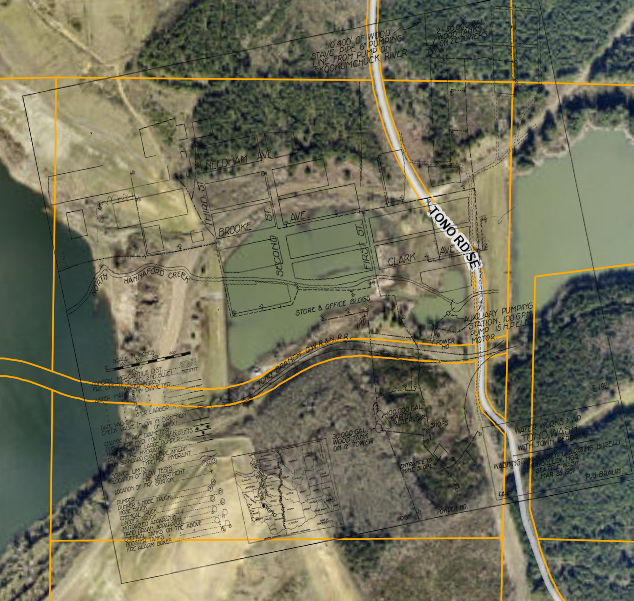
This is significant because the landscape of Tono disappeared when mining techniques changed after the town itself was abandoned.
In 1969 coal mining in the fields around the Tono site was revived when the Pacific Power and Light company bought the land and built a new steam plant to produce power. It was during this era that the Tono site saw its largest change. The ground on which the town had sat was scraped up in order to get to the coal beneath it. The coal mining terraforming was so severe that the town site is currently dominated by two massive ponds.
For decades, Tono had been a fairly significant town in Thurston County, on par with Yelm, Tenino, and Tumwater. But because it was a company town, when the resource ran out, the town itself ran out of reasons to exist.
What I keep coming back to is how completely Tono was erased. There was no fight over historic districts, no argument about “character,” no committee meeting where someone insisted their grandfather once lived in a particular house and demanded the coal company spare the building. The ground was literally peeled back; the past scraped away to get at what the land still had left to give. What’s left now are ponds big enough to swallow the entire town grid.
And yet, somehow, Tono survives.
Tono survives in census tables, photos, mining reports, and the stubborn curiosity of anyone who has ever tried, like I have, to find the ghost of a town that isn’t even a ghost.
It’s funny: we spend so much energy today trying to keep the past standing upright. We landmark houses whose only real significance is their ability to slow down a duplex development. We wrap ourselves around “character” as if it were a fragile antique rather than something living communities constantly renegotiate.
Tono is a lesson in impermanence so complete I can't help but be amazed. An entire town, just gone.
Two ponds where families once lived. You couldn’t “preserve” Tono if you tried; the coal company settled the question half a century ago. And yet, that doesn’t make it any less historical. If anything, it makes it more so. Tono forces you to engage with history as a process, not a museum exhibit. You can’t stand in the middle of a preserved streetscape and pretend the past is still intact, because the flow from the past to today is change. Change even includes the scraping of an entire landscape until there is nothing left.
You have to reconstruct it. You have to work for it. And there’s something freeing in that.
The lesson of Tono, the one that historians, preservationists, and anyone who loves their community ought to sit with, is that losing the physical stuff isn’t the same as losing the history. The built environment is not the memory. The map I matched by lining up an old railroad grade with a weirdly long modern parcel tells me more about Tono’s rise and fall than any building would. The ponds tell a truth the hardware store never could: the town’s existence was always dependent on what lay beneath it.
We forget that history is supposed to breathe. Towns grow, plateau, disappear, reappear in footnotes, and get rediscovered in GIS layers. Some places make it. Some fade. And sometimes the fading is the story.
Tono reminds me that you can lose every house, every street, every trace of a community’s physical presence, and still have history worth knowing. You don’t need to encase it in glass to make it matter. You don’t need to keep a structure standing to let the story breathe.
Team Melt Down the Marus Whitman Statue, Signing On
This feels like an “Am I taking Crazy Pills” sort of moment for me. Why are we spending more than a year discussing the finer points of where and how exactly it would cost to move a statue based on a historic, racist, Christian nationalist lie?
Whitman’s story is familiar to anyone who passed through the Washington public school system before the last couple of decades. The missionary-doctor who “saved the Oregon Territory” through a heroic ride east, an early frontier morality tale.
But generations of historians have undercut that myth. The story wasn’t merely exaggerated; it was manufactured. It was deployed to justify white settlement, minimize Indigenous sovereignty, and frame American expansion through a Christian nationalist lens.
The statue in Olympia was installed for that purpose. The program for its 1953 dedication spells out the message in stark terms: Washington’s political leaders openly used Whitman to elevate a factually wrong, racially exclusionary narrative of the region’s past.
The object itself embodies that propaganda campaign. Keeping it upright on our state Capitol grounds, no matter where it’s placed, keeps the old story upright as well.
Apparently, from what I’ve been able to learn, bronze has a very high melting point. That means you’d need an acetylene torch to start cutting apart the statue. But, foundries and scrap metal operations exist in Washington State. I feel like we should start looping them in. See what they got.
That said, I already have DMs sitting in my spam folder from Walla Walla residents who are willing to set me straight about the Marcus Whitman legacy. I will let you know if I do get into a discussion with them about “debate” that has been settled now for 124 years.
What else you should be listening to or reading this week
Listen to the Olympia Standard! Finally (I think) we’re done looking back at the 2025 Election. In the most recent epsidoe, Daniel Garcia (@heal.oly.project) sits down with Sarah DeStasio, the third campaign consultant we’ve featured, to talk about the progressive races for city council. I want to add, that I had some fears going into this year. Whether I could get the podcast out on a regular basis. And how closely I’d have to involve myself with actual campaign episodes (which I wasn’t excited to do). With the ongoing support of producer Jemmy Joe and the addition of Daniel and Erika Lari, I think we did an amazing job.
Nathalie Graham from the Stranger does a year in review with the Tumwater School District. It is amazing how Tumwater became a symbol and location for the anti-trans forces in Washington. But, at the same time, couldn’t get their most high profile and best funded candidate over the finish line.
Olympia at Dusk at like 4