
The Carlton and the Choices We Made to Get Here
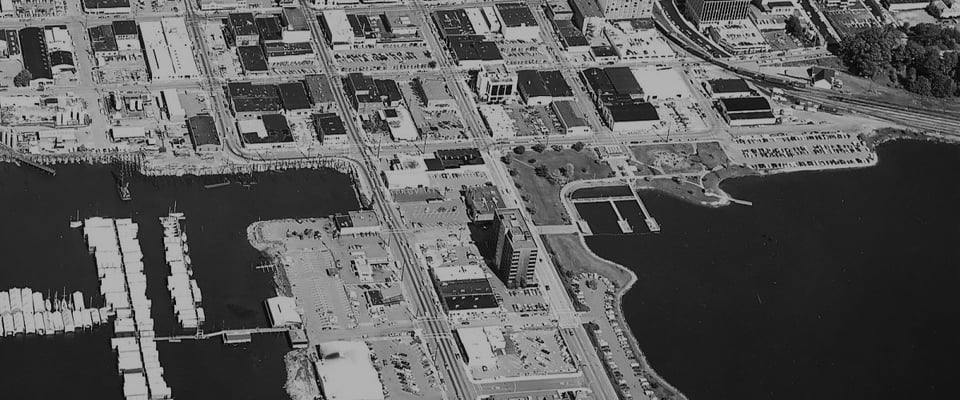
Parking lots are our civic negative space. We create empty space for car storage so we can more easily access the places that remain after we build parking lots. We need this empty space because we’ve built so much other empty space, large roads and freeways, to facilitate even more car use, so we can travel even longer distances. In downtown Olympia, we’ve been transforming used space into empty space for decades. One of the projects I explored a few years ago was mapping the parking lots across downtown Olympia. And because we have maps of what used to be there, we can track what we lost. Today is the first essay in a series of unplanned length that I am going to write irregularly here about what we replaced with parking lots.
Also, a new episode from The Olympia Standard on Neighborhood Associations and how they might be going in the right direction. And, some reading for your reading list.
The Carlton and the Choices We Made to Get Here
This is the start of what I hope to be a long-term project. I want to track the history of parking lots in downtown Olympia. They’ve become a dominant land use type. I made a map that shows just how pervasive these empty spaces really are.
It hasn't always been this way. A few examples remain, but our blocks were historically covered in buildings. This density was a social good. Mixed uses like housing, workshops, and shops were tightly packed together. Everything was walkable because we didn't have a choice. We didn't have cars.
There’s another side to this that we don't talk about enough. These dense blocks are more economically productive. They generate more tax revenue than suburban lots or big box stores. It’s a bit of a hidden truth that cities end up paying for the services of suburban and rural residents. Parking lots just eat away at the economic health of our local government.
Think about what we lose to sea level rise. If we don't act by 2095, downtown Olympia will lose about 370 acres. That’s over 600 million dollars in value based on 2018 data. The land in low-lying Olympia is worth about 1.6 million dollars per acre. Land outside the flood zone is worth less than a third of that. The land most likely to be lost is our older city. It’s the part built before cars. It’s ironic that we’ll probably keep the car-dependent parts of town while the rising tide, caused by car pollution, takes the most productive core.
And, in an era of nearly every local government dealing with structural deficits, it’s worth looking at the literal structures causing the problem.
Scandal and Padlocks at the Hotel Carlton

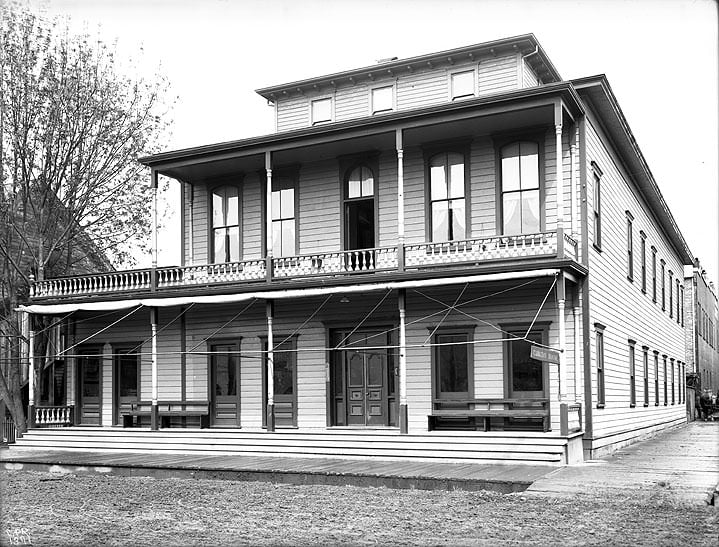
My first case study is the gravel lot at State and Columbia. If you look at old Sanborn maps, you see a vibrant mix of life. There was a metal shop, a second-hand clothing store, the Salvation Army, and several restaurants. The main anchor was the Carlton Hotel.

The building started as the Carlton House. It stayed that way for a couple of generations. In 1891, it was the center of a local scandal. A seventeen-year-old girl named Lizzie Jacobs was taken there for safety after a failed elopement. Her suitor, John Beggs, got into a fight with Lizzie’s mother and knocked her to the sidewalk. The couple fled in a horse-drawn carriage before an officer stopped them.
By 1902, the place was renamed the Hotel Carlton. The new manager wanted a first-class establishment to show off Olympia’s prosperity. By 1908, you could get breakfast or dinner there for 25 cents. But things took a turn during Prohibition. In 1931, a lawsuit claimed the hotel was bought specifically to be a liquor joint. A federal court issued a padlock order. The hotel was forced to close for an entire year as a penalty.
By 1933, the owners tried to move past the legal trouble with a new name. The final chapter came in 1947, when it was called the Hotel Hutson. That August, the city ordered the building to be torn down. It was seemingly the end of a structure that had been a part of the landscape for decades. And that is where the history of the building goes cold. But before we continue, I want to talk about something else.
Naturally Occurring Affordability
If you look at old crime reports and news snippets from before 1947, it’s clear the Carlton and the Hutson were housing people who were down on their luck. It had become what we now call naturally occurring affordable housing. Nobody set out to build low-income housing here. It just happened because the building was 50 years old and rundown enough to be cheap.
We saw the same thing a few years ago with the Angelus Hotel at 4th and Columbia. These places stay affordable because they are old and lack new investment. They are rare now because modern rules make them impossible to build. Features like shared bathrooms or tiny rooms were often prohibited by modern codes. When these buildings get sold, the cost of safety upgrades is so high that the owners have to raise the rent. That moves them out of reach for the folks below the working class.
Even when we build on top of old parking lots, using more liberalized rules that allow for building in a way that we could 100 years ago, we have to wait decades for that cycle to restart. This creates a conflict between fixing up the city and keeping it stable for residents. The city effectively subsidizes its own gentrification. We trade historical affordability for a modern landscape that is legally and financially inaccessible to the people who live there now.
The Housing Crisis and the City Fathers
Back in 1947, the city certainly didn't care about low-end housing. They ordered the Carlton torn down despite a massive housing shortage. This was after service members from Fort Lewis and McChord Field started flooding Olympia. The crisis was so bad that people were renting out converted chicken coops.
Even with that level of desperation, Olympia’s leadership rejected federal housing funds. Local landlords actually celebrated the decision with New Year’s toasts in 1943 because they knew it meant they could keep the rents high. They were happy the city turned down the money. The mayor who rejected the money made a half-hearted public appeal for landlords to keep rents low, but it didn't do much. At the same time, the city was moving to destroy Little Hollywood, the shantytown on the edges of the Deschutes Estuary. The city knew there was a shortage, but they still opted to tear down what little housing existed.
The Ghost of the Carlton
Even with the demolition order, buildings didn't vanish immediately. Aerial photos from the fifties still show a building at that spot, but not the angular-roof version that was the Carlton. There was also a newer flat-roof building used by the Olympia School District. It seems the old hotel address was absorbed into the school district offices.

In the 1970s, the location started hosting a senior center. A local nonprofit found a good deal in the abandoned school offices. Seniors would go there to pick up bus passes well into the 1980s. When the senior center finally moved across the street to the modern community center, the Carlton's footprint was finally gone into a parking lot.
We decided after the 1940s that cars were more important than anything else we could do with the land. But it’s heartening that the Carlton survived long enough to be used for something good. It helped educate children and support seniors before it finally became a lot for cars.
Looking at this gravel lot today, we don't necessarily see a place to leave a car. We can see the lost economic vitality that could be funding our services. We can see the naturally occurring affordable housing that we regulated out of existence for decades. We can see the choice we made to trade a vibrant, productive community for a flat surface that contributes nothing to our future, exempt the moral backing of climate change and sea level rise.
It took nearly a century for the wrecking ball to finally win at State and Columbia. Now, we are the ones living with the quiet, expensive consequences of that victory.
The Olympia Standard #148: Neighborhood Associations
For decades, official neighborhood associations have been an essential part of Olympia’s civic fabric. This week, we examine how these associations operate with Michael Craw from The Evergreen State College, a scholar in the field. Then, Daniel sits down with Grace Fletcher to discuss the new generation leading the Council of Neighborhood Associations and their evolving approach to civic engagement.
What else you should be reading this week
Good journalism from the Inland Empire that isn’t from Range Media. The Inlander covers Federal prosecutors indicting Harvest Plus for luring migrant workers to WA under false contracts. Victims were forced into unsafe labor at a vineyards owned by the billionaire family behind the Vancouver Canucks where they faced wage theft and cartel threats.
Some folks are going to out-of-hand reject a point because you’re citing times behind the Iron Curtain, but this is just a reminder that car-centric design is a policy choice.
One of the choices that journalists make is to cover flood victims who live on property adjoining a river. At some point in the story, there will be an observation about how they’ve either never seen the river act this way or move this far or that they could never imagine the river destroying their house. Despite physical evidence to the contrary. The Seattle Times reminds us that the river doesn't change its behavior; the river is going to do what it has always done. We just learned to get out of its way. We never controlled the river; we just learned that we never controlled the river.

