
Speak out on Whitman and Deeper into TRL and the Evergreen Pool
We have a packed agenda this week.
First: Here is something small you can do this week to advance justice and defend history in Washington State. Either send an email to the State Capitol Committee or sign up to give public comment at their meeting on Thursday. They are again considering a way to move or otherwise preserve the presence of Marcus Whitman at the state capitol.
It is well past the time when we need to give Whitman the confederate general statue treatment.
The Whitman Statue is based on the "Whitman Saved Oregon" myth that was constructed in the late 1800s as a narrative to defend a white supremacist view of Pacific Northwest History. That is the long and short of it. By continuing to try to figure out how to keep the Whitman Statue around, we are avoiding the harsh truth of how his statue was placed in our capitol to begin with.
Here are some background articles on Whitman:
You can sign on to the meeting this next Thursday at 10 a.m. here. You can also send public comment to [email protected]
The Deep History and Structural Mismatch of Timberland Regional Library
When Eric Wilson released his analysis of Timberland Regional Library's finances, he gave a name for something a lot of people had already felt but couldn't quite pin down. He called it the "Scissors Effect." Revenue and expenditures were diverging like open blades, compounding year over year, until the gap became a chasm. His report is urgent and damning. But it's also the latest chapter in a much longer story, one that doesn't start with a deficit. It starts with a blueprint drawn up in 1950 that designed a system that was, from its very first breath, a compromise between counties whose interests were never quite as aligned as he'd hoped.
The Wilson Reports: A Forensic Look at the Current Fiscal Crisis
The numbers Wilson presents are devastating in their simplicity. Between a baseline period and 2026, system-wide revenue grew by 18 percent. Expenditures grew by 34 percent. That gap might sound manageable in a single year, but it compounded into a structural deficit that expanded from $948,000 in 2023 to a projected $3.8 million shortfall for 2026. The scissors were open for years. Nobody in a position of authority said a word about the blades.
What makes Wilson's analysis so striking isn't the math. It's the institutional culture that let the math go unaddressed for so long. As recently as September 2024, the Executive Director told the Board of Trustees and the general public that TRL was "in the black" and carried no deficit. This was said even as expenditures had exceeded revenue for two consecutive years. Early in 2025, leadership presented staffing plans asserting that no layoffs would be necessary. Within months, the system had collapsed into the largest reduction in force in its history, cutting 61 positions and eliminating 38 percent of branch staff. In December 2025, the board unanimously approved a $3.8 million deficit budget without any plan to address it, simultaneously breaching its own 30 percent reserve policy without apparent alarm.
Wilson's explanation for this is what he calls the "Governance Gap." The board did receive monthly financial reports, but those reports only showed current-year data. That design made four consecutive deficit cycles look like isolated, one-time problems rather than a system in collapse. Leadership consistently reframed the numbers as "conservative estimates" or built-in "wiggle room" that wouldn't actually materialize. Most critically, the board was denied multi-year financial projections. That's a standard tool used by most of TRL's peer library systems, some of which model their revenue and expenditure trajectories up to eleven years out. Without that kind of forward view, the board couldn't see the fiscal cliff coming. By the time the ground gave way, the fall had already started.
Wilson's diagnosis of "institutional optimism" is damning. It's also, as the historical record makes clear, a very old pattern in this institution. One that was baked in long before any of its current administrators arrived.
History and the Bowerman Report: The Original "DNA"
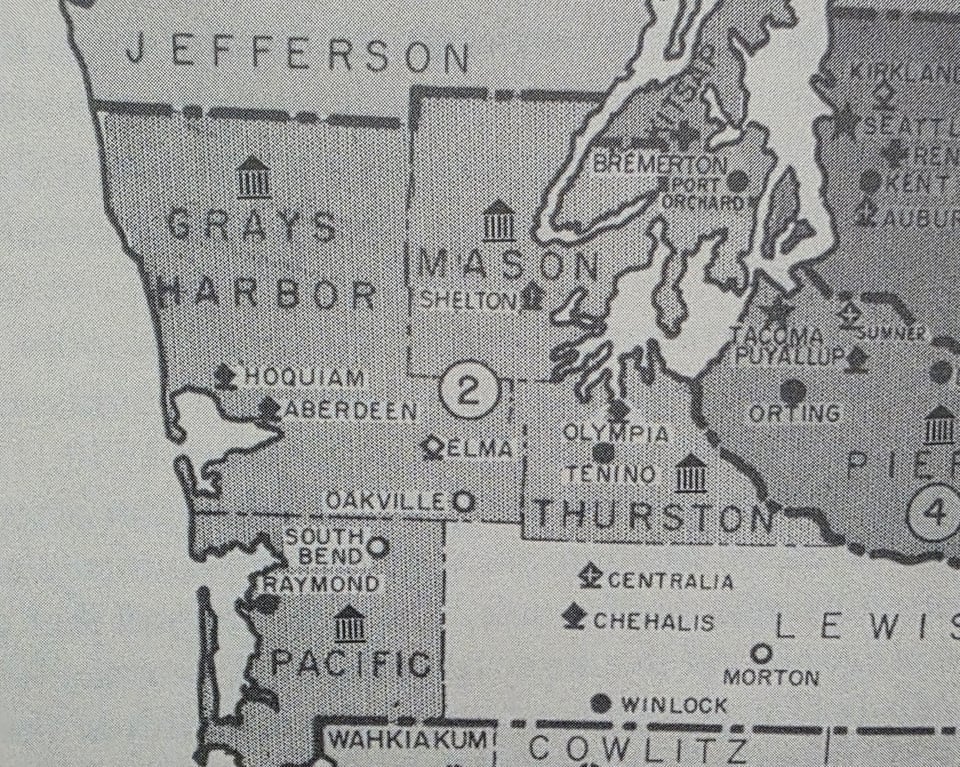
To understand Timberland, you have to understand what it was built to solve and what it was never quite able to escape. The 1950 Proposed Regional Library Plan, known informally as the Bowerman Report, came out of genuine post-war optimism about making public services more rational and equitable. Its core argument was that small, independent municipal libraries were simply too limited in population and tax base to ever reach what Bowerman called "adequacy," a standard of service comparable to what people in Washington's largest cities could access. The fix was consolidation into regional systems organized around "natural trading and economic areas," units large enough to generate at least $100,000 (or $1.4 million currently) in annual revenue and support professionally trained staff. The model borrowed explicitly from the school district consolidations of the 1940s. The five counties Bowerman proposed to unite shared, in his assessment, "common economic interests." That assumption started fraying almost immediately.
As early as 1948, Mason and Thurston counties had joined their library services into the Thurston-Mason Rural Library District, a partnership designed to share costs across unincorporated areas. By 1959, that partnership had deteriorated into open political conflict. Mason County commissioners were, in the language of the time, increasingly "irked" by the $12,000 annual cost of bookmobile service. They characterized the whole arrangement as a "book-deal" that wasn't serving the county's most remote residents, including people along the Hood Canal. The joint board came under fire for what Mason County leaders described as structural bias in favor of Thurston County. Things got tense enough that officials briefly floated the idea of abandoning the district entirely and just charging residents two to five dollars for individual library cards.
The 1960 formation of the South Puget Sound Regional Library, which brought the City of Olympia into the existing Thurston-Mason arrangement, was supposed to stabilize the coalition. It didn't. It created a new center of political gravity instead. When the SPSRL board later tried to withdraw from the broader five-county regional demonstration, worried about the pace and terms of a proposed permanent district, the Mason and Thurston County commissioners didn't take it lying down. They waited for vacancies on the SPSRL board and systematically filled those seats with members who supported the regional merger. The reconstituted board reversed the withdrawal. It was an early and telling sign that the five-county arrangement would be held together not by genuine shared purpose, but by political pressure and structural lock-in.
The Timberland Library Demonstration moved through the early 1960s amid persistent local skepticism. When a ballot measure in 1968 sought to make the district permanent, opposition showed up in distinctly local flavors. Some Lewis County residents questioned why they should pay for their "cows to read." In Montesano, Grays Harbor County residents worried the new district would simply "take their building away." Rural fire districts saw the library levy as a direct threat to their own funding, a competition for limited property tax dollars that would persist for decades. Despite all of it, the measure passed in November 1968 with 62 percent of the vote. Though it is notable the margin was barely over 50 percent in Lewis County.
The first major existential threat arrived just four years later. By 1972, rural farm groups and granges in counties like Pacific and Lewis were circulating dissolution petitions. Their argument was straightforward: taxes were "skyrocketing" while services had declined, and the system was "top-heavy" with administrative overhead that consumed resources without delivering results. The legal question of whether a single county could walk away landed before Washington Attorney General Slade Gorton. His ruling had consequences that reach all the way to today. Gorton concluded that no county had the statutory authority to withdraw on its own. The only exit from the five-county arrangement was full dissolution of the entire district. And a dissolution petition required (at that time) signatures from 10 percent of the entire district's voters, not just 10 percent from whichever county was unhappy. The five counties were, as a matter of law, locked in.
Picking Apart the Structure: A Failure of the Modern Model
Bowerman's assumption that the five counties shared "common economic interests" made sense in 1950. It doesn't hold up in 2026. The collapse of the timber industry across rural Washington and the growth of Thurston County as the center of state government have produced a demographic and economic shift that the original blueprint never accounted for.
In 1930, Thurston County held just 20 percent of the combined population of the five counties, ranking third behind Grays Harbor, which led the group at 38.4 percent. By 2020, Thurston had grown to represent 54.4 percent of the district's total population, an outright majority, while Grays Harbor had dropped to just 14 percent of the regional share. These counties are no longer peers. They're a large urban anchor and four rural not even satellites, all governed by rules designed for a region that no longer exists.
The comparison with the only other regional library system produced by the Bowerman framework is worth pausing on. The North Central Library, serving Chelan, Douglas, Okanogan, Grant, and Ferry counties, came from the same post-war consolidation logic. But its demographic story has been very different. Chelan County led the group in 1930 with 45.6 percent of the regional population. Grant County has grown significantly since then, producing a more distributed balance where no single county commands an outright majority. North Central hasn't experienced the structural subsidy problem that now defines Timberland's budget, and that's not a coincidence. It is what happens when the founding assumptions of a regional model don't get overturned by ninety years of uneven growth.
That subsidy problem is the crux of the modern critique. The Ridley-Simon Efficiency Test evaluates public services by measuring the ratio of effort, meaning expenditures and staffing, to results, meaning actual service delivery like circulation. By that measure, TRL's own data shows a system that's crossed into diminishing returns. Between 2017 and 2026, salary spending for TRL's central Service Center doubled from $2.2 million to $4.4 million. The Service Center's share of total staff rose from 14.4 percent to 19.2 percent, even as the rest of the system lost 30 frontline positions. TRL now delivers 9.6 circulations per resident. That's the lowest figure among its six peer library systems. Sno-Isle delivers 13.3. Whatcom County delivers 14.2.
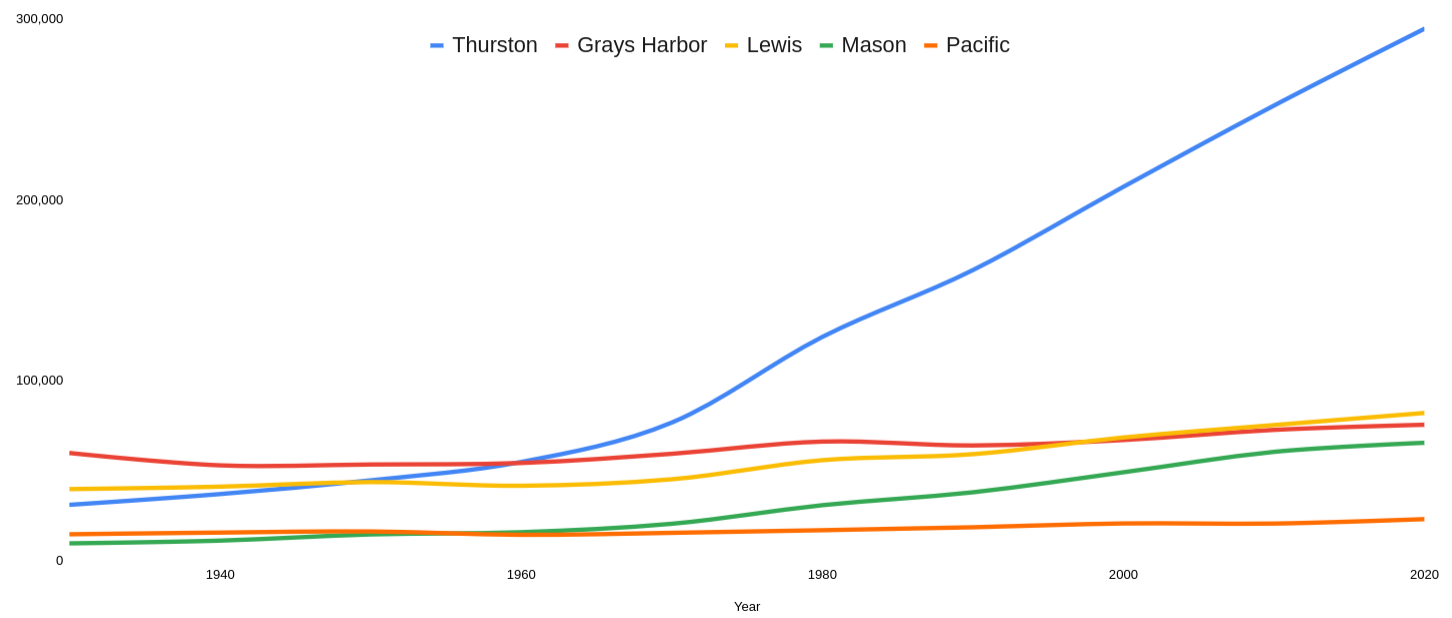
The county-level numbers are harder to ignore. In the 2026 budget, Thurston County generates $15.6 million in revenue and receives $6.6 million in local library expenditures. Grays Harbor generates $3.05 million and receives $2.98 million in local spending. Thurston is paying a $9 million premium into the regional system, a sum that largely funds central administrative overhead and the cost of keeping small, remote branches running in counties that couldn't sustain them on their own.
There's a structural fix that analysts have described as a "regional divorce," transitioning from a consolidated district to a federated or contract-based model. Under that arrangement, Thurston County could redirect its $9 million premium toward services that fit an urban population: more digital licensing, longer hours, better technology infrastructure. The remaining four counties could form a smaller rural cooperative, scaled to their actual geography and potentially eligible for federal and state rural development grants that a mixed-district like TRL can't easily pursue.
It's a reasonable idea. It's also currently functionally impossible, and a 2024 law made it harder. Senate Bill 5824 was passed in direct response to a 2023 attempt to dissolve the Columbia County Rural Library District in Dayton. That effort followed a dispute over books with LGBTQ+ themes, and it exposed what critics called a loophole: under the old law, it took signatures from just 10 percent of voters in the unincorporated area to force a dissolution vote of a rural library district that served a large non-annexed city. In Columbia County, that was 107 people. SB 5824 raised the threshold to 25 percent of all eligible voters across the entire district. It also extended voting rights to residents of incorporated cities who had previously been barred from dissolution votes even while paying taxes to support the library. The bill passed 44 to 5 in the Senate and 94 to 2 in the House.
The irony isn't subtle. Gorton's 1972 ruling locked the five counties together as a matter of judicial interpretation. SB 5824 has now reinforced that lock through statute, raising the bar for dissolution high enough that even a legitimate restructuring effort, one driven by fiscal reality and demographic change rather than a culture war, is out of reach without new legislation. The bill was written to protect libraries from bad-faith attacks. What it also does, as a side effect, is protect a dysfunctional regional structure from good-faith reform.
Bowerman warned in 1950 against "the conservative forces of vested interests" that would resist regional consolidation. He couldn't have anticipated that the vested interest most difficult to move would eventually be the consolidated institution itself. Or that the expert, forward-looking governance tools he prescribed for adaptation would be precisely the tools a future administration would withhold from its own board. The DNA he wrote into Timberland Regional Library encoded both its ambition and its central problem: a system built for counties with common economic interests, in a region that's spent seventy-five years quietly growing apart.
The Olympia Standard #151: Evergreen Pool and the Future of Aquatics
What is the future of aquatic sports in Olympia and beyond if the Evergreen Pool is closed? We sit down with swim-team boosters this week to walk through the risks of losing the region’s largest public pool and how we can sustain athletic facilities into the future.
What else you should be reading or watching this week
Journalists at McClatchy papers across WA and ID (obviously including the Olympian) voted 90% to authorize a strike over low pay after 11 months of stalled talks. Many earn $45–52k and struggle with rising costs. Unions say profits aren’t reinvested; negotiations resume May 5.
I’m going to keep suggesting you listen to Adults in the Room, but only because things like this keep on happening.
Seattle Transit Blog takes a look at the years-long effort Intercity Transit took for the route redesign that is going live now. Of course, The Olympia Standard covered this all the way back in February.

