
Rebalance the Stadium
It isn’t the hottest take to say that people who have been stepping forward to “defend women’s sports” aren’t the type of people walking around wearing “Everyone Watches Women’s Sports” hoodies. And that is not the debate I’m going to enter into today. What I wanted to do was pull back from a discussion we always seem to have about one of our most famous public buildings and why the things are the way they are.
And like a lot of things, they are because we choose for them to be. The economic structure around Lumen Field and who gets to make money there is actually built in state law. And that state law keeps women’s sports (specifically soccer) from growing in Washington State. That’s the thesis for today’s essay.
Also, and as always, some relevant reading material at the bottom.
Rebalance the Stadium
Systems we set up nearly thirty years ago aren't carved in stone. When legal frameworks pick winners like super-rich NFL teams over professional women's soccer, we've got to unpack that history and talk about rebalancing the scales.
The group owning the Seattle Reign and the Sounders is exploring options to move away from publicly owned Lumen Field. This search opens up a great chance to ask why anything besides NFL football feels out of place there, despite early promises.
In modern American sports, this structure hurts women's teams the most.
When Washington State voted in 1997 for the stadium, campaign leaders made bold promises about soccer. They pledged guaranteed public access to the field alongside permanent community rights, framing the facility as a shared local home.
That commitment showed up everywhere during the campaign. Newspaper ads featured packed World Cup matches, and local soccer leaders spoke at community events. Grassroots organizers connected directly with over 120,000 youth soccer families.
The connection ran deep. A key court ruling even required the ballot title to call the project a "football/soccer stadium," cementing soccer's role in the plan.
Referendum 48 barely passed, landing at 51.1 percent to 48.9 percent. Fewer than 35,000 votes separated the two sides across the state. In a race that close, dedicated soccer advocates provided the final push needed for victory.
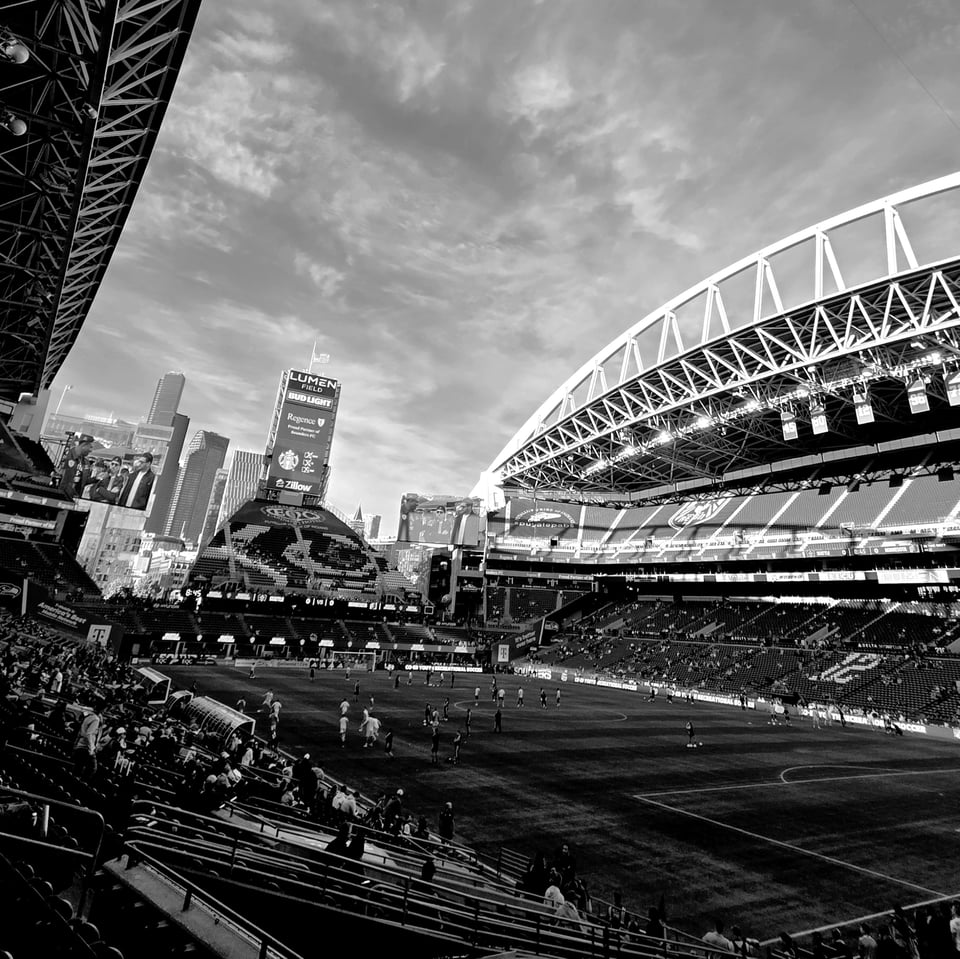
Architecturally, the building feels tailored for soccer compared to standard NFL venues. Open corners yield broad sightlines, and the field footprint fits a full World Cup pitch. These choices make Lumen Field a premier place to watch pro soccer.
But the stadium just above the architectural decisions belies the deeper truth. The center of the Seahawks logo, the eye of the osprey, is painted on the seats in the north end zone (or north touchline). Even during soccer games, the NFL is present. From my seats for Sounders games in the southwest corner, you have to look up to the right into the second deck to see the logo of the Seattle Reign on a seat-covering tarp. Women's sports are present, but they are an afterthought.
Behind that architecture and stadium design sits a legal setup telling the real story of our priorities. The financial framework presses hard on women's soccer in Seattle. When agreements were finalized, soccer became a paying tenant locked into sub-leases under a rival franchise's schedule.
Under RCW 36.102.060, state law told the Public Stadium Authority to sign a long-term master lease with one designated "Team Affiliate."
That entity was First & Goal Inc., owned in 1997 by Paul Allen and still today directly tied to the Seahawks. That policy choice put master lease control of the public complex into NFL hands. Clubs like the Reign and Sounders lack a direct relationship with the public authority, forcing them to negotiate as subtenants with Seahawks management.
The state legislation didn't cap rent, require fair revenue sharing on parking or concessions, or shield non-NFL commercial rights. First & Goal held all the leverage as master landlord. They took top revenue streams from suites, concessions, signage, and naming rights while holding primary calendar dates. Youth and amateur sports received low-cost access, but pro soccer had to take whatever market terms it could get.
The Seattle Reign feel this setup directly. Drawing 8,000 to 12,000 fans, they play inside a venue built for 68,740. They curtain off upper decks, leaving roughly 10,000 open seats visible while paying high overhead for gate staff, security, concessions, cleanup, and lighting. Modest matchday revenues struggle against high fixed costs while top income streams flow to the master tenant.
Artificial turf adds another layer of friction, raising joint wear and injury concerns for elite players. On top of that, the Reign rank third in scheduling priority behind the Seahawks and Sounders. Match dates, field access, and pitch prep stay tied to larger men's teams.
The stadium can deliver huge moments. When 34,130 fans gathered for Megan Rapinoe's farewell match, they set an NWSL attendance record. That night proved what can happen, but it didn't fix the high baseline expenses of regular matches scheduled around other events.
Compare that to the Seattle Storm at Climate Pledge Arena. Seating around 18,300 for basketball, the building fits its crowd well. The Storm secured co-anchor tenant status inside the city's redevelopment agreement with Oak View Group. Local leaders proved they can write fairness for women's sports into major civic contracts.
Voters approved the legal guidelines for Lumen Field in 1997, but the state legislature kept the power to rethink the landlord role. It made sense for Paul Allen to favor his franchise while funding a statewide election. Nothing in our legal framework stops lawmakers from updating those terms today.
Thirty years is too long to keep a static framework in a changing sports market. Major League Soccer was starting out when Referendum 48 passed, and professional women's soccer didn't exist in the United States yet. MLS and the NWSL are established leagues now. Ownership changes show the shifting landscape. Sounders ownership and the Carlyle Group bought the Reign, Neeru Khosla bought the Seahawks in August, and the original master lease expires in 2032, just six years away.
Neither the Seahawks nor the Public Stadium Authority hold ultimate control over the venue's rules. That responsibility rests with the state legislature, which wrote the original 1997 statutory framework and retains full power to update it.
Three decades ago, state lawmakers put an NFL franchise at the top of the economic pile. Today, the NFL dominates American media. Playing a 17-game schedule, the league commands most top 100 annual broadcasts and draws over $11 billion in national media rights, even while facing ongoing questions about brain injuries and domestic violence responses. We should question why public policy grants special financial favors to a team in such a wealthy league.
State leaders face a straightforward policy question: should Washington keep slanting the financial setup at Lumen Field toward a men's league that doesn't need public help? Sticking with the old arrangement holds back growing women's franchises when fairer models are already operating in Seattle.
What else you should be reading this week
I sure am glad the UW Center for an Informed Public is back at it. As the academic year begins, and election season ramps up, they are back doing quick rundowns of disinformation including pointing out how DOJ/DHS press releases on non-citizen voter charges act as "pseudo-events." Amplified by partisan media ahead of the 2026 midterms, they build a false narrative of widespread fraud, despite non-citizen voting being extremely rare.
I love discussions about geography, especially how geography is expressed in human behavior, regional personalities and policy. Colin Woodard is one of my favorite people in this regard. And this map showing four categories of communitarian vs. individualistic regions and aggressive vs. passive is fascinating. We’re aggressively communitarian by the way, despite our Freeze-ish reputation (which I disagree with anyway).
Sometimes a Great Notion really is not only Ken Kesey’s magnum opus, it is the Great Cascadian Novel, from a certain point of view. You should read it. I just picked it up again after finishing Justin Beal’s Sandfuture. I had picked up Beal’s book because I wanted to read a biography of Seattle-born World Trade Center architect Minoru Yamasaki. What I got was a book that now rivals PrairyErth in how it treats history and perspective. You should look at the email from a few weeks ago to see my opinion on that book. So anyway, Sandfuture is a rare and lucky find. Back to Sometimes a Great Notion though. This is at least the fourth read through of this book for me. When I say “from a certain point of view,” it is always important to think about is that Kesey’s perspective understands our history from a short clip in the 1960s and from what (despite his counterculture standing) still rooted in white, male insights. Nothing too deep. I really do love the book, I’m having a great time.

