
Racism in Housing in Olympia and the Importance of the Local Grind
I’ve told this story before, about how Olympia downzoned its way into a housing crisis over 40 years and rode the wave of emotion to pass an open housing ordinance after Martin Luther King Jr. was assassinated. But I bring them together this week, in the third week of Black History Month, to talk about understanding the things we can change and how that relates to the world we’re in today.
Also, this week’s episode of the Olympia Standard is unique. I usually know the topics we cover pretty well, but this was the first time, despite having four kids in Olympia schools, that I’ve looked at the district through the lens of choosing where a student would go.
Racism in Housing and the Importance of the Local Grind
As soon as Martin Luther King Jr. was assassinated, Olympia didn't look at the news. It looked inward.
It’s an interesting phenomenon, and one that feels incredibly familiar to us now. It’s the same collective gut punch we felt when George Floyd was murdered. We hit the streets, we organized, and we finally started asking the hard questions about our own backyard. In the days following Dr. King’s death, the Olympian ran a series of articles based on interviews with the local Black population. These pieces laid bare truths that we deeply know now, but they were radical to see in print back then.
In early April 1968, Black residents and activists explicitly labeled Olympia a "racist town." They pointed to the city's consistent failure to enact any kind of open housing legislation as the primary evidence. An activist named Dickson was particularly outspoken. He criticized the local hypocrisy of excluding Black people from institutions like the Elks Club while using their tax dollars to provide that same club with fire and police protection. He emphasized that the avenues normally open to any promising individual were closed to him solely because of his race.
In her research for "Blacks in Thurston County, Washington, 1950–1975" Dr. Thelma Jackson documents how systemic real estate practices actively pushed Black families out of the city centers. We often hear the local story that Black residents settled in Lacey because it was close to the military bases at Fort Lewis. Dr. Jackson’s work reveals that the steering was actually driven by legal barriers.
Because Lacey was largely unincorporated and newly developing during the 1950s and 60s, it lacked the exclusionary property deeds that barred non-whites from other neighborhoods. Real estate agents and developers capitalized on this by funneling Black buyers toward the few areas where they were legally allowed to own property. It was segregated by design, and it created a geography that persists in our county’s demographics today. Dr. Jackson notes that these obstacles forced families to find creative workarounds, like using white allies to scout and purchase homes on their behalf just to bypass door-slamming discrimination.
This was true even though these racially restrictive covenants had been legally unenforceable since the late 1940s after the Supreme Court struck them down. That didn't stop Thurston County developers. They continued to add them to deeds for at least another half-decade after the court decision. They were banking on the fact that social pressure and realtor cooperation would do the work the law no longer could.
The local real estate industry was a major point of criticism. Residents were disturbed by a trend toward "ghettos," and they accused realtors of steering Black families into specific areas while simultaneously discouraging white buyers from those same spots. John Finley noted that despite high employment, the local racial situation remained as dire as in other states. Others warned that forcing Black families into decaying, older housing would inevitably lead to state-sanctioned neglect.
Workers like Ed Chatman faced such significant difficulty finding any housing at all that activists began considering marches around City Hall. They wanted to force action against the pervasive slights and slurs that defined the community's daily life.
The path toward open housing in Thurston County in 1968 was a contentious journey. It wasn't a smooth transition. It was marked by urgent activism and fierce, vocal opposition. The movement gained real momentum in April 1968, shortly after Dr. King's assassination, when the Thurston-Olympia Open Housing Committee presented petitions with over 1,500 signatures to county commissioners.
Key organizers like Patricia Avery, Herb Legg, and Paul Whelan led the charge, and they were supported by students and faculty from St. Martin's College. Olympia eventually led the way by passing an emergency open housing ordinance on April 29. Lacey followed in late May, but only after its City Hall was jammed by proponents. Lacey's path had bumps along the road because councilmen like William C. Ryan and Thomas Huntamer questioned the need for such laws. They suggested that discrimination simply wasn't a local issue.
Opposition was often out in the open. Duke Stockton, a former teacher and self-described segregationist, was a fixture at these hearings. He argued that these laws infringed upon individual property rights. He was a true believer in being an actual racist, was a local organizer for a racist political party, and regularly spoke on a literal soapbox to rail against integration.
The Greater Olympia Board of Realtors, led by president Lee Childers, endorsed the view that fair housing legislation deprived property owners of a basic individual freedom. Mrs. Maxine Padget, a spokesperson for the realtors, argued that civil rights advocates were attempting to dominate policies even when existing rules weren't being violated.
One of the most specific fights was over the timeline for filing complaints. The proposed ordinance suggested a 50-day window for a citizen to file an unfair housing statement. The realtors pushed back hard. Mrs. Padget argued the limit should be 30 days, while Lee Childers suggested a 10-day limit. They reasoned that a long delay was unreasonable and unfair to brokers. In reality, a 10-day window would have made it nearly impossible for a victim of discrimination to gather evidence and file a claim.
Childers also argued that the real estate fraternity shouldn't be the only group subject to these regulations. He felt that any non-discrimination requirements should fall equally upon private homeowners as they did on agents. While some realtors stated they would go along with an ordinance as businessmen, they remained firm that civil rights go both ways and that the protection of property must be maintained above all else.
Legal hurdles further complicated the process. County Prosecutor Harold Koch identified numerous legal loopholes in the proposed county-wide human rights commission. He criticized it as an unenforceable gesture and accused the committee of trying to grant vigilante investigative powers to a group that wasn't part of law enforcement.
These disagreements led to a fractured system. While proponents wanted one uniform law, Tumwater eventually divorced itself from the area-wide effort by passing its own specific version. This version included blanket defenses for landowners and provisions for private hearings. Bruce Pym argued these additions subverted the entire spirit of the law. Because of these complexities, while the county adopted an ordinance in late May, they deferred action on a human rights commission for a long time.
Ten years later, this history should feel familiar. Where open housing ordinances existed, zoning and economic realities began to undercut the progress. Olympia’s modern housing landscape was forged in the late 1970s, which was a period marked by the largest influx of new residents in our history. Before this, the construction of small multi-family housing, like duplexes and quadplexes, generally tracked with population growth.
However, a series of contentious debates starting in 1976 fundamentally altered the city’s trajectory. This led to systematic downzoning that prioritized exclusive single-family neighborhoods. A pivotal moment occurred with the Nut Tree Loop proposal. A developer envisioned 21 quadplexes on what is now a neighborhood of expensive single-family homes. This project sparked fierce public opposition.
Residents expressed a fear of the urban and the potential for denser, poorer communities to enter their neighborhoods. Opponents used inflammatory rhetoric. They claimed that multi-family housing would turn Olympia into a ghetto and lead to increased crime. By 1980, despite some city leaders arguing for denser living to prevent sprawl, the city commission succumbed to pressure and began shelving plans for multi-family expansion.
Throughout the 1980s and 1990s, Olympia implemented systematic downzones that outlawed anything other than single-family homes in many residential areas. This policy transformed hundreds of existing duplexes and small apartment buildings into non-conforming units. The stated goal was to encourage home ownership, but the practical result was gentrification.
The impact on our city’s racial makeup has been profound. While we passed Open Housing ordinances in 1968 to combat explicit discrimination, the subsequent zoning laws created a different form of segregation. In the Pacific Northwest, income serves as a proxy for race. Because single-family homes are the most expensive housing type, neighborhoods dominated by them have remained predominantly white.
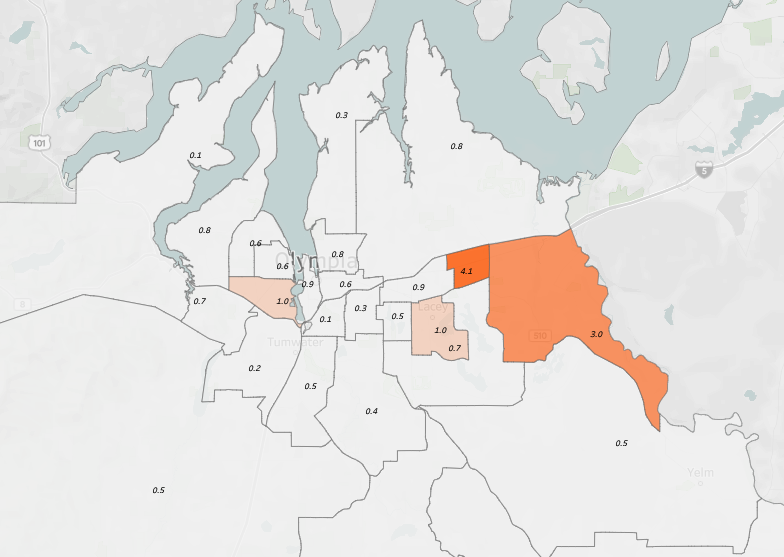
Data shows a clear correlation: the more single-family homes a neighborhood has, the higher its percentage of white residents. In recent decades, the city adopted a nodes approach to density. They concentrated apartments in commercial areas like Capital Mall while protecting single-family neighborhoods. This strategy has led to a stark racial divide. Between 2010 and 2017, the high-density node in Tract 105.1 on the westside became significantly more diverse, while the adjacent single-family neighborhood in Tract 105.2 actually grew whiter.
This isn't a unique local failing. You can see similar examples across the country of communities using downzoning as a tool to implicitly preserve racial divisions when other methods became illegal. In Arlington, Massachusetts, they once zoned for plenty of apartments. But as integration became a real prospect in the 1960s, their attitude toward development shifted. Activists used both explicit and coded anti-integration language to rally opposition to apartments and push for downzoning.
Unlike earlier efforts, our local downzoning efforts are largely absent of on the surface racial animus. I’m not saying these neighborhood activists weren’t trying to keep their neighborhoods white. I think you can draw a pretty clear conclusion there. I'm just saying there isn't much smoking gun evidence in the historical record.
However, you don’t have to look far to see downzoning tied directly to the broader civil rights struggle. When you pull back from these small-scale efforts to a nationwide view, you see single-family zoning being discussed in a much different way. When we were downzoning, the NAACP was struggling to find inroads in the courtrooms to fight against exclusionary zoning.
HUD Secretary George Romney tried to force the Detroit suburb of Warren, Michigan, to strike single-family zoning and allow affordable housing in 1970. His effort failed, and his political career ended because of it. Civil rights organizations then retrenched to fight unheralded courtroom battles over zoning in the Midwest and the East Coast.
According to the NAACP in the early 70s, the suburbs were the new civil rights battleground. They argued we should do battle in the townships and villages to lower zoning barriers and create opportunities for Black families seeking housing closer to jobs. The National Committee Against Discrimination in Housing said segregation won’t stop until local governments are deprived of the power to manipulate zoning to screen out families on the basis of income and, implicitly, of race.
In Seattle, the end result of five decades of downzoning is white-majority neighborhoods expanding across the city. One collection of blocks in the Leschi neighborhood went from over 90 percent Black in the 1970s to 11 percent today. The Black population of King County was pushed south and out of Seattle.
In Olympia, neighborhoods that downzoned saw a smaller increase in racial diversity over the last 10 years. Not only did these neighborhoods stay whiter, but in the middle of a historic housing crisis, these neighborhoods actually had fewer people living in them in 2020 than they did in 2010.
I've said this before. But it is well worth repeating: There are few open racists left. Duke Stockton's don't stalk city council meetings anymore. That is obviously an advancement in my lifetime. But you don’t have to be racist to benefit from racist outcomes and a racist system. There is a huge layer of people who will tell you they are not racist but participate in racist systems before you ever get to the people working to dismantle them.
We know the current landscape of dominant, exclusionary single-family zoning happened at the same time the last tools to legally and openly discriminate in housing were taken away. We also know the nation’s leading civil rights organizations have actively worked against this kind of zoning for half a century.
I've been writing these essays specifically this month because it’s February. I've tried to get out of my own way during Black History Month and give space to stories that highlight where we've been.
We sure do live in interesting times. It is hard for us to slow down and take a look at our context when we seem to be hurtling downhill. Every day, some new outrages and crises draw our attention away from the ground at our feet. What I am reminded of is that there is always so much to fight for here and now.
Martin Luther King was killed in Tennessee, the country caught on fire, and the right thing to do for Olympians was to finally force the passage of open housing ordinances. They were weak. They didn't address the underlying zoning. For decades, we lost the plot.
But this slow boring of hard boards in local politics is always there for you if you have passion and perspective.
It is something you can impact. You have more control here than you think.
We are tending a garden in a storm. We can’t stop the wind from blowing. But we can choose which stakes to reinforce and which seeds to protect. It is easy to get overwhelmed by massive, national debates that feel completely out of our hands, but that energy can be better spent on the hard boards right in front of us. By focusing our effort on things we can actually influence, we trade anxious, unattached frustration for tangible progress. We accept that we can't control the entire city’s direction, but we have agency over how we show up.

On The Podcast: How to Understand the Fine Grain of Olympia Schools
We are in the season where, in the Olympia School District, you can choose a different path for your kids. In this episode, we sit down with OSD4All's Erika Lari to talk about the new guide the group recently released to describe, in fine detail, all of the different programs around the district: https://osd4all.org/district-guide/
What else you should be reading and watching this week
Urban Future Farms is on this week’s episode of Washington Grown!
Independents are having their moment in Idaho. The last time this happened in Thurston County, it was towards the tail end of the Obama era when Independent ID peaked in Washington State. Since then, Democratic ID has been on a constant rise, with both Independent and Republican ID cruising downwards. To me, when Independent candidates start breaking through, it is a sign of the dominant party not addressing some need a third party might address (in a non-first past the post system) and the minority party brand being held back my national branding.
Scientists used tree-ring dating to pinpoint Mt. Rainier’s massive Electron Mudflow to summer 1507, refining previous estimates. This helps clarify its timing and causes and could improve future lahar hazard planning.
There have been a few articles lately comparing the regional culture of the Upper Midwest and the reaction to immigration raids (here and here). Colin Woodard, a source in the first link, talks about the dominant political culture in Minnesota coming from New England. The interesting part for me, and where I will pay some attention in the next few weeks, is talking abotu Woodard’s broader analysis of political cultures, and how they relate to the Pacific Northwest. He describes our region as being a mix of both New England (Minnesota) culture and that of Appalachia, which is the heart of the Trump-centric coalition right now.

