Mist and Filter: Reclaim Your Discernment
There are two groups that are opening this email today: those of you who don’t need the advice in the main post and those who recently took it.
The primary point of the main essay I wrote this week is for readers to be discerning with their media consumption and lean into non-algorithmic tools like email (hello there!) and RSS feeds. There is still plenty of history wrapped up in the piece, so very much still worth reading if you haven’t already. But, right here, I want to acknowledge that this piece was primarily written for folks who found me on a certain popular social media platform.
So, if you’re here already, thank you.
And just a quick note for those of you who joined this newsletter yesterday: In addition to the primary essay I write on Saturdays, I also share other writing I do (that may not have a local focus) and links to other things you should be reading (or in this case listening to).
Mist and Filter: Reclaim Your Discernment
This week, I want to take a step back from the usual history and politics. Instead, I want to talk about "now." I mean literally what you are doing in this moment. I want to talk about your discernment. This is about the choices you make regarding what you read or, more broadly, the media you consume.
To that end, thank you for reading this.
I want to acknowledge that most of you are probably reading this on a social media feed. My relationship with these platforms has shifted lately. I started by posting these essays directly into the feed of a platform I used to use for everything. It was my space for social updates, political debate, and personal stories. I shared different things with different circles of friends. Just about a year ago, I stepped away from that space entirely. I hid all my old content and stopped posting for a while. It was only a few months ago that I decided to share these essays there again. They also live on my personal blog and go out as an email newsletter. I'll come back to that.
I got the core idea for this essay from the second season of a podcast called Hush. It was hosted by Leah Sottile, who is one of the most talented journalists in the Pacific Northwest. If you haven’t listened to it, you really should. The second season investigates the truth behind the death of a young woman in rural Columbia County, Oregon. If you live near me in Washington, this place feels very familiar. It is a lot like Mason, Grays Harbor, or Pacific counties. These are rural areas that are poorer than the I-5 corridor. They don't have large, suburban towns. Life there is stretched out across long roads lined with commercial timberland. Curiously, these communities are not always supported by timber jobs anymore. The trees are there, but the steady payrolls often aren't.
The most important part of the series looks at how news moves through these towns. We live in a society that has largely moved past the daily physical newspaper. Several episodes of the podcast discuss how media is changing during this pivot point. We are stuck between the death of the local paper and the rise of what we loosely call social media.
In places like Columbia County, the information landscape feels a lot like the weather. When the local paper fades, it doesn't leave behind a clear, empty space. It leaves a mist. Information becomes hazy and hard to pin down. You can see the outlines of what’s happening in your town, but the details are blurred by rumors and social media chatter. This mist makes it difficult to know where the solid ground of a fact ends, and the fog of a theory begins. This is the definition problem we’re stuck in: we are trying to navigate a new world using old maps that don't account for the weather.
The Problem With Definitions
We have a definition problem right now. This is why I don't trust most polling about where people get their news. A typical poll asks a simple question: "Where do you get your news?" The results usually show that fewer people say "the local newspaper," while more people say "social media." This is a shallow way to look at the world. These polls offer almost no context on what "social media" actually means to the person answering.
Think about the variety of that term. Does it mean a well-funded influencer who speaks at political rallies but sues when institutions don’t treat them like a journalist? Does it mean a post from your cousin Ray? Does it mean watching short videos made by a former Washington Post reporter who now works for themselves?
The term "social media" is too blurry. At the same time, the term "newspaper" has become too specific. We need better ways to describe what is happening. We know what newspapers are because we remember what they used to be. As recently as the mid-2000s, if you lived in a medium-sized town and said "the newspaper," people knew what you meant. You were talking about a well-staffed organization. It had reporters for different topics. It was usually owned by a chain, which meant it had professional human resources and legal standards. It had at least two layers of editors to steady the tiller. There was a business office for ads and subscriptions. Usually, there was an executive who cared enough to go to the Kiwanis or Chamber meetings.
That is not what people mean today. Most of those business functions now live in a different city or state. A local paper might only have three or four reporters left. These people have to cover everything at once. If there is still an editor who lives in the actual town, they are likely overwhelmed. They have no local support to help them make tough calls.
A newspaper used to be an institution. Now, at best, it is a small operation. Those are two very different things. One is an anchor for a community. The other is just a branch of a business trying to stay afloat. They are fighting one small battle in a world war thousands of miles above us.
The Physics of Friction
Social media is just a tool. It is often used poorly by the ghosts of local media companies. However, it is used very effectively by people who want to spread anger or misinformation. Our current media mess is actually rooted in how newspapers started in the United States in the 1800s.
I often talk about the history of the press. Most papers used to be proudly partisan. In its early days, my local paper, The Olympian, called itself a Republican newspaper. The idea of a neutral, non-partisan press supported mostly by ads is a relatively new invention. It feels old because it is what our parents grew up with. They remember it as "the way it always was." Because of that, we treat the loss of the neutral paper like a lost inheritance. We view it the same way we view walkable downtowns.
We didn't lose downtowns by accident. We built Walmarts, malls, and massive parking lots to replace them. We leveled parts of our city centers to make room for cars. We wanted people who lived in far-off neighborhoods to be able to drive in and park easily. We chose convenience over community.
We did the same thing to newspapers. As social media platforms grew over the last twenty years, they started eating the ad sales that kept newspapers alive. Eventually, two or three large platforms became the only way for businesses to reach people. This happened so fast that ad buyers didn't have a choice. Why would a local business struggle to buy a print ad or obscure banner ad when they could just put a digital ad on a platform that targets everyone instantly?
The platforms didn't just take the revenue. They changed the visibility of our communities. In the old days of the partisan press, you knew exactly where a paper stood. It was bright and clear, even if it was biased. Now, the algorithms have created a digital mist. We see what the system wants us to see, filtered through a logic we aren't allowed to understand. We’re wandering through this mist of recommended content, losing sight of the local landmarks that used to keep us grounded. We’ve traded the friction of the sidewalk for the phantom images of the feed.
The adtech systems owned by Google might be broken up soon. In April 2025, a federal court ruled that Google holds an illegal monopoly over the technology used for advertising. This case has moved into a high-stakes phase to decide the punishment. The Department of Justice wants Google to sell off parts of its business to make the market fair again. Google says this is too extreme. A judge is expected to make a final decision later in 2026. This will likely lead to years of appeals.
Following this victory, thousands of publishers are now suing for billions of dollars in lost revenue. Late last year, a court made things easier for them. These publishers no longer have to prove Google is a monopoly because the court already decided that. Now they just have to prove how much money they lost.
Even if the publishers win, the results might not help your local town. The money will likely go to the large companies or private equity firms that bought up the papers years ago. They are the ones left holding the bag.
The real goal should be changing the economics of media. The way this information gets paid for is the most important part. When you put all of the attention economy into one giant bucket, you stop caring about the quality of the content. You just want people to keep looking at the screen. Anything that makes it easier to keep scrolling is good for business. Anything that makes you stop and think is bad for business.
The current system is a filter. That filter is designed to boost ad sales. But a local institution is based on friction. Friction, in this case, is local knowledge. It is human-scale.
Jane Jacobs described the importance of the relationships that exist when you can walk down the street to a local store. You might go there to grab some apples. You talk to the person behind the counter. That is a human interaction. It is different from ordering apples online and having a stranger in a car drop them at your door. The walk and the conversation are friction" but they are also what build a community.
The Choice to Look Away
When I looked at the history of the towns in the Hush podcast, I was surprised. I expected to find old partisan newspapers because that is usually the case in the West.
I wanted to write about how we have seen this shift before. I wanted to show how old partisan papers had been the "steamrollers" that destroyed the media landscape that came before them. Eventually, those papers grew up and became responsible to their towns.
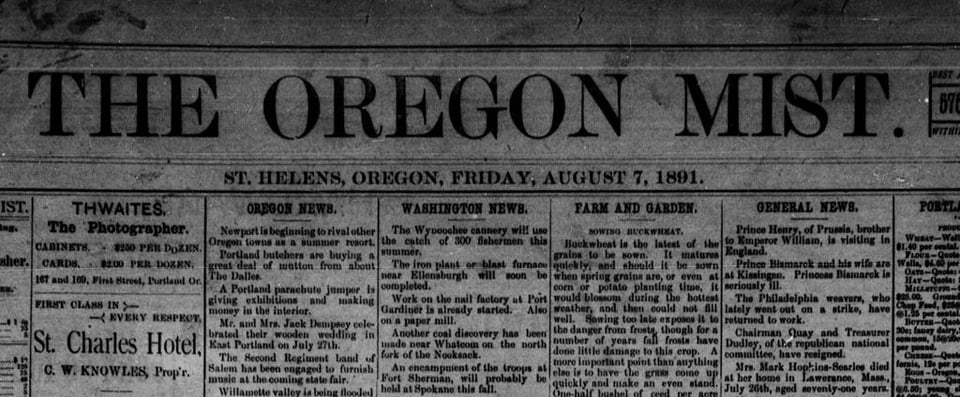
But in Columbia County, I found a newspaper that just wanted to be fair. In 1891, the editor of the Oregon Mist wrote a letter to his readers. He said he would give them the best paper his limited budget allowed. He asked the public to help by sending in reports of what was happening in their neighborhoods. He invited people to discuss matters of general interest. But he also said he would reject letters that were "radical and personal" in nature.
Think about that filter. This editor wasn't an algorithm. He lived in the community. You could see him on the street. You knew where his house was. If you disagreed with him, you knew where to find him. The entire information system was built on a foundation of trust.
Maybe this is why my town, Olympia, used to have several different newspapers at the same time. They served the same people and covered the same news. They just did it at different speeds. People trusted those papers because they knew the people writing them.
As I said, you are probably reading this on a popular platform. I have gotten into the habit of posting on this site again. But it has been a long time since I tried to show my whole life there. I stopped posting about my family. I hid my old photos. I realized that the platform was asking for too much of my personal life in exchange for engagement. I couldn't do that anymore.
I am posting these essays as an experiment. And since starting, it seems like people enjoy the weekly updates. I am grateful for that. But I am also going to ask you to do something strange.
I want you to stop. Please stop depending on an algorithm to tell you what to read. Use your own mind to decide what content is worth your time. I think you should do two specific things.
First, subscribe to my email newsletter. I will send you what I write every week. I will also include my podcast. You have an email address for a reason. Use it to take control of your reading habits.
Second, you should look into an RSS reader. These are older tools from the earlier days of the internet. They are very simple. They collect content from the websites you choose and show it to you in order, from oldest to newest. I have been using one for over twenty years. It is like a podcast app, but for reading. It allows you to subscribe to a website without giving that site your personal data or letting an algorithm get in the middle.
This is about discernment. We don't really know what is happening inside the code of these big platforms. I won't use the word addictive, because I am not a doctor. But I will say that it is not healthy to let a company you don't know decide what information enters your brain.
Editors used to be the gatekeepers. In a perfect world, you knew the editor. You could judge their work. You could tell them they were wrong. An algorithm is different. It doesn't exist as a person you can talk to. You can't hold it accountable for the mistakes it makes.
We need big changes. We need to break up monopolies. We need to make these platforms more transparent. Those are systemic problems. But you can take individual action right now. You can choose to find your news and your essays directly. You can subscribe to a newsletter and never like or comment on a social media post again. That is how you break through the mist and reclaim your own attention.
Me Writing in Other Places: Irish identity for an American on the West Coast in the current moment
This is an essay I wrote last year, meditating on Irish-American identity before St. Patrick’s Day, as we moved forward past the Presidential election. I think the message is still pretty much the same.
What else you should be reading this week
A lot of Boomer history on the reading list this week. First, how Seattle’s first marijuana initiative had roots in Olympia.
OlyWA Days of Change continues to stand alone as the best Olympia History Project ever. This week, Carolyn Byerly takes us to the history of SafePlace.
If you're not listening to KUOW’s Adults in the Room, you're missing a lot. The series is four episodes in, and it explores a Seattle School District crisis from a couple of decades ago, over abuse by a respected Garfield High School teacher. There are so many issues that the show takes a glancing look at, including race and busing. But I am shaken by the description of how fiercely communities and institutions attack those seeking accountability from the powerful.
Excellent service journalism from a publicly funded reporter: When forests become financial assets for investors, ownership loses its connection to place. Gates break the relationship between land and community, turning shared landscapes that once sustained local traditions like hunting into private assets.

