
Which pop cultural artifacts will endure?
There’s real value in having shared cultural touchstones. And we're losing that.
I was watching an old episode of “Law & Order” recently. In it, several people die from the flu because a scam artist had labeled viles of saline solution as the flu vaccine and then sold that to doctors in an off-market deal.
Those doctors then gave the vaccine (or what they thought was the vaccine) to their highest risk patients who were immunocompromised. Because those patients weren’t protected, they contracted the flu and died.
So the district attorney, Jack McCoy, prosecutes said scam artist. There’s a great moment in the trial during McCoy’s cross examination of the guy:
McCoy: You just testified that you didn’t think there was much risk connected to your ersatz vaccine.
Scammer: I didn’t think so, nothing substantial at least.
McCoy: You didn’t think that what you did posed any substantial risk, is that your testimony?
Scammer: Yes.
McCoy (pauses): Did you ever see an old movie called “The Third Man”?
(The defense attorney objects. The judge raises an eyebrow.)
McCoy: The defendant says he couldn’t foresee any substantial risk to his actions. I’d like to explore that state of mind a little further.
(The judge allows it.)
Scammer: “The Third Man,” with Orson Welles. It’s been a long time.
McCoy: Orson Welles plays a blackmarketeer who steals penicillin and then dilutes and sells it with tragic consequences: Death, amputation, children die.
(Another objection!)
McCoy: It’s a parallel situation, your honor, I think the analogy is apt.
(The defense attorney is overruled.)
McCoy: There’s a famous scene on a ferris wheel.
Scammer: I remember that scene.
McCoy: Orson Welles goes for a ride on a ferris wheel with his friend, and it stops when they get to the top. And his friend, who’s played by Joseph Cotten, asks, “Why? Why did you do this?” Orson Welles says, “For the money.”
Joseph Cotten is horrified: “Have you no conscience? How do you live with yourself?”
Orson Welles points to the people on the ground far below. And the people on the ground are very small, walking around in the square. And Welles says, “Would you really feel anything if one of those dots down there suddenly stopped moving?”
This is the scene they’re talking about:
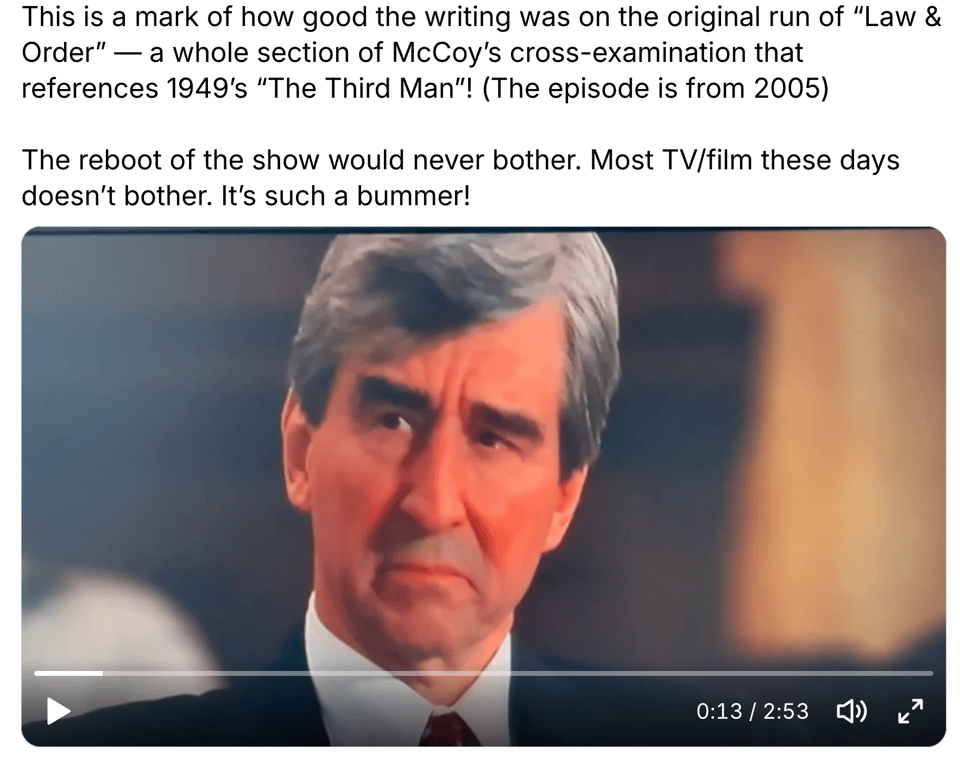
I’m not sure when I first watched this episode of “Law & Order,” but I’ve seen it countless times. And I’m always struck by the exchange because it’s so unusual to see an older film referenced like this in a legal drama. It’s memorable and an indication of how good the writing often was in the original run of the show — and how much of that is lacking in the reboot.
I posted a clip of the scene on BlueSky, noting that, right now, it feels conspicuous that TV and film do not reflect the reality that older pop culture still comes up all in the time in real life conversations.
Someone then responded that, no, of course not:
No one under 40 has seen “The Third Man.” It's on no popular streaming service. Many of them find it difficult to watch black-and-white films.
First of all, this person is wrong. “The Third Man” is not only on a popular streaming service, it’s on a free streaming service: Tubi.
“The Third Man” came out in 1949, which means the “no one under 40 has seen it” line is also off. The movie came out 77 years ago. Chances are, most people have not seen the film, unless we came across it on TCM.
So what, though?
Guess how I learned about “The Third Man”? By watching this episode of “Law & Order”!
It originally aired in 2005, which is, coincidentally, the same year YouTube launched. For viewers of the original broadcast, it may not have been easy to find that scene online, but the internet certainly existed. The joy of falling down a rabbit hole is looking up something you’re unfamiliar with and getting a little smarter in the process!
It’s also worth noting that in the 20-plus years since the episode first aired, there are currently at least four versions of that famous clip on YouTube.
But even if you never bothered with any of this, the way that cross examination is written on “Law & Order” tells you exactly what happens in the scene from “The Third Man.” It’s not just an aside where, if you know, you know — and if you don’t, too bad.
The episode takes the viewer’s hand and walks us through it.
When does it not work as well?
“The Pitt” took a different approach this season, with an exchange between two doctors that references both the 1995 movie “Babe” (about a farmer, played by James Cromwell, and his pig) and “Gilligan’s Island” (the 1960s sitcom about a pleasure boat skipper, his hapless second mate and the daytrippers with whom they are shipwrecked indefinitely).
But the scene doesn’t do the work of explaining either the film nor the show, the way that “Law & Order” did with “The Third Man.”
So perhaps, not surprisingly, some of the show’s very involved, possibly very young fandom did not know what to make of these references. Someone posted a clip of the scene and said: “What is this argument?” Someone else chimed in: “Literally came out of nowhere and I had no idea what they were talking about. There’s barely even subtext here, like wtf was this?”
“Babe” is far from an obscure movie; it was nominated for seven Oscars, including Best Picture. And while Gen-X and Millenials weren’t around for “Gilligan’s Island” in its primetime run, the show was a constant presence on TV via reruns, and later as a staple on Nick at Nite. These are shared references many people understand because, even if you didn’t watch the shows, you absorbed an awareness of their existence through pop cultural osmosis.
Younger generations aren’t encountering reruns at all because they’re not flipping through TV channels looking for something to watch. Streaming — with everything available on-demand — means that sense of discovery now works differently, if it happens at all.
Which is why I’m so curious about how younger people do, or don’t, become familiar with pop culture that was made before their time, be it film, TV, music, books, or video games (I’m still amazed my parents bought Pong back when it first came out; we were not video game people!).
Does the current setup discourage an interest in things that came before their time? Or are they simply entering pop culture’s expansive history in different ways, from different starting points?
The unstoppable force that is the original “Devil Wears Prada” meets the immovable object that is Gen-Z (and younger)
“The Devil Wears Prada” came out in 2006 and has been a staple on TV ever since. I think that’s how I actually saw it, probably on HBO. At home. Not in theaters.
The movie has had staying power for a few reasons — never underestimate the power of memorable, quotable dialogue! — and has lived on in memes, gifs and that one scene where Meryl Streep’s ice-cold magazine editor instructs her new assistant played by Anne Hathaway on the ways in which clothing sold in chainstore retailers is determined by decisions made in that very office.
A sequel was inevitable.
“The Devil Wears Prada 2,” with a budget rumored to be $100 million, opened in theaters last week, bringing in $233 million globally at the box office. Women made up 76% of the audience.
But — and it’s an intriguing “but” — only 12% of women under the age of 25 were among those moviegoers. (Men under 25 were even fewer, at 2%.)
This doesn’t surprise me, though. It probably doesn’t surprise you, either. People under the age of 25 likely have little or no awareness of the movie. It was made before they were born and therefore it is old.
It’s surreal to think that “The Devil Wears Prada” is so ancient in pop cultural terms as to be off-the-radar for a significant number of young adults.
This didn’t used to be such an albatross! The osmosis I referenced was doing so much work for previous generations.
And I think that’s gone for good. Which is a shame.
I’m not even arguing that the first “Devil Wears Prada” is special enough that it should endure longer than it already has. I’m arguing that it’s a well-made movie on pretty much every level — and that kind of quality is becoming a rarity. I want younger generations to see the 2006 version of “The Devil Wears Prada” because I want them to see what a movie looks like when it has the right pacing, a witty script, equally witty performances, a story that has something to say, plus a delicious production design. I want them to be able to recognize these traits going forward — or recognize when they’re missing.
That’s media literacy, as well.
Understanding references
The Apple TV musical comedy series “Schmigadoon” ran for two seasons and was created by Cinco Paul (who wrote the songs) and Ken Daurio.
It’s about a young couple (Cecily Strong and Keegan-Michael Key) who are out hiking one day, when they get lost and find themselves in a place populated by people who seem an awful lot like … well, characters from musicals. In the first season, they are mid-Century Broadway musicals like “Oklahoma” and “The Sound of Music.” In the second season (which I preferred) it’s musicals of the 60s and 70s, including “Cabaret” and “Chicago” and, in an entirely different stylistic vein, “Hair.”
The first season has since been adapted into its own Broadway musical and is nominated for 12 Tony Awards this year.
To fully enjoy the campy pleasures of “Schimgadoon” requires at least a familiarity with the musicals it’s lampooning, starting with the title itself, a riff on Lerner and Loewe’s “Brigadoon” from 1947, later adapted into a 1954 movie from director Vincent Minnelli.
Maybe you never saw these musicals on stage. But nearly all of them were also made into movies that used to appear on TV semi-regularly until the last decade or so. But none are obscure, and you can still find them pretty easily. 1972’s “Cabaret” is free on Tubi. You can rent “Brigadoon” for $4 on YouTube.
“Schmigadoon” functions like a game of Name that Reference. The thing is, that’s a fun game.
I am curious, though, when the Apple show premiered in 2021, if it drew a measurable Gen-Z audience. Because very little here probably lands. And yet for older generations, even if you’re not into musical theater, you probably have a casual awareness of at least some of these titles. If nothing else, at least an awareness of Rob Marshall’s “Chicago,” which was made more recently — in this century! — winning the Best Picture Oscar in 2003.
But for anyone born in this millennium, 2003 was literally a lifetime ago.
My obsession with osmosis
I’ve never seen an episode of “Bonanza,” the TV western that aired for 14 seasons from 1959 to 1973. And yet I can sing the tune to its galloping theme song if asked. Why? I have no clue. But somehow it made its way into my consciousness.
When I was a kid, HBO aired a version of Neil Simon’s 1963 newlywed comedy “Barefoot in the Park.” It wasn’t the 1967 movie, starring Jane Fonda and Robert Redford, but a filmed version of a 1981 Seattle production starring Bess Armstrong and Richard Thomas.
There’s a scene where a worker from the phone company arrives to set up their line in the apartment. Their new number? Eldorado 5-8191.
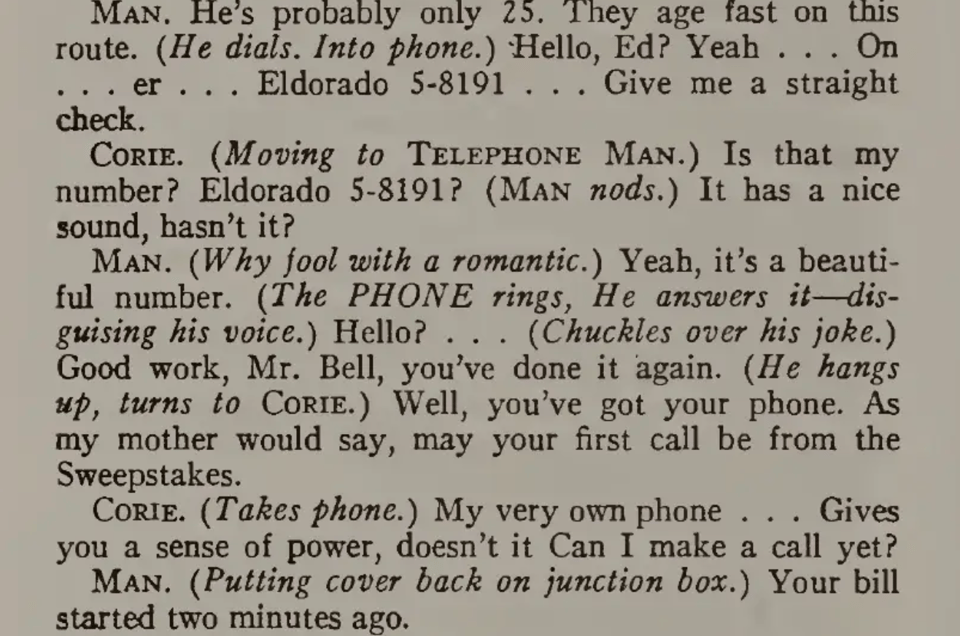
The Seattle production of the play was modern dress — set in the 80s, in other words — but they didn’t change the script, including the old way of styling phone numbers, which contained a combination of letters and numbers.
I’d never heard of that before! But context clues did a lot of work; clearly this was how phone numbers existed at some earlier point in time. Huh. OK!
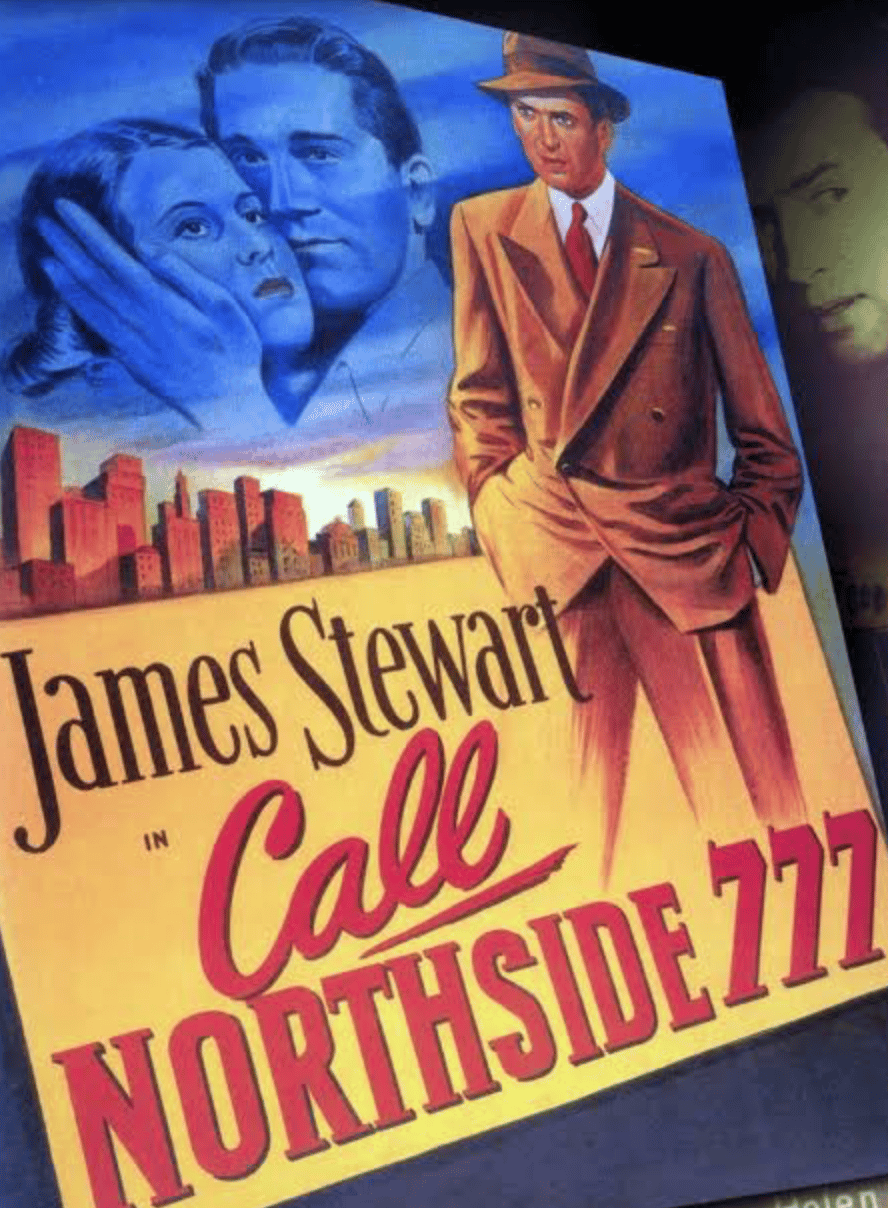
And that’s why, when I later encountered the 1948 James Stewart Chicago-set noir “Call Northside 777,” I understood that the title is referencing a phone number.
Here’s an explanation from Mental Floss, which uses Lucy and Ricky Ricardo’s phone number from “I Love Lucy”: Murray Hill 5-9975.
The Ricardo’s MUrray Hill5-9975 meant their number was 685-9975 (“Hill” and its capital H served purely as a mnemonic), with the 68, or “MU,” representing the east side of Manhattan’s telephone exchange. This is also why phones still have letters over the numbers.
Full words were used to help customers remember the telephone exchange name, and because they were easy to understand, especially for switchboard operators. Similar-sounding letters would cause confusion, so distinct names or phrases were preferred. The specific words used to identify the two-letter codes weren’t standardized, but rather recommended by AT&T/Bell in their Notes on Nationwide Dialing, 1955, which was distributed around the country as people started to make more and more long-distance calls. You can see the list of names for each telephone exchange here.
I love learning about historical artifacts and footnotes!
It’s possible that I might have learned this bit of trivia about phone numbers some other way. But it’s so fun — so easy — when a TV show or film introduces you to something that feels novel.
AI might just make this a moot concern
Someone recently recirculated an old Variety interview with “Avengers” director Joe Russo, wherein he makes a prediction about AI:
“Potentially, what you could do with [AI] is obviously use it to engineer storytelling and change storytelling,” Russo said. “So you have a constantly evolving story, either in a game or in a movie or a TV show. You could walk into your house and say to the AI on your streaming platform. ‘Hey, I want a movie starring my photoreal avatar and Marilyn Monroe’s photoreal avatar. I want it to be a rom-com because I’ve had a rough day,’ and it renders a very competent story with dialogue that mimics your voice. It mimics your voice, and suddenly now you have a rom-com starring you that’s 90 minutes long. So you can curate your story specifically to you.”
He’s envisioning a world where everything is so tailored to each individual person, we have no shared references binding us together. Just a million permutations on fragments of ideas and old IP.
Now granted:
When asked in “how many years” AI will be able to “actually create” a movie, Russo predicted: “Two years.”
That was in 2023. So his prognostication, at least up to now, has been dead wrong.
I don’t think audiences actually want to sit down and order up their entertainment like they’re ordering a meal.
We’ve seen a mild form of this with streaming and the indecision that descends when you find yourself endlessly scrolling for something to watch.
It was easier when shows were just "on" at certain times and all you had to do was get yourself in front of the TV — or get yourself to the movie theater — and the rest was done for you.
Cultural touchstones
There’s real value in having shared touchstones and a shared body of knowledge. Because the accumulation of this knowledge has cultural meaning. When entities encourage us to exist disconnected from lives and artistic output that came before us, we become that much easier to manipulate.
I don’t know how much, or in what form, this existed in centuries past, before mass media. Oral traditions were probably important. Maybe bible stories and religious rituals were most influential because they were ubiquitous and reinforced through repetition.
But from mid-19th Century on, when literary magazines and newspapers were publishing novels in serialized form — think Charles Dickens and Mark Twain and so many others — perhaps that created a larger collective awareness of pop culture of the moment.
The birth of cinema meant so many of those stories were then adapted to the screen decades later, extending that timeline of awareness.
For a long time, the core curriculum in schools included many of these same books. More recently, the dead white men curriculum no longer dominates, which is good. But perhaps it has also led to a fragmented awareness of certain stories, of which we once assumed most people would have a working knowledge.
There are fewer external prompts that introduce us things that came before our birth. And that narrows our understanding of … well, everything.
Ted Turner’s legacy
The media titan Ted Turner died this week at 87 and I want to direct you to a piece by the critic and film journalist Kristen Lopez, whose website (and newsletter; subscribe, it’s good stuff!) can be found at The Film Maven.
One of Kristen’s areas of expertise is classic film, so I was interested in her thoughts about Turner, who founded Turner Classic Movies, aka TCM, in the 1980s:
I want to eulogize Turner through the network that brought classic films to audiences everywhere, and whose future still feels shaky in the wake of another upcoming corporate merger. Without Ted Turner, bare minimum, we wouldn't have a TCM to remind us why classic films matter while fighting to preserve them.
TCM is where I first watched 1957’s “A Face in the Crowd” about the corrupting influence of fame, the accumulation of (a very tacky kind of) wealth — sound familiar?? — and political wrangling sans a moral compass. It’s directed by Elia Kazan, from a screenplay by Budd Schulberg.
At the story’s center is a phony and a huckster (Andy Griffith, playing against type) who is all too eager to sell his soul. Works out well for the guy, too — the TV viewing public happily swallows his bullshit and he becomes a star. For anyone familiar with the movie, it’s one that’s come to mind during both of Trump’s administrations. Also, Walter Matthau is in it, which is reason enough to watch any film. And guess what — it’s also free on Tubi. Go watch it! Amazing movie that’s cynical as fuck! Makes “Succession” look tame by comparison!
But I don’t know that I would have known about it without TCM airing it one night. It’s so easy to watch older titles when they’re just on.
Here’s more from Kristen’s piece:
Turner, in a lot of ways, was the ultimate classic film fan. In the mid-1980s he acquired the MGM catalog, including a host of pre-1950 films from Warner Bros., RKO and MGM. Turner wanted to find a way to both preserve the movies he'd acquired, while also giving others opportunities to see them. Can you imagine if Turner had just decided to release on them on physical disc a few times and that's it? Unlike most linear cable channels, which spend a majority of their budget on licensing content (think of HBO in the 1980s), TCM immediately started with a strong amount of content it already owned, keeping costs down.
More importantly, Turner seemed to genuinely care about the movies themselves. Watching the splashy day TCM premiered in Times Square in 1994 you see Turner flanked by classic film stars like Jane Powell, Arlene Dahl, Van Johnson, and Celeste Holm. The look on his face is one of genuine joy. Couple that with the first few years of TCM. The set Osborne used for his intros and outros doesn't look expensive, but homey. Turner understood TCM was meant to be an extension of the living room, a place where audiences could watch these classics with someone, like [host Robert] Osborne, who might have been watching in his home as well. Commercial free, the interstitials and interviews had a similar nostalgic feel while presenting in-depth interviews with performers from that time (many of whom were still alive).
You can read Kristen’s full piece here.
Vulture’s Josef Adalian also writes about Turner’s influence this week, and made a similar point but from a different angle, referencing’s Turner’s TBS cable network, noting that it doesn’t usually get talked about in the same way as Turner’s other creation, CNN, but:
… its impact was significant, particularly on Gen-X kids who were the first generation raised on cable. Before Viacom carved out a niche for retro TV with Nick at Nite and TV Land, Turner’s Superstation served up a steady diet of syndicated sitcom reruns every morning and afternoon. While local TV stations also had reruns as part of their programming schedules, TBS was the first to supersize the idea and nationalize it with two- and three-hour blocks that were gussied up with interstitial promos and branding. What was a trip down memory lane for boomers was how kids and teens of the 1980s first got into shows like “Gilligan’s Island,” “Get Smart,” and “The Andy Griffith Show.”
I’ll end with a simple thought:
The world can become a very small place if you only interact with — only think about, and seek to encounter — things that were made during your lifetime.