
Should amoral characters pay for their crimes?
Audiences might be unintentionally pining for the days of the Hays Code, or maybe they're responding to something else.
From the mid-1930s through the late 1960s, certain things were officially considered off limits in the movies. Sex, nudity, profanity, interracial relationships, graphic violence, drug dealing and ridicule of clergy were all considered unacceptable.
That’s because movie studios followed content guidelines outlined in the Motion Picture Production Code, more commonly known as the Hays Code, after Will H. Hays, who was president of the precursor to the Motion Picture Association of America (MPAA).
The Hays Code wasn’t devised by a government entity, but by two Catholic men — one the editor of the Hollywood trade Motion Picture Herald, the other a Jesuit priest — who were concerned about the influence movies were having on children. Studio heads agreed to adopt their guidelines as a way to circumvent any campaigns that might call for government-mandated censorship. We’ll do it before anyone passes a law that makes us do it, was the thinking.

The Hays Code was paternalistic, misogynistic and detached from reality. But even with it, characters were allowed to make terrible choices. Just off the top of my head, in the 1942 Katharine Hepburn-Spencer Tracy romantic comedy “Woman of the Year,” her character adopts a child refugee from Greece as some kind of bandage for their fraying marriage. He’s not into the idea and returns the kid to the orphanage like he’s returning an unwanted item of clothing to a department store. If you think this behavior isn’t odious — from two characters we’re supposed to like and root for! — well, you’re not paying attention.
I’m not in favor of any restrictions, but I don’t disagree with the broader, more general premise underlying the Hays Code, which is that the media we engage with can shape how we think and talk about the world.
By the 60s, a number of factors (including a power vacuum at the MPAA) contributed to the chipping away and eventual abandonment of the Hays Code, when it was replaced with the MPAA rating system (R, PG, etc.).
That’s widely seen as a good thing. Filmmakers should be able to tell stories that aren’t sanitized or idealized. People engage in all kinds of vice, so what? Sex is part of life, why pretend otherwise? And just because something is shocking or disturbing doesn’t mean a movie shouldn’t portray or contend with it.
I bring this up because the Hays Code was mentioned in a social media post that caught my attention.
I’m cropping out the person’s name because this isn’t a dunk, but an opportunity to think more deeply about the premise put forth:
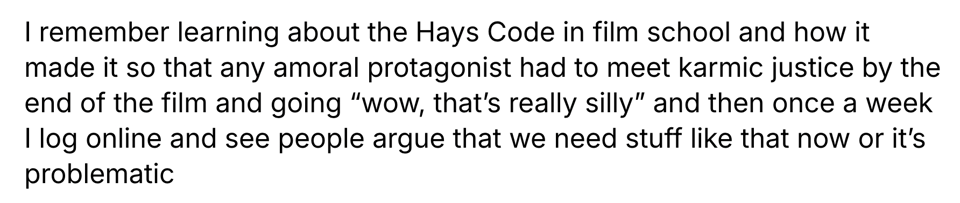
Here’s what this person is referring to: The Hays Code didn’t want movies to glamorize crime or “create sympathy” for those who violate the law.
Even when the code was in its infancy, people were rolling their eyes. The Nation ran a piece pointing out the obvious issues of equating the idea of the “law” (which can be punitive or unfairly applied) with “justice,” and it’s obvious how quickly this can become a problem for storytelling.
The Hays Code was corny and prudish! So I get why a rule ensuring that amoral characters are punished by the end sounds “really silly” and why this person is baffled (annoyed? disgusted?) that anyone would want a return to that.
Except, I have a theory! A few theories, actually.
But here’s the main one:
The reason some audiences aren’t saying “wow, that’s really silly” to such a square idea — of comeuppance or consequences or getting a taste of their own medicine — is because it doesn't feel silly.
In fact, it feels very important right now, but weirdly rare and mostly absent from the stories Hollywood has been greenlighting.
Over the last couple of decades, TV and movies have been especially enamored with the antihero, to the exclusion of other kinds of protagonists. When there’s not a good mix, I do think it can start to feel off, even subconsciously.
You could argue TV and film are just reflecting reality. People who do terrible things in the real world don’t suffer consequences most of the time, not if they are rich and/or powerful. And these fictional stories are mirroring that.
I don’t have an issue with that.
But I do think it’s become the predominant mode of storytelling, so much so that it feels unrelentingly pessimistic and people are responding to that.
Let me pause for a moment to mention a different social media post I saw recently, which is a transcript of an absurdist deposition with a DOGE employee who is unable to tell the questioning lawyer what DEI means:
This is absolutely hilarious and deserves a Veep-style TV adaptation.
— Melanie Walsh (@mellymeldubs.bsky.social) March 09, 2026
The exchange is ridiculous. But I want to push back on the knee-jerk reaction that it “deserves a Veep-style TV adaptation.” TV has absolutely primed audiences to think we need this reflected back to us through the prism of comedy — not to better understand it (because what’s not to understand here?) but simply to acknowledge its existence.
I think there are more interesting ways to process the moment we’re living through and I suspect that’s actually what’s eating at some audiences too.
It’s possible some of the criticisms, which sound moralistic — like a return to Hays Code era restrictions — are more about an expression of frustration with an abundance of fictional stories that show the worst of the worst getting away with it every time.
That’s the prevailing reality we are currently living in. So I can understand why people see that repeated in fiction and think: What the fuck? Are screenwriters capable of having any other ideas?
Yes, of course they are! That question should be leveled at the studio executives who determine what gets made.
I was thinking about the 2007 legal thriller “Michael Clayton” the other day. Even though (spoilers for a 20-year-old film) the attorney for a corrupt conglomerate gets got at the end, writer-director Tony Gilroy’s movie is not widely considered corny. Because it’s not corny. A “truer” conclusion, perhaps, would have gone another way. But this is the story of a fixer for a high-end law firm (played by George Clooney) who sold his soul long ago, but has finally become disgusted enough by the constant parade of moral compromises his life has become to do something different for a change.
That story can be true, too. And there’s nothing silly about wanting TV and film exploring that some of the time, too.
Why else might people be clutching their pearls when amoral characters get off scot-free?
Because some of the people posting these thoughts are just young! And they’re working through their ideas in real time on a public facing platform, instead of in the privacy of someone’s home or dorm room.
People have always argued about movies. That’s good, movies should provoke reactions. But I think certain sentiments or opinions can seem more widespread than they actually are by virtue of social media’s funhouse mirror effect, which distorts just how widespread certain viewpoints are. Often, you only need a small number of users to create those perceptions.
I also think media literacy is a skill that’s become diminished. How to recognize and understand symbolism, theme, allusion, intentional contradictions. Even the ability to focus on (and therefore comprehend) a story. This makes conversations about TV and film shallower than they could be.
Reduced media literacy also means a lack of shared references. Younger generations haven’t been passively exposed to pop culture that existed before their time in the same way older generations were, so there’s not always a sense of context — of filmed stories and tropes existing on a continuum that’s existed for 100 years. There have always been trends and reversals and exceptions to every rule.
But back to my original theory:
Sometimes you just want to see a fictional person experience consequences for their shitty actions!
It happens so rarely in real life that I think we really pine for that. We need that right now. There may be an absence of fair play in reality, but it’s not wrong to want to experience some of that in our fiction.
So what is Hollywood interested in?
A lot of wealthaganda is being pumped out right now where there are zero consequences for vile actions. Why wouldn’t people find that dissatisfying?
Consider this recent report:
Staff at the nation’s largest Immigration and Customs Enforcement detention facility have placed bets on which detainee will be the next to die by suicide, according to new reporting from the Associated Press based on 911 calls and detainee accounts.
I think audiences see this happening in the real world and are troubled by yet more jaded, fictionalized portrayals of the people who set these kinds of horrors in motion.
It's somehow seen as "cooler" to take the "Succession" approach, where the cruelest among us are never brought to their knees. Fiction can — and I would argue should — envision ways that the status quo might be challenged.
I'm not saying you can't show characters being terrible. But I do think an unrelenting cynicism that no one will ever be held accountable does bother people.
“Andor” is the one counterexample that frequently gets mentioned. And I always have to gently remind folks that out of 400-500 scripted series made each year, we should find it troubling that only one show — one! — comes to mind.
Besides, Hollywood is still self-censoring anyway. The head of Pixar recently told the Wall Street Journal that the studio cut the LGBTQ storyline from 2025’s “Elio” because it didn’t
want to expose its young audience to things they weren’t ready to see or hadn’t discussed with their parents. He said, “We’re making a movie, not hundreds of millions of dollars of therapy.”
This is the most succinct response I saw to that company line:
btw about that pixar thing, the reason why these people think having a conversation about gay people with kids is difficult is because they don't know a way to say to their kid "gay people are normal but you are not allowed to be one" without sounding like a bigot (there is a reason for that)
— Lina. (@rabbitlegs.bsky.social) March 08, 2026
What’s the alternative to antiheroes?
Gennifer Hutchison was a screenwriter on “Breaking Bad” — one of the more celebrated antihero TV series in recent memory — and she’s pushed back on the idea that only “bad guys” are interesting characters, both for writers and audiences:
I see folks dismissing “heroes” as boot-licking, prissy rule-followers, while characterizing “villains” as the marginalized fighting oppressive systems and it makes me so frustrated because flip that. It's not simple. It shouldn't be. When I say I love writing heroes, it's because of all the complexity that springs from the simple, central idea that being a hero means helping make things better despite personal danger and loss, and being a villain is making things worse for selfish personal gains.
“If we’re talking about the societal influence of art,” she said, “show the messiness of what it takes to make shit better. What you have to break in order to do so and why that is just. Show the sacrifices.”
Yes!! It’s disappointing that this kind of premise doesn’t get greenlit more often.
Wouldn’t it be fun to argue about the choices characters make in those circumstances? Because those choices are inevitably going to be imperfect and compromised and possibly bad! Contending with that in fiction feels like good practice to contend with it — discuss it — in real life with more nuance.
Maybe people don’t really want a return of the Hays Code.
Maybe they’re exhausted by a deluge of stories that amount to “it’s good to be the king” and crave other ideas about what life could look like.
Hollywood is run by captains of industry, who are the real world equivalents to amoral protagonists, certainly when it comes to labor issues.
Perhaps they don't want audiences to believe it’s possible to defang those with the most power.
Accepting an award from the National Book Foundation in 2014, the writer Ursula K. Le Guin made this observation:
“We live in capitalism. Its power seems inescapable. So did the divine right of kings. Any human power can be resisted and changed by human beings. Resistance and change often begin in art.”
People realizing we can expect more and better — not just from one another, but from entertainment itself — might be more imminent than any return to Hays Code-era restrictions.