
Why does nobody wear glasses on screen anymore?
People who wear glasses are everywhere in real life. So why isn’t that true on screen?
People in TV and film used to wear glasses.
I don’t really notice this this unless I’m watching something that’s a few decades old and think: Hey, glasses! And then: Why does nobody wear glasses on screen anymore?
Most people need some kind of corrected vision. Two-thirds of Americans, in fact (raises hand). That number is closer to 100% when you’re talking about reading glasses and anyone over 40. Look around as you go about your day. Glasses are everywhere. So why isn’t that true in TV and film?

When actors do wear glasses on camera, it’s usually because they are a prop that’s built into the character’s DNA, like Clark Kent.
There are exceptions. The comedian and actor Ali Wong (“Beef”) might be one of the more prominent exceptions. She needs glasses and she wears glasses, both on stage as a comedian and on screen as fictional characters. Why isn’t this more common? I appreciated that Walter White wore glasses on “Breaking Bad,” and I’ll always be charmed that Marlee Matlin wore glasses to the 1987 Oscars, where she won for “Children of a Lesser God.” She almost never wears her glasses in more recent appearances, so read into that what you will.
I’m not suggesting a conspiracy. Or even that people who wear glasses need to see themselves represented on screen. I just think the absence is weird.
A cinematographer once told me that glasses can reflect the lighting setup in unintended ways. That makes a certain amount of sense. As budgets get tighter, there’s less time to figure out how to shoot a scene so that glare isn’t an issue. I’m just saying, people used to wear glasses in TV and film fairly often and apparently it wasn’t an issue. Surely it’s possible now, too.
Glasses do show up on a lot of animated characters, from “Scooby-Doo’s” Velma to “Daria’s” title character to “Bob’s Burgers’” matriarch Linda to “Family Guy’s” Peter Griffin. Animation somehow captures this one pretty banal detail of life that Hollywood otherwise has no use for.
There are reading glasses galore in the early seasons of “Law & Order,” and the actors use them in subtle but interesting ways. Putting them on or taking them off serves as a kind of punctuation — a pause that upends a more predictable rhythm of the scene. And I’ve always loved Jessica Fletcher’s big-framed readers on “Murder, She Wrote.”
You know who looks incredible in a pair of glasses? Check out the horn-rimmed specs on Goldie Hawn in the 1978 comedy “Foul Play” with Chevy Chase.
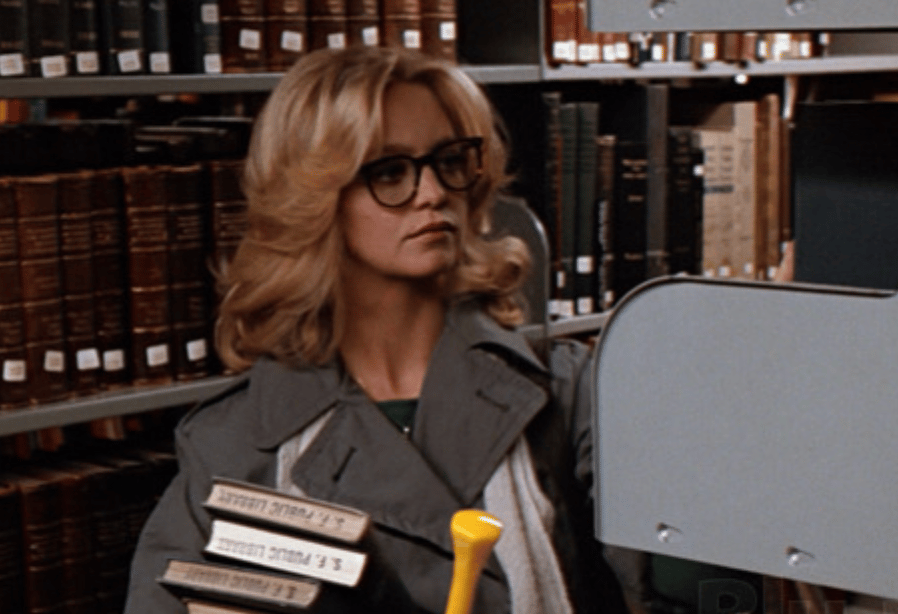
(It’s streaming on Pluto and while not everything holds up, a lot does. “I think we got off on the wrong foot,” Chase’s character says. “Yes, and it seems to be in your mouth,” Hawn replies. Movies used to have banter! We used to be a society!)
Like Clark Kent, they’re not just glasses though. They’re a costume choice that’s supposed to tell us something about the character. Early on, a friend laments that she locks herself away in the library where she works, hiding behind her glasses: “You used to be a cheerleader!” The glasses (which appear only sporadically) are meant to convey that she’s no fun anymore. Whatever. But still. Still.
Anyway, down with Lasik. Let’s get some more glasses back on screen.
The obsession with IP
Netflix is bringing back “Star Search,” that staple from the 80s perhaps most famous for featuring a 10-year-old Britney Spears. The new version will premiere live on Jan. 20, and with so many other talent shows that have come in its wake in the decades since, this feels like yet more recycling of old ideas. (Will the new show include a spokesmodel category?! That was always a weird one. Maybe they’ll update it to an influencer category 🙃)
In other news, Disney recently announced that a live-action spinoff of “Beauty and the Beast” is in th works centered around … Gaston.
Yes, Gaston — the French provincial gym bro who decides Belle is his and goes berserk when he’s denied because “no one says no to Gaston”:
I’m so disinterested in anything associated with Disney at this point — or yet another familiar title being reworked while original ideas are left unproduced — that I barely registered the news.
But video essayist Lola Sebastian made a trenchant point:
Not exactly surprised that Disney is doing a Gaston movie at this time in history. "What if that violent, charismatic misogynist who hates reading had something to him?" is not exactly an exciting question right now. Especially written & directed by men.
Unrelated but related: UCLA released its Hollywood Diversity Report on TV (for the year 2024) and the findings are very Gaston-esque:
Among the 222 scripted series within the top 250 shows studied for the report, only 49 had a female creator. Creators of color were mostly excluded from scripted shows
In contrast, white men accounted for almost 8 out of 10 (78.9%) show creators
Nearly four-fifths of the leads in the most-watched streaming comedies and dramas were white actors. Overall, almost all other races and ethnicities were underrepresented as leads in the top shows
People with disabilities also remained underrepresented, with only 14.4% of shows featuring a lead actor with a known disability.
And yet!
Households of color and female audiences … continued to drive the rankings of top shows
You gotta laugh.
You can read the full report here.
Meanwhile, the trailer for Nate Bargatze’s “The Breadwinner” has dropped and despite the fact that Bargatze might have the most underwhelming screen presence of anyone to step in front of a camera, it seems fitting that he’s toplining a movie (out in March) premised around a specific sort of thematic regression Hollywood decision-makers are going for at the moment.
Here’s the premise:
After his wife (Mandy Moore) lands a major business opportunity, a husband (Bargatze) must become a stay-at-home dad and chaos ensues.
In other words: Wouldn’t it be funny if a man were to (squints) keep house and parent his own children??
It’s worth mentioning Micheal Keaton and Teri Garr already did this nearly 45 years ago in “Mr. Mom” (and did it a helluva lot better, if the trailer for “The Breadwinner” is any indication). But then again, Keaton is, in fact, an actor and he understands how to bring energy and nuance and wit to his performances.
I know Bargatze has a lot of fans through his standup. But judging by his rough performance as Emmy host earlier this year, I’m struggling to see how his general affect — so low-key as to be dead behind the eyes — is meant to translate to a medium that tends to be pretty unsparing about these things.
Charisma used to be a thing Hollywood wanted in its leading men!
Anyway, “Mr. Mom” is free on Tubi if you’re interested.
The (tarnished) globes
Finally, I just want to close out with an appreciative nod to Richard Rushfield over at The Ankler and his full-throated critique of the current incarnation of the Golden Globes, which airs on Sunday.
He gives a thorough accounting of where things stand and why audiences should not treat this as just another fizzy awards show to serve as a distraction in these dark times, it’s actually a symptom of these darks times:
It’s kind of crazy that we have to keep going over this, but the corruption remains so glaring that it’s still significantly in the terrain of, “How can this actually be happening?” So just to make sure we’re not just imagining this, here’s your quick bullet-pointed watch guide to what we affectionately call Hollywood’s Greatest Annual Golden Embarrassment.
The newsletter is paywalled, but here’s a pertinent excerpt:
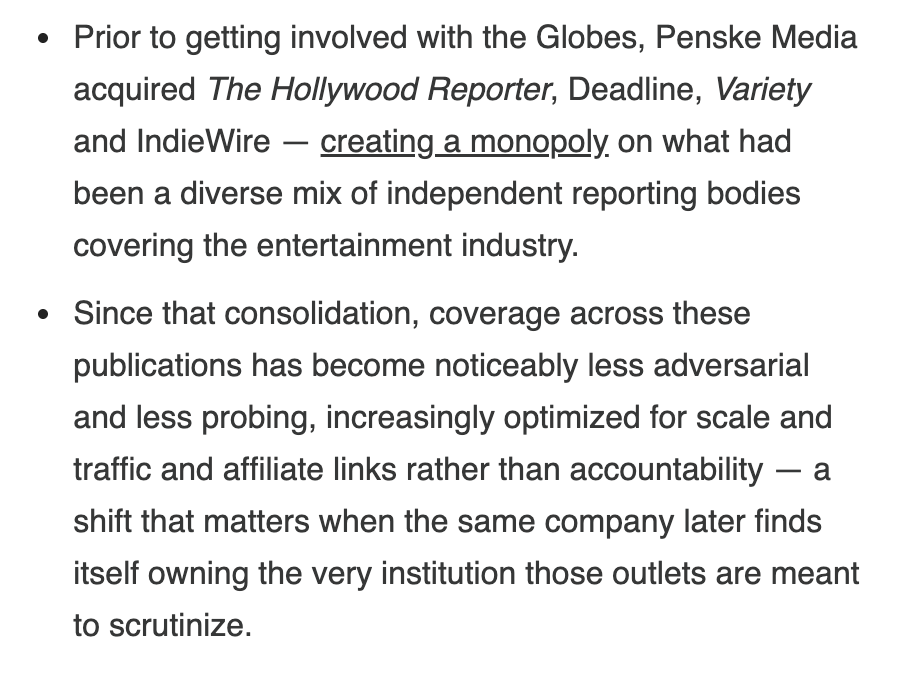
I’m still not sure this is common knowledge for most readers.
So to underscore the point: The biggest Hollywood trades used to compete with one another. Now they are all owned by the same company. Which is also now a co-owner of the Golden Globes.
As Rushfield spells out:
Penske Media not only controls the coverage of the Golden Globes, but also solicits advertising and sponsorship from the films and shows competing for the awards. FYC [For Your Consideration] advertising constitutes the primary revenue stream for trade publications.
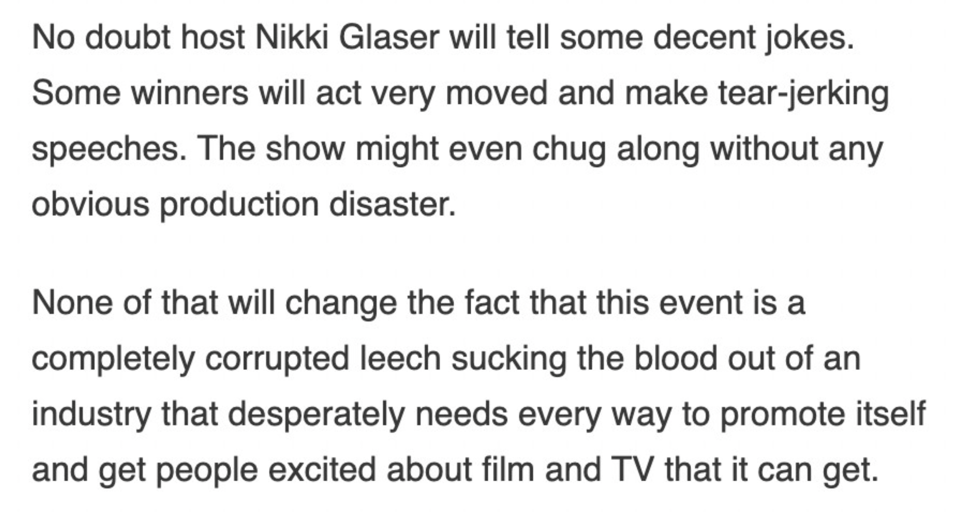
The full newsletter is here.