
Is Hollywood becoming conservative?
Spoiler: No. Because it always was.
This week, The Guardian ran a commentary from film critic Jesse Hassenger with the headline: From Melania to Kid Rock’s halftime show: why is Maga art so dreadful?
First and least importantly: I take issue with The Guardian’s styling of the word MAGA as “Maga.” It’s an acronym, for fuck’s sake, write it as such!
I saw some thoughtful responses to the piece, including this one from the culture writer and editor Frankie Huang:
I don’t casually compare stuff to China’s Cultural Revolution but this reminds me of 八个样板戏
“Art” created under authoritarianism will always be rotten because creativity is killed at the very inception, so that the work is devoid of beauty, wit, and anything else that makes art great and engaging.
In a cultural climate hostile to freedom of expression, people who care about this kind of thing will have to start looking between the lines and under the proverbial floor boards to find where people are still saying/singing/dancing/drawing what comes from the heart.
The writer Andrew Hiller made this point:
A key part of art is the artist wrestling with ideas. A key part of authoritarianism is the suppression of ideas.
But overall, the piece prompted all kinds of facile reactions, because it’s easy to say: “Of course this stuff is bereft of talent or ideas!”
I find this analysis tepid but also smug in its belief that fascists could never make something people will want to watch. You only need to glance at the popularity of tradwife phenomenon on social media for a counter-example.
There are plenty of others that are far more mainstream. After Vietnam, Hollywood oh-so-briefly made movies that dared to portray service in the military as something other than a noble experience. But then came “Top Gun” in 1986, a deeply conservative pivot away from that. It’s a fundamentally conservative movie that is also, yes, very entertaining. And financially successful; it was No. 1 at the box office that year.
So coming back to our current moment, I think there’s a more useful analysis we can embrace in terms of understanding what is getting made right now.
What is art … and what is just content?
I thought this was a smart observation from Hassenger:
While conservatism isn’t inherently at odds with art, Trumpism may be. It was forged (or at least enabled) in the depths of reality television, which can be art, but generally prefers not to, recasting narrative as an endless gameshow with non-union writers.
My beef is with his use of the word “art.” I don’t want to parse what is or isn’t art, but calling either the halftime show or the documentary “art” seems like a grave misunderstanding of what’s going on. Instead I’d use that dreaded word: content.
That’s important, because a lot of what’s coming out of Hollywood right now is not art either!
But unlike other content, which exists for more traditional creative or business-oriented reasons, this is content that exists for ideological purposes. Mostly to curry favor with an audience of one.
Here’s more from Hassenger:
Trump, and therefore the Maga movement, demand submission and fealty. A surprising number of people are willing to provide it, even while crowing about their freedoms. But real artists, even conservative ones, tend not to be so easily constrained. Even if conservatism creeps back into Hollywood, Maga art will be subject to a hilariously on-the-nose deal with the devils
Conservative creep
“Even if conservatism creeps back into Hollywood” is itself — ironically — a conservative talking point.
Because if you really believe Hollywood is awash in liberal or radical ideas, and run by liberal-minded powerbrokers, you haven’t been paying attention to what’s happening in boardrooms. Or what appears on our screens.
Three years ago, when Hollywood actors and writers went on strike, studio executives were sneering about holding out until workers lost their homes. That’s conservative.
Actress Melissa Barrera getting fired from “Scream 7” after sharing a social media post calling Israel’s treatment of Palestinians in Gaza a genocide? Dave Chappelle getting as many Netflix specials as he wants, despite his flagrant transphobic content? Lionsgate teaming up with Mel Gibson on the two-part movie “The Resurrection of Christ” with a budget of $250 million? All conservative choices.
Many gay and bisexual actors remain in the closet, at least publicly, and that’s not because Hollywood isn’t conservative. White men still make up the vast majority of working screenwriters, and are in the most powerful (and best-paid) positions as show creators and showrunners. Same goes for film directors.
On screen, it’s as if Covid never happened — or, at best, is a relic of our recent past. Longterm health issues that have resulted from Covid, the usefulness of masking or the need for clean indoor air standards are absent from fictional narratives. That’s conservative.
It’s been decades since abortion has been portrayed or seriously considered as an option, let alone a word uttered on screen. I’m still annoyed by Judd Apatow’s “Knocked Up” and the line about “smashmortion”; yes, those idiot roomies in the film are meant to be infantile and therefore too squeamish to say “abortion.” But I would argue that Apatow’s fascination with making the weaponized incompetence of the man-child an “adorable” archetype is a deeply conservative framing, and that movie came out 20 years ago!
Shall we talk about the vast array of shows that are shoveling wealthaganda down our throats and asking us to clap in delight? I am sure that many viewers, maybe even most, who are appalled by the encroachment of fascism in our daily lives are also the same people who happily obsess over “Succession” or “The White Lotus” or “The Gilded Age,” which treat obscene wealth as a sour joke or a smooth-brained diversion. But these stories are notably incurious about the lives of the have-nots, who make those riches possible. That is conservative.
Cop shows still prevail on TV, which means copaganda still prevails on TV. The many series of Taylor Sheridan and Ryan Murphy — maybe the two most prolific producers working in TV — are undergirded by messaging that is fundamentally conservative.
When “Andor” is the only example people cite that centers regular folks banding together to fight fascism (out of 400+ scripted shows made each year), that’s not because Hollywood isn’t conservative. When labor unions are virtually invisible in fictional worlds, that’s not because Hollywood isn’t conservative.
Wrester Brody King did not appear on an episode of “AEW Dynamite” this week because, it was reported:
AEW minority owner and TV partner Warner Bros. Discovery made the call not to have Brody King on Dynamite due to the prospect of further "F*ck ICE" chants. WBD reportedly wanted to avoid upsetting WWE Hall of Famer and United States President Donald Trump because of the pending Warner Bros. Discovery acquisition by Netflix, which still requires regulatory approval.
Apple pulled its Jessica Chastain series “Savant” — about an undercover investigator into hate groups, and based on a real person — shortly before its premiere last year. According to reporting by entertainment journalist Rick Ellis:
While Apple TV semi-publicly blamed the show’s delay on the raw emotions following Charlie Kirk’s assassination, after speaking with people at Apple TV familiar with the decision-making as well as sources connected with the show, I have been told that Kirk’s murder simply was a convenient excuse to remove a show Apple executives worried would prompt a wave of criticism from conservative media types, who would see the show’s premise as an overt criticism of their political beliefs.
Let’s keep going.
When media companies are run by CEOs who cozy up to the president, that’s not because Hollywood isn’t conservative.
You could argue their attendance at the White House for a recent screening of the Amazon documentary was just a pragmatic business decision. Other “pragmatic” business decisions: Lawsuit settlements that many have equated to payoffs, or the suspension of one late-night talk show and the elimination of another for reasons that are squishy at best.
To anyone who insists this is just business, the counter-argument is that putting greed ahead of everything else — instead of, at the very least, not consorting with and legitimizing an agent of chaos and pain and destruction — is an inherently conservative framework. Vichy France has its reputation for a reason.
All of which is to say: The hypothetical of “even if conservatism creeps back into Hollywood” is disingenuous on its face. It’s always been there to a degree, and most assuredly post-Reagan.
To Hassenger’s point, most Hollywood creatives have more flair and, yes, artistry, in how they insert a conservative-skewing worldview into their work. That’s what I’d like us to think about more deeply.
Because that halftime show or that Amazon “documentary”? Clumsy and easy to recognize for what they are, and therefore easy to dismiss.
It’s everything else — big mainstream projects that do not get the conservative label — to which we should bring the same skepticism. No one is saying you can’t enjoy any number of contemporary shows or films. But let’s at least be smarter about what we’re watching, and not just shrug it off.
Media messaging can be potent and work on a subconscious level. No one is immune. But the best way to avoid falling for the okey-doke is to scrutinize the ideas, themes and portrayals of any TV show or film.
The Olympics
I might be the only grump who preferred when both the Summer and Winter Olympic Games took place in the same year. It was exciting! An Olympic year! Then you had to wait another four years until next one.
That was standard from 1924 until 1992, when the decision was made to split the games. Now, the Olympics are every two years, alternating between the summer games and winter games. I’ve yet to find an adequate explanation for the change, but I suspect it was to ensure the Olympics were front of mind … well, every two years. I’m still stubborn enough to feel like we just had an Olympics with this kind of schedule. I think we undervalue a sense of anticipation.
I’m also probably in the minority with this complaint so … on with the Milano Cortino games!
Which have been kind of … messy?
The hockey ice rink is smaller than anticipated. (This analysis suggests it doesn’t matter, but still, a basic thing that shouldn’t cause confusion!) Some of the Olympic medals awarded have either broken, cracked or fallen off their ribbons. (You had one job …)
The gold medal winner in the women’s biathlon is a French athlete who was “convicted of committing credit card fraud against a national teammate in October and was handed a three-month suspended prison sentence.” What??
There’s an ice dancing scandal concerning allegations of sexual assault which has made it difficult to get excited about the event. Time magazine has a good rundown here: How France Skated Through Scandal to Edge Out Team USA for Ice Dance Gold. There’s also a judging/scoring controversy regarding the recent performance of the team (yes, the same team connected to the aforementioned allegation) which you can read about here.
Some ski jumpers allegedly “artificially enlarged their crotch area by injecting their genitals with engorging chemicals or stuffing their underwear to create bigger bulges.” Even the tiniest bit of extra fabric can apparently help jumpers stay aloft longer and therefore go further.
When a Norwegian bronze medalist in the biathlon was interviewed after competing, he talked about … cheating on his girlfriend. How did she get dragged into this?! Yiiiiiiiikes.
Haiti (sending two skiers to the games) was forced to modify its very cool uniform for reasons that didn’t sit well with me. Here’s AP’s reporting:
The skiers will compete in uniforms designed by Italian-Haitian designer Stella Jean that originally featured an image of Toussaint Louverture, the former slave who led a revolution that created the world’s first Black republic in 1804. The IOC ruled that the image violated Olympic rules barring political symbolism, requiring Jean to come up with a creative solution: painting over the nation’s founding father.
Those same rules mean Ukrainian skeleton slider Vladyslav Heraskevych was disqualified from competing because his helmet features images of athletes killed by Russia during the war in Ukraine. One option would have been to wear a different helmet. He said no, on principle.
Here’s what IOC President Kirsty Coventry had to say about the decision:
It’s not about the messaging. It’s literally about the rules and the regulations and that, in this case, the field of play, we have to be able to keep a safe environment for everyone and sadly, that just means no messaging is allowed.
How do images on his helmet have any bearing on keeping a “safe” environment for the field of play? Russia isn’t even at the Olympics; the country was banned for violating the Olympic truce when Putin invaded Ukraine in 2022.
Punishing an athlete for commemorating the very thing that Russia was banned from the Olympics for doing is … ironic.
According to the Olympic Charter, “no kind of demonstration or political, religious or racial propaganda is permitted in any Olympic sites, venues or other areas.”
I mean, the no-politics rule starts to look pretty shaky when you consider that even though Russia is banned, 13 Russians and seven Belarusians are competing nevertheless.
The carve out is called Individual Neutral Athletes (AIN). To qualify, an IOC panel looks at the athletes’ social media posts for any that support the violence in Ukraine, which would be disqualifying.
The idea being, why penalize individuals for the actions of a state leader? Well, Global Athlete, an international advocacy organization, has some thoughts about that. From an open letter to the IOC:
These athletes have been developed, trained, and funded through Russian and Belarusian state sport systems that remain deeply intertwined with military and state apparatus.
Many continue to train in state-funded facilities and receive support from national sport structures.
The IOC's vetting process has proven inadequate; it cannot truly assess which athletes have supported the war, have ties to military or security services, or will be used for propaganda purposes upon their return.
Russian state media will celebrate every AIN medal as a Russian victory, regardless of whether a flag is raised. The Kremlin controls the narrative domestically, and a neutral status provides no barrier to propaganda exploitation.
The org says Putin wields sports "as a tool of state propaganda, using athletic success to legitimize an unlawful and devastating war” and that the so-called neutrality of AIN athletes is in fact "a political act with real-world consequences."
The games are supposed to be about putting aside geopolitical divisions to come together and focus on athletic competition. I get it.
But nobody exists in a vacuum, including the games themselves, which are filled with corporate messaging, as if that were neutral just because it’s the private sector.
This piece from the Summer Olympics in 2024 rightly points out the fallacy therein: Despite Protest Rules, the Olympics Have Never Been Neutral.
Here’s what another IOC spokesperson had to say about Heraskevych:
He can, and we would encourage him, to express his grief, but in the end let me be clear. It’s not the message, it’s the place that counts. There are 130 conflicts going on in the world. We cannot have 130 different conflicts featured, however terrible they are, during the field of play, during the actual competition.
Why not? It’s worth discussing.
Stop being such a party pooper
Despite it all, I’m still a sucker for the games.
I thought I knew about most events, but just learned about the existence of snowboard cross where — unlike skiing, where it’s one person at time racing against the clock — they all race down the hill together at the same time?? It looks intense. The Winter Games are not beating the “sports as possible death wish” charge.
Oh, and I think I have a theory as to how doubles luge came about. In its current form, two people race down the track on a sled, feet-first, lying flat on their backs, literally one stacked on top of the other. Here’s what it looks like.
I was so curious how this positioning came about — who was the first to say, “Hey, what if you lie on top of me and we hurtle down the ice?” — and I couldn’t find an explanation.
But I did find this on Reddit:
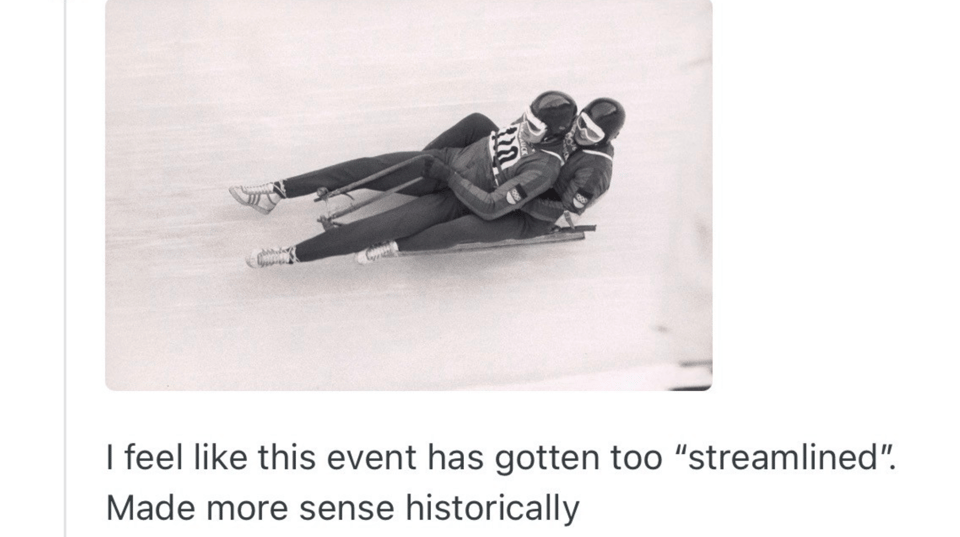
OK, if they originally were positioned sitting up like the photo above, one in front of the other, I can see how how the quest for better aerodynamics could have eventually led to both athletes lying back flat on the sled, one literally on top of the other.
(Technically the top person isn’t putting all their weight on their partner. They have a small flat surface for their butt — a seat, for lack of a better word — that is slightly raised and centered between the bottom person’s crotch/leg area. The rest is core strength, I guess.)
Regardless of how it got that way, it’s a wild sport.
They pretty much all are … which is why we watch.
Finally, for the Chicago Tribune, I talked with Lindsay Slater Hannigan, who is the sports sciences manager for U.S. Figure skating. She’s also helping to produce the NBC broadcast.
Her focus is workload management, which boils down to: How many jumps should any individual skater be doing, in training, before they see diminishing returns — or increase the likelihood of a repetitive stress injury?
Workload in ice dancing, which doesn’t have jumps, is much harder to quantify, but she says their average practice day is the equivalent of running 11 miles.
It’s interesting stuff!
She also talks about efforts to get better cameras for the judges, who can choose to review footage of a skater, and she uttered the word “AI.” I caught my breath. But she says AI can actually help judges make fairer decisions, so … I guess we’ll see.
You can read more here.