How do we watch what’s on our screens?
Are we losing the skill to engage with long-form storytelling?
It’s always fun when an under-promoted show or film makes its way into the larger pop cultural consciousness, if only because it proves that executives are often clueless about which projects will spark with audiences. So when an underdog breaks through, it’s very much: The people have spoken!
This usually ends badly, because every unexpected hit tends to be subsequently exploited and stretched beyond what it can handle. But the initial, seemingly organic burst of audience interest? Can’t beat it.
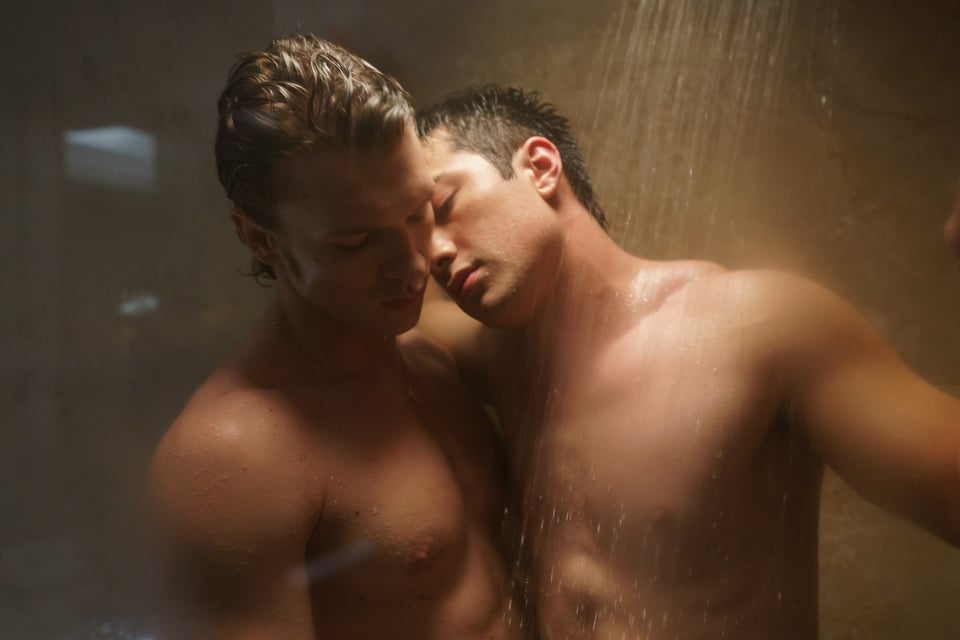
The most recent is “Heated Rivalry,” the horny hockey player romance which came to HBO Max late last month from the Candian streamer Crave. A recent commentary about it from SlashFilm caught my eye because it talks about how we’re being asked to watch TV and film right now.
Here’s the author B.J. Colangelo first identifying a persistent issue:
A distressing trend in American streaming is the popularization of what Netflix calls "casual viewing," or the idea that shows and movies need to be crafted with the understanding that people watching aren't actually watching.
Colangelo brings this up because so much of “Heated Rivalry” exists in the spaces between the dialogue. Long silences and looks exchanged that convey a range of potential thoughts and emotions: desire, discomfort, uncertainty, amusement, fear mixed with hunger and curiosity:
This is a show that explores character growth in what isn't said as much as what is said.
By refusing to have characters make bold declarations or grand speeches to tell the audience what they're feeling, "Heated Rivalry" forces viewers to be active participants. It's up to us to determine the meaning behind a glance, smirk, or foot tap under a press conference table.
I don’t fully agree with this — I think the show is underwritten at times and audiences are being asked to do some of the work the scripts should be doing — but let’s table that for the moment. Because Colangelo’s larger point is a good one.
It’s so much more interesting — more complicated and fun — to infer certain things rather than hear a character state them plainly. Especially when you have an actor like Connor Storrie, as the Russian player Ilya Rozanov, who understands how to smolder, and you realize that so many actors working today just do not. Hudson Williams co-stars as the Candian player Shane Hollander and his character isn’t meant to smolder — he’s too inexperienced for anything that assertive — but Williams is very good at conveying a careful reticence mixed with very real, very dirty longing.
Non-dialogue elements — like how someone is shot or framed; the looks they exchange with other characters, or the absence of any facial reaction — can enrich the moment on any show or film. Why deny yourself that as a viewer by not paying attention?
By the way, I’m guilty of this too — I read Colangelo piece’s while an old episode of “Law & Order” was on in the background.
There’s a distinction in my mind, though, between that and treating new shows and movies as something that’s on while you’re doing something else. Why — how — is that pleasurable?
Here’s the funny thing about my “Law & Order” example. I’d seen the episode so many times that I didn’t need to focus intently on the plot and could notice other things, like the way a scene was lit. With the detectives assembled in Lt. Van Buren’s office, it was fun to try to suss out the light sources and note the absence of overhead fluorescent office lighting in an environment where you’d very much expect it. So I’d argue (to myself, even) that paying attention to shows you’ve already seen and allowing yourself to notice other things in the frame is going to be more enjoyable because you’re paying attention.
Careful watching also helps us with discernment. I think “Heated Rivalry” is a lot of fun and does some things very well, including the sex scenes and depicting the deepening feelings that develop between the two main characters. Storrie and Williams have been delightful and charming on the press tour that’s followed in the wake of the show’s popularity, which has also probably boosted its profile and appeal.
But the series itself is singleminded in ways that are limiting. Absent any kind of meaningful world-building, the setting becomes blank and non-specific. Barely anyone else on screen is a three-dimensional human being. The show does little to explore who the two main characters are outside their dynamic together, which I think can work for a stand-alone film, but a television series can and should explore a broader range of themes and a larger storytelling landscape. I’m probably the outlier who wishes the show had any interest what it’s like to be a professional athlete (and a hockey player in particular). I want to see more skating, because skating is sexy and this is supposed to be a sexy show!
Anyway, I have to chuckle whenever I see the Emmys* mentioned in regards to “Heated Rivalry,” because a show can be enjoyable — good, even! — without being great. We can appreciate what it does well without pretending its limitations aren’t right there.
A lot of people clearly disagree. And there are worse shows to be overpraised.
*Based on my reading of the Emmy rules, I’m pretty sure this season of “Heated Rivaly” will not be eligible to go up against other U.S. shows in contention anyway, because HBO Max is merely a distributor, rather than co-producer, of the Canadian series.
Let’s go back to the larger question, about how we watch what’s on our screens
I think there’s an assumption that watching a TV show or film is as simple as plopping yourself down in front of a screen. That it’s something you can do automatically.
But I would argue that being able to engage with longform storytelling is a skill that has to be learned and practiced regularly. Things like: How to focus and make connections. How to read between the lines and pick up on allusions and subtext. How to recognize emerging themes and understand the stakes. This is how you get lost in a story, and it enriches the experience.
I wonder if this mental process is driving kids to watch and rewatch the same movie over and over again. Maybe they’re learning how to watch a story and adapt to its pathways and rhythms. Figuring that out takes repetition at first, and I think real intellectual work is happening for young people with repeated viewings.
Reading books is one way to develop tools for critical thinking and to recognize and understand different storytelling forms. Literacy isn’t just the ability to read, but to understand what you’re reading. Or, at least, try to sort through those questions. Once you can do that, you can start distinguishing between what feels meaningful and what feels empty. Not all storytelling is good. Or even a story. (See the trend of scenes-but-no-story that proliferates in a lot of TV and film at the moment.)
If we’re relying on schools to help foster these skills, things aren’t looking good. At least one middle school in Washington, D.C. has removed all full-length novels from its eighth grade curriculum. “Reading full novels has real and important benefits for middle school-age children and in life,” is how one alarmed parent put it.
Eight graders should be reading novels. It will be easier for some, harder for others. But encountering challenging intellectual experiences is not inherently bad! It teaches you the temperament and patience needed to push through challenges. Not doing that isn’t going to help anyone figure out how to engage with longform storytelling or enjoy the richness of the experience therein. Stories tell us something about our lives — our own and those of others around us. We shouldn’t be so quick to let that go.
All of this transfers to how audiences watch TV and film. And a good chunk of what we’re watching these days is disincentivizing these skills.
I saw a social media post recently about standup comedy that made a similar point:
I couldn't imagine being a comedian nowadays. A big part of understanding jokes is understanding what's being said in or out of context. As people get dumber, they seem to be losing the skill of putting things in context.
Context is huge. And longform storytelling is all about creating context for everything that happens.
Our attention spans are diminished thanks to a few factors, including an endless supply of short-form videos, among other things. We’ve forgotten — maybe never learned — how to slow down, concentrate, and let a show or film take its time. The pacing might be terrible. Or your brain might be fried from TikTok. Wouldn’t it be nice if more of us could tell the difference?
Everything is television?
Here’s a twist that left a bad taste in my mouth.
The journalist Derek Thompson has a newsletter out where he theorizes that social media has become … well, television.
Social media has evolved from text to photo to video to streams of text, photo, and video, and finally, it seems to have reached a kind of settled end state, in which TikTok and Meta are trying to become the same thing: a screen showing hours and hours of video made by people we don’t know. Social media has turned into television.
This feels absurd, but also not off base. I hate it.
Here’s more:
By “television,” I am referring to something bigger than broadcast TV, the cable bundle, or Netflix. In his 1974 book “Television: Technology and Cultural Form,” Raymond Williams wrote that “in all communications systems before [television], the essential items were discrete.” That is, a book is bound and finite, existing on its own terms. A play is performed in a particular theater at a set hour. Williams argued that television shifted culture from discrete and bounded products to a continuous, streaming sequence of images and sounds, which he called “flow.” When I say “everything is turning into television,” what I mean is that disparate forms of media and entertainment are converging on one thing: the continuous flow of episodic video.
By Williams’s definition, platforms like YouTube and TikTok are an even more perfect expression of television than old-fashioned television, itself. On NBC or HBO, one might tune in to watch a show that feels particular and essential.
On TikTok, by contrast, nothing is essential. Any one piece of content on TikTok is incidental, even inessential. The platform’s allure is the infinitude promised by its algorithm. It is the flow, not the content, that is primary.
One implication of “everything is becoming television” is that there really is too much television—so much, in fact, that some TV is now made with the assumption that audiences are always already distracted and doing something else.
We always land here, don’t we.
Thompson is not optimistic about what this all means:
When literally everything becomes television, what disappears is not something so broad as intelligence (although that seems to be going, too) but something harder to put into words, and even harder to prove the value of. It’s something like inwardness. The capacity for solitude, for sustained attention, for meaning that penetrates inward rather than swipes away at the tip of a finger: These virtues feel out of step with a world where every medium is the same medium and everything in life converges to the value system of the same thing, which is television. I don’t have the answers here. But we should figure it out soon. The marble is still spinning, but it is reaching the bottom of the bowl.
This complaint isn’t exactly new, though
The thing about our preoccupation with “casual viewing” — or background viewing, or second screen viewing, or putting something on while you’re folding laundry — is that it isn’t a recent phenomenon. It’s always been part of the television landscape.
In fact, complaining about the state of TV is pretty much as old as television itself. In 1961, FFC chairman Newton Minnow coined the term “vast wasteland” in a speech he gave to the National Association of Broadcasters, noting that, “When television is bad, nothing is worse.”
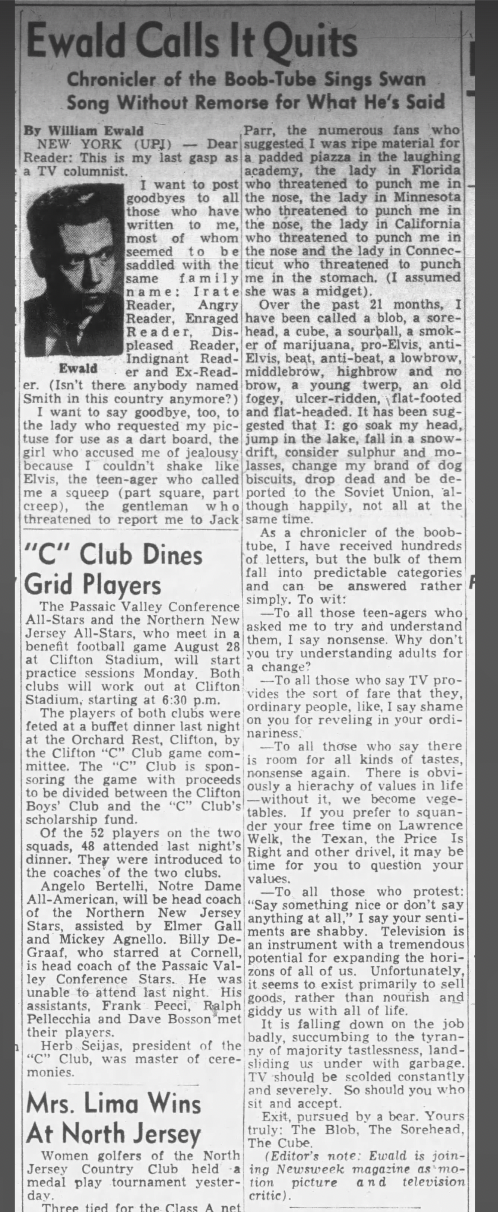
And as early as 1959, people were calling TV the “boob tube,” a phrase that turned up when self-described “chronicler of the boob-tube” William Ewald quit as TV columnist for the UPI newswire.
He did not mince words:
— To all those who say TV provides the sort of fare that they, ordinary people, like, I say shame on you for reveling in your ordinariness.
— To all those who say there is room for all kinds of tastes, nonsense again. There is obviously a hierarchy of values in life — without it, we become vegetables. If you prefer to squander your free time on “Lawrence Welk,” “The Texan,” “The Price Is Right” and other drivel, it may be time for you to question your values.
He also had something to say about what is often referred to, in modern parlance, as “haters”:
— To all those who protest: “Say something nice or don’t say anything at all,” I say your sentiments are shabby. Television is an instrument with a tremendous potential for expanding the horizons of us all.
Your sentiments are shabby. A devastating putdown!
Ewald ends his column with that old chestnut from Shakespeare: “Exit, pursued by a bear.”
But the real kicker is one additional piece of information that appears after his sign off in parenthesis and italics at the bottom:
Editor’s note: Ewald is joining Newsweek magazine as motion picture and television critic.
So much for harrumphing off in a fit of pique.
What do we really look like?
There’s been a lot of discussion about Christopher Anderson’s photos that accompany the recent two-part Vanity Fair piece on the president’s inner circle.
Specific attention was given to the extreme close up of White House press secretary Karoline Leavitt, which revealed every pore, wrinkle and lip-plumbing injection mark.
How's Karoline Leavitt faring in the onslaught of questions about the Epstein files? "It's pretty clear he wants us to be aggressively offensive when it comes to this issue." https://www.vanityfair.com/news/story/trump-susie-wiles-interview-exclusive-part-2
— Vanity Fair (@vanityfair.com) 2025-12-16T19:11:08.031Z
Setting aside whatever thoughts one may have about the moral character of the people featured — and hooboy, there are a lot of thoughts — I do think it’s worth considering why there was such revulsion, or at least surprise, generated by that one photo in particular.
Again, let’s try to separate out who is in the photo and discuss the photo itself. Because I think we collectively have no idea what we, as humans, actually look like.
I don’t think that’s a good thing.
When was the last time you got that close to someone’s face? Maybe a lover? Or a child? Otherwise, our interactions benefit from at least a few feet of space between us.
Skin is not made of resin, it has texture. The details that come through in Anderson’s photo of Leavitt are what human faces actually look like. This is not a bad thing nor a good thing, but simply a reality, and it’s concerning that so many people were disturbed when confronted with this.
It’s the inevitable outcome of photo editing techniques that began with smearing Vaseline on a camera lens to soften the edges and evolved into more sophisticated software that was once the domain of experts and is now in the hands of anyone looking to tweak their own photos. Celebrities may be vain, but they also know their image is part of what they are selling, and increasingly I sense that mentality has extended to the rest of us.
I’m not saying everything needs to be deglamorized. But there is magic in imperfections.
What does it mean for us, as a society, when no one knows what we look like anymore?
Many were surprised to learn Leavitt is only 28 and it’s also worth examining why we collectively bought into the idea that it is bad if aging is perceived. You only get to see yourself age once. Why chase a youth that can never be restored, and deny a life that has been lived in the meantime?
Actors experience tremendous pressure to do just that. Hollywood prefers a fantasy, and while there should be room for that (to a degree), I’m concerned about the hostility and repulsion that follows when something closer to reality appears on screen.
I’m tilting at windmills here, but let’s not pretend this isn’t weird and harmful and boring in ways that have become normalized.
Bring back real, possibly semi-wonky teeth! Let lead actors have bellies! Show the details of their faces! This is who we are, and we should be skeptical of anyone who tries to tell us otherwise.
By the way, there was some ignorance around those Vanity Fair photos and I don’t think that’s the fault of readers. We as journalists don’t do enough to explain the job, but I’m glad Anderson made this point clear in an interview with Newsweek:
It is curious that the internet is shocked that I would not retouch the blemishes. I guess I find it shocking that people would expect that journalistic photos should be retouched. Celebrity photos are celebrity photos. Politicians are not celebrities. Let’s not mix things up.
I’ll take it a step further, because there’s a distinction between how the “celebrity or not a celebrity” question is handled by glossy magazines vs. newspapers.
The latter do not retouch or alter photos. Of anyone or anything. If they have, consider that a major ethical breach.
Newspaper photographers are photojournalists who cover an array of stories on any given day (they could be covering a crime story one moment, then shooting food images for a restaurant review the next, and then covering a pro sports game later on) and that means what they shoot is what was happening in that moment. What photojournalists do is, literally, reporting. Sometimes additional lighting is used. And the subject might pose for the photo if it’s a portrait. But that’s it. We as readers need to be able to trust that what is being depicted in the photo really happened as we see it, and hasn’t been altered to suit someone’s agenda.
Magazines operate differently and will do entire photo shoots, providing wardrobe as well as hair and makeup teams (and paying all those costs). And then, yes, subsequently photoshop the images. If the celebrity has enough clout, their publicist might dictate which photographer is assigned (and even which reporter) and might demand, and get, photo approval.
Newspapers do none of that. Or at least they shouldn’t, not if they’re acting ethically. In my time working at the Tribune, this has always been strictly enforced.
I don’t know why magazines do it differently — well, I do; these are generally pitched as flattering profiles and the biggest outlets are, in fact, in the business of selling glamor — but in my opinion it blurs too many lines. If the story itself is a form of reporting, the photos should follow suit.
But at the very least, it’s good for readers to know more about these nuances, if only because it makes us more informed about the media we’re consuming.