Over My Dead Body
Over the past few years, I’ve had the opportunity to learn about and practice gardening with native plants at my house. Working with native plants has helped me focus on something I felt I could (mostly) control. The Nicole from early 2020 and prior would have scoffed if you had told her she was to become an avid gardener. Tyler likes to remind me that, when we first bought our house in Riverton, NJ, he said, “would you consider turning our front yard into a meadow?” I said, “over my dead body.” Like many of us, I grew up thinking grass was the only way.
Well, I’m not dead. But our front yard is slowly becoming a native plant haven (what you might call…a version of a meadow).
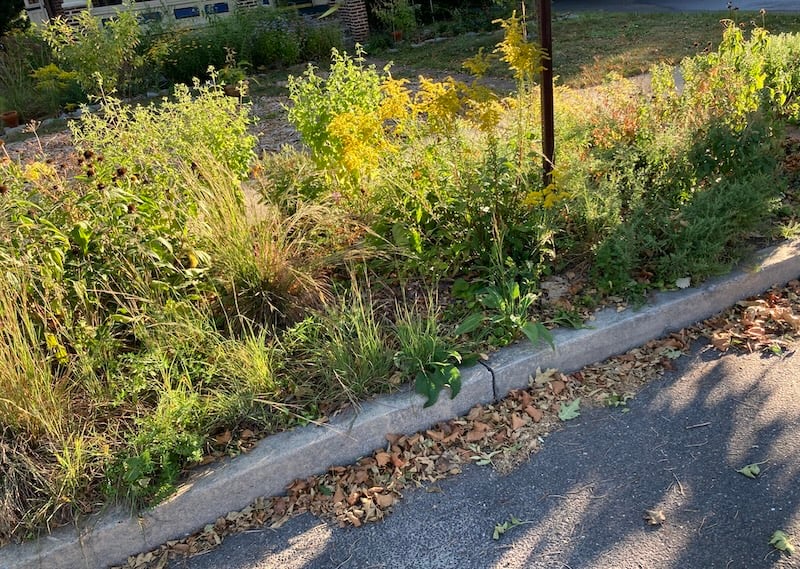
I would say that working with native plants brings me a lot of joy. Corny! I know I know. But we know from science that gardening is very literally good for your mental and physical health, and native plants help the environment. (Look, if you’re not into this, please just plant a few. You can even do so in containers.)
Native plants…
-help adsorb storm water (do you really want water in your basement?). Many of their roots go way down past grass roots.
-provide food and habitat for beneficial insects (you know, the ones who pollinate the food we eat!) and small animals.
-do not require pesticides (which are not good for bugs, animals, OR humans and cost money).
-require less water than non-native plants (saving you money!).
-capture carbon (which helps mitigate global warming—do you really like being this hot?).
-are pretty! There is more variety that you might have assumed. Check out the Jersey Friendly Yards website for many examples.
Interest in native plants has been around a while. The Native Plant Society of New Jersey was established in 1985, for example. I didn’t really learn about native plants until 2020 (yeah, I’m one of those people who didn’t really spend time outside until the pandemic started), and I suspect the recent increase in their being in the mainstream news can be linked to the increasing urgency of the climate crisis (and how native plants can help!). One of the reasons I enjoy working with native plants so much is that they don’t require a lot of fuss. In other words, I’ve been able to keep them alive. :) I can’t say that about the non-natives I planted when we first moved in. We do have some non-natives here, including kerria. That’s OK! But the more native plants, the merrier…
I think of lot of my readers (hello all 19 of you, including Tyler and yours truly) are already familiar with the benefits of native plants. But if you’re not, or if you are looking for resources to share with friends and fam, lean more from the Audobon Society, the US Forest Service, PennState Extension, and the Xerces Society.
I didn’t intend to go on and on about why natives today, but here we are. If you are still reading, maybe this next part is what you were looking forward to (?). I’ll talk a bit about audience and motivation in another Note.
If you follow our house instagram account, you know that I am working on a plant list for two new native plant beds that will go where we sheet-mulched this summer.
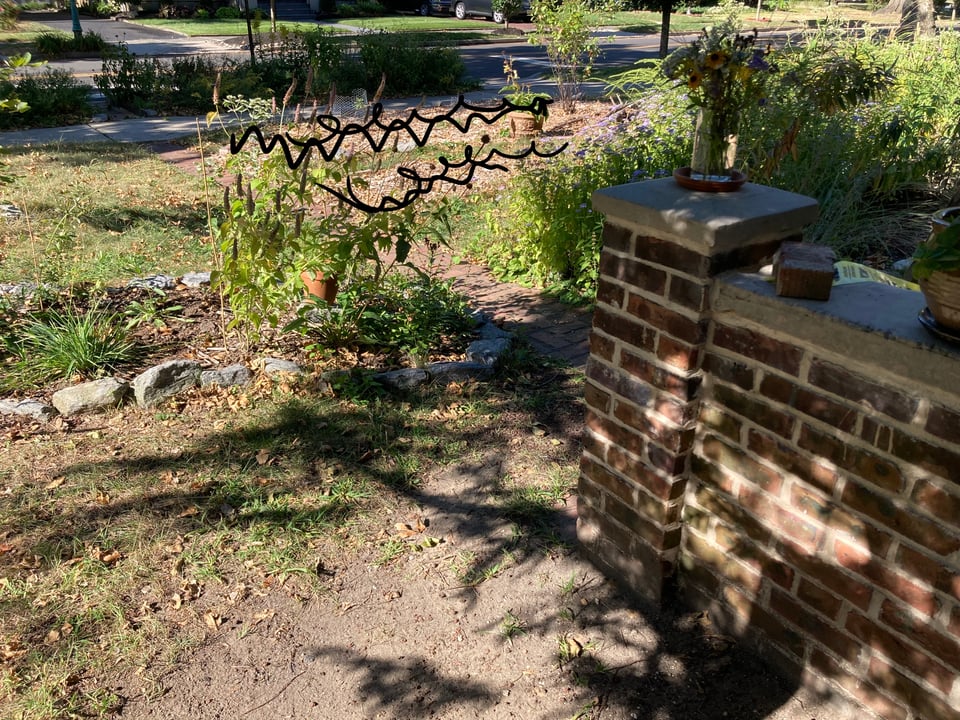
I’ll be planting some natives we have on hand that I bought throughout the summer and some that we grew over last winter. I created a spreadsheet of all the plants and organized them by bloom time. It’s great to have your garden blooming from spring through fall so bug buddies have stuff to pollinate all season…and it looks prettier. Next steps will be: 1-figuring out how many plants I have room for; 2-deciding what I want to plant and giving away the rest (or finding another spot for them; 3-deciding what’s missing and acquiring additional plants as needed.
Here is a list of what I currently have available to plant (I know, I need to work on my Latin names). I have one or two of most, but I have more of others such as eastern columbine (which were easy to grow outside over the winter) and New York ironweed (which I really like and keep buying).
Bearberry (groundcover)
Lanceleaf tickseed
Eastern columbine
Black chokeberry
Gray dogwood
Blue wild indigo
Eastern bluestar
Buttonbush (prefers moist, wet soil)
Butterflyweed
Common milkweed
Orange conflower
Wild bergamot
Joepye weed
Coneflower
Obedient plant
Swamp milkweed
VA mountainmint
Gray goldenrod
NY aster
Woodland sunflower
Eastern blazing star
Smooth blue aster
NY ironweed
Anise hyssop
Blue mistflower
PA Sedge or little bluestem
I want to add a few more that will bloom earlier in the season, so I’m going to try to source the following this fall:
-golden alexander (bloomed first for us last spring)
-golden ragwort (did you know this stays green all year? wild; started blooming 3/26/2024)
-blue-eyed grass (this plant is magical - it bloomed off and on for several months)
-pussytoes (grows easily in crapola soil)
-hairy beardtongue (a little fussy, but relatively early bloomer)
I’d also like more Virginia bluebells (started blooming 4/10/2024) and jacob’s ladder (started blooming 3/16/2024), but I’ll have to stash these in a small, part-shade bed we have in the front that replaced a non-native holly.
I want to pay attention to bloom time, but I also want to make sure I have several so-called “keystone” native plants. Keystone plants are particularly good for the place where you are in that they provide lots of food and shelter for native insects and other critters. I’m in the eastern temperate forest (ecoregion 8). The National Wildlife Foundation (NWF) had good handout on keystone plants for this region. You can access it here, but I think they’re re-doing their resources on this, for what that’s worth.
Of the plants on the NWF list (linked above), we have several. For example, we do have two baby pitch pines in pots (not listed above). We’re not sure what we’ll be doing with these (they get quite large), but they’re fine for now where they are…did you see that 200 caterpillar species use pitch pines as a host plant? Holy moly. Goldenrod is also a powerhouse, but we have relatively little of that ready to go into the ground. I’ll add that to the shopping list. (Or, we could divide what we have in other beds.) We have asters as well as woodland sunflower (could use one or two more of the latter, though I noticed they poop out in direct sun—then magically revive themselves over night). We have blackeyed Susan elsewhere (but can always use more!). In short we’re doing OK on keystone species but need to make sure we have enough before planting.
I think that’s a good first pass at planning these new beds. I’ll want to think a bit about height and spread, too, as I decide what to plant. Let me know what you think. I’m really excited to be able to walk down the paths through the front garden beds with native plants surrounding me on both sides.
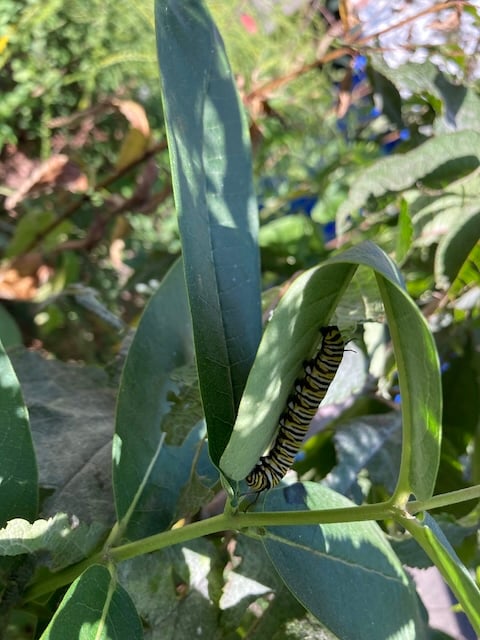
I’ll leave you with a photo of a monarch caterpillar in our side garden we’ve been following. Thanks for reading!
Here are some Additional Notes.
I saw someone deliberately throw a glass bottle out their car window on State Road in Philadelphia, almost directly across from Riverton, on Saturday, September 7, while I was driving. We still do this? I have observed this periodically a few times over the last few months and continue to be surprised. Stop it!
The Riverton Environmental Commission and Green team (I’m on both) organized a talk (upcoming!) by Dr. Kimberly Norris Russell called “Meeting Bees’ Needs: Promoting Native Pollinator Populations in Managed Landscapes.” It will take place September 19, 2024, at 7:00PM at the Porch Club (213 Howard Street). Free! All are welcome. Please come and learn with us.
I just read this article in The New York Times about naming heat waves to help draw attention to the dangers associated with them and their connection to climate change (this has been in the news before). Did you know that, according to the CDC, 1,200 people die of heat each year? New Jersey (one of the “fastest-warming states”), where I live, developed a “heat hub” where you can gather more info on how the state hopes to “minimize the impacts of extreme heat.” Oof. One of the few things I can do about this, aside from planting small native plants, is to support the maintenance of existing trees and the planting of trees (more on this in an upcoming Nature Note).
Looking for something else to read? I really like Heather Marold Thomason’s Hungry Heart. I was following Thomason because I was a fan of her business Primal Supply Meats, which closed in 2023. Her newsletters focus on the intersection of food and sustainability.
I also really like Pat Sutton’s Garden Gang newsletter. Tyler wanted me to name this newsletter Nicole’s Nature Ninjas, but thought that sounded to much like Pat’s Garden Gang and wasn’t sure if using the word ninja was offensive. Anyway, Sutton writes primarily about native plants. She’s really a resource hub for workshops, tours, native plant sources, and more, particularly for the South Jersey region. See also her website.
I Observed a (gas-powered) truck idling on Wednesday, September 11, 2024. Idling of this nature is illegal in New Jersey. Idling is bad for your health, and it wastes money. Please don’t do it.
Are you registered to vote? Make sure you are, and please vote! (Borrowed from Thomason - thank you for the reminder!)
Last night, on September 12, Tyler and I spotted a skunk near our car just after dark and a juvenile fox near the country club!