On Salt Hay and Muskrat Houses
It’s been a minute. Watching the U.S. federal government disintegrate in slow (or fast?) motion is unpleasant, but I have been doing all I can to try to stop it or simply make it more bearable where I live.
What does that look like when it comes to environmental action?
Education is action. So, for starters, I continue to learn new things. I had the pleasure of finally attending the Pinelands Short Course, organized by the State of New Jersey Pinelands Commission and held at Stockton University. (Save the date for the summer edition!) It was great.
If you’re not already familiar with the Pinelands, you should definitely visit some time. They’re a short drive from where I am in Riverton and are known for their incredible biodiversity, among other things. If you want to read a classic about the Pinelands, check out John McPhee’s The Pine Barrens.
I’m not going to try to summarize all I learned at the short course. And, to be frank, I was exhausted the day I was there. So, here are few fun facts and things for you to check out.
Mosses with John Hooven
Where to begin? Mosses have been around for 500 million years(!), and there are three main types in NJ: granite, peat, and true. If you’re out and about and want to identify them, check out Keith Bowman’s Field Guide to the Moss Genera in NJ.
Salt Hay with Horace Somes, Jr.
I hope someone has done an oral history with this presenter! Somes is the 6th generation of his family residing in Wading River, NJ. He explored the history of harvesting salt hay (which grows in salty water), which had been a big industry. Horses ate the hay, and the horses did farm work. Today, some people use salt hay for landscaping/mulching (though it’s difficult to find). This article provides some good historic photos of harvesting the crop and some info on the relationship between salt hay harvesting and marsh restoration today. Check out this one too.
Special Collections about the Pinelands at Stockton with Heather Perez
Wow, I was really impressed by the collections Perez, a Stockton librarian, featured in this presentation. You can check out those that have been digitized online. If you have time, take a few minutes to look through photos of the Pinelands taken by chemist and naturalist Robert E. Rose.
Have you ever seen anything more majestic than a bunch of muskrat houses?
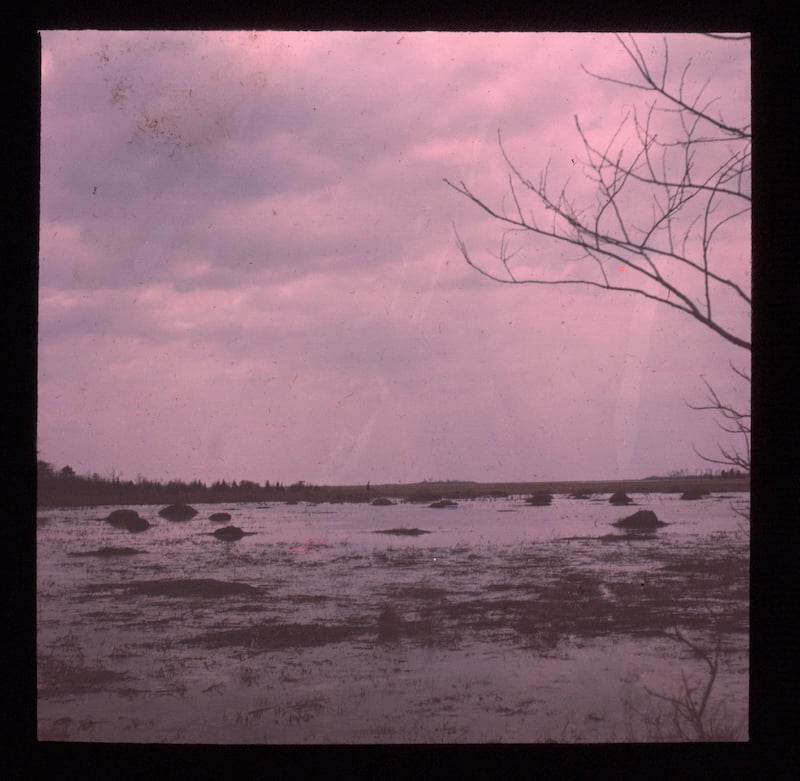
I didn’t think so.
The New Jersey Drought with Joe Martucci
Martucci, a meteorologist, gave us some background on when the current NJ drought conditions started and provided a guess as to whether they might let up in the near future (probably not). I’m a weather nerd and enjoyed getting his perspective.
While I’m on the subject of weather, I will take this as an opportunity to encourage you to join the Community Collaborative Rain, Hail, and Snow Network (CoCoRaHS) as a precipitation observer. CoCoRaHS is a non-profit org, and getting started just requires the initial cost of buying an approved rain gauge and setting it up per their instructions. Then, you enter your precip each morning on the app. For bonus points, you can add additional comments on conditions. I really enjoy contributing and am glad the data is used by orgs such as the National Oceanic and Atmospheric Administration (NOAA). Here I am.
That’s all for now.
Additional Notes.
Wondering what we’re losing due to the Trump administration’s firing of NOAA scientists? Check out this interview with Sarah Cooley. Cooley who had been the director of NOAA’s Ocean Acidification Program.
I’ve been working on a book list for my climate change reading group (which will go toward my service project for my Rutgers Environmental Stewards certification). It shaping up to be a good list (more on that soon). In the meantime, I wanted to share one book I just finished that will likely be on the list—in case you are looking for something to read now: Bill Mckibbon, The End of Nature (1989).
Thank you for reading. Views my own!