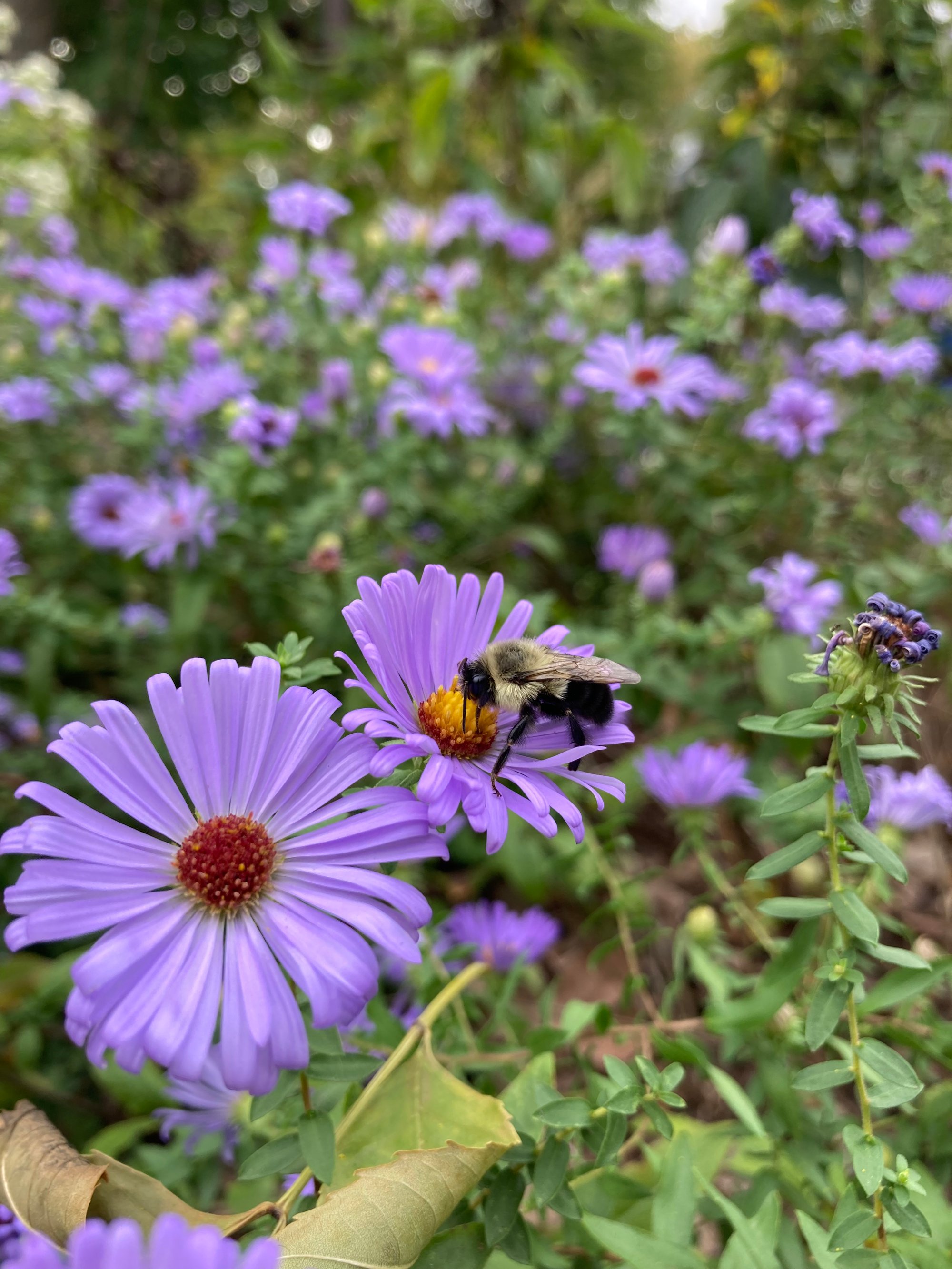
Butterflying
Looking out my porch windows at my front garden a few days ago, I scanned for wings fluttering among the blooms. I was trying to recapture the magic of the two days I spent butterflying with the New Jersey Butterfly Club in Cape May, New Jersey, in September. Who knew I would enjoy spending four-five hours a day looking for our colorful little invertebrate friends?
The trip started out somewhat ominously. Rain and wind were predicted for my time in Cape May. I wasn’t sure it I would actually have a chance to go out.

But it didn’t actually rain much while I was there, and the sun did, in fact, come out. Luckily, a few intrepid members of the club also joined me.
Everyone in the group was welcoming and kind. A local guided us to naturalized areas in Cape May Point. (I think we started out at Cape May Point State Park). We spotted a monarch (Danaus plexippus) on some blue mistflower (Conoclinium coelestinum) right off the bat.

We ran into some other wildlife as well, such as this eastern mud turtle.

We saw lots of common buckeyes (Junonia coenia).

And several caterpillars.

Before the end of our first day, we watched a monarch being radiotagged with a fancy transmitter you can track with an app. (I’ve been tagging monarchs with stickers through the same program. I tagged six so far this season!).

On day two, we continued our quest through Cape May Point. We spent the first part of our morning in the pollinator garden at the Cape May Point Arts and Science Center (where I was staying). Below, you can see an American lady (Vanessa virginiensis) enjoying the sun.

We also spent a some time in Cape May Point Park (nestled in a neighborhood), which boasts several abundant native plant gardens. Here, I met my first cloudless sulfur (Phoebis sennae).

You can read the inventory of what we spotted on this trip on the South Jersey Butterfly spotting website. Click here and here.
Wishing for more butterflies, on September 30, I was very excited to find an orange sulfur (Colias eurytheme) on New York ironweed (Vernonia noveboracensis) in our own garden…

…not to mention monarchs such as this male (which I tagged) on New England aster (Symphyotrichum novae-angliae).

I loved my time in Cape May learning new things and meeting new people. It turns out that butterflying—or observing any invertebrates or wildlife—is a very accessible form of conservation. Here are some tips I learned about how to butterfly:
—look in sunny areas when the temperature is above 60 degrees…
—and there is little wind…
—…and you have a few minutes to just wait!
—When you see one, if you point it out, be sure not to cast a shadow on it. Otherwise, it is more likely to flutter away.
When I look at a butterfly, I wonder lots of things. How did they find that flower for nectar? Why and when is it going to fly away? Will it spend the night near by or far away? How long as it been around, and why are parts of its wings frayed? Where is it going next? Are they aware of other butterfly species around them?
You can butterfly alone or with others. Or, you can butterfly alone and assume you’ll meet kindred spirits! One thing I have liked most about this hobby is encountering strangers in nature looking for things and exchanging notes about our adventures. Earlier this week, while surveying the Boundary Creek Natural Resource Area in Moorestown (a Burlington County, NJ, Park), I introduced some birders to butterflying and the native plant (snakeroot, Ageratina altissima) the orange sulphur I observed was perched on.

After about half an hour there, I had been disappointed that I had not yet seen a butterfly. And then, to my delight, I saw the orange sulphur…followed by a variegated fritillary (Euptoieta claudia), an eastern tiger swallowtail (Papilio glaucus), a monarch, and, I think, an American lady (Vanessa virginiensis). All I had to do was wait a little while longer to see so many species within a few feet of each other. I couldn’t wait to tell Tyler what I saw when I got home.
Sometimes you have to create your own joy so you can keep resisting.
Additional Notes
What’s on my bookshelf? A lot of things! But here are a few books about butterflies I look forward to reading soon:
The latest issue of Butterfly Gardener! This is available to members of the North American Butterfly Association.
Patricia Taylor Sutton and Clay Sutton, How to Spot Butterflies (Boston: Houghton Mifflin, 1999).
What I have been up to? I attended the second annual Climate Summit at the Cape May Point Arts and Science Center last Saturday. The biggest takeaway was that we need to show leadership by talking about climate change and helping individuals (not to mention governments and corporations) understand what they can do to mitigate it. I knew this, of course, but sometimes it’s good to hear it.
I learned about a few resources I want to share:
”Today’s Weather,” Climate Change Institute, Climate Reanalyzer, University of Maine. (If I had a science brain, I probably would have majored in meteorology.) According to the website, the resource “shows the current foretasted conditions across the globe. This is a good place to see how air and sea-surface temperatures depart each day from the long-term average.” I think I would need an expert to help me understand what I’m looking at!
National Academy of Science and the Royal Society, Climate Change: Evidence and Causes (Update 2020). This publication is not brand new, but one speaker noted it was a good one to give to folks who still may need to be convinced that climate change is happening and/or folks who are looking for a basic introduction to the science. On the Royal Society’s website, you can also see a 2026 update to a few key questions about climate change. The website linked in the previous sentence also includes a very good, short video about climate change and its consequences.
Finally, and, perhaps, most importantly, Bob Mullock, the President of the Cape May Point Arts and Science Center, concluded the convening by reminding us that we (as in, people living in one of the wealthiest countries in the world) need to remember to help those who are experiencing the worst of climate change here as well as abroad (a concept usually referred to as climate justice).
How are Monarchs doing? All butterflies need our help. Monarchs probably are the best known butterflies who need our help even though the Eastern monarch numbers are up. (And here’s a few notes on why butterflies are important.) So I was disheartened when a monarch on our property unsuccessfully emerged from its chrysalis the day I came back from my butterflying trip. But today, I found a monarch friend in our garden that just made a chrysalis. We are rooting for you.

Views my own.