
A Volcano Caused the Black Death?
Plague on a Boat

Modern Medieval
by David M. Perry and Matthew Gabriele
Not really, but sort of.
According to a new paper just published by an interdisciplinary duo of scholars though, a 1345 eruption by an unknown volcano seems to have significantly effected the climate. In written sources from the period, they noticed increased references to overcast weather and a peculiar lunar eclipse. This led them to examine polar ice cores, which showed increased evidence of volcanic ash in the period, and tree rings in Europe, which showed reduced growth (likely from less sun and wetter weather).
Ok, but so what?
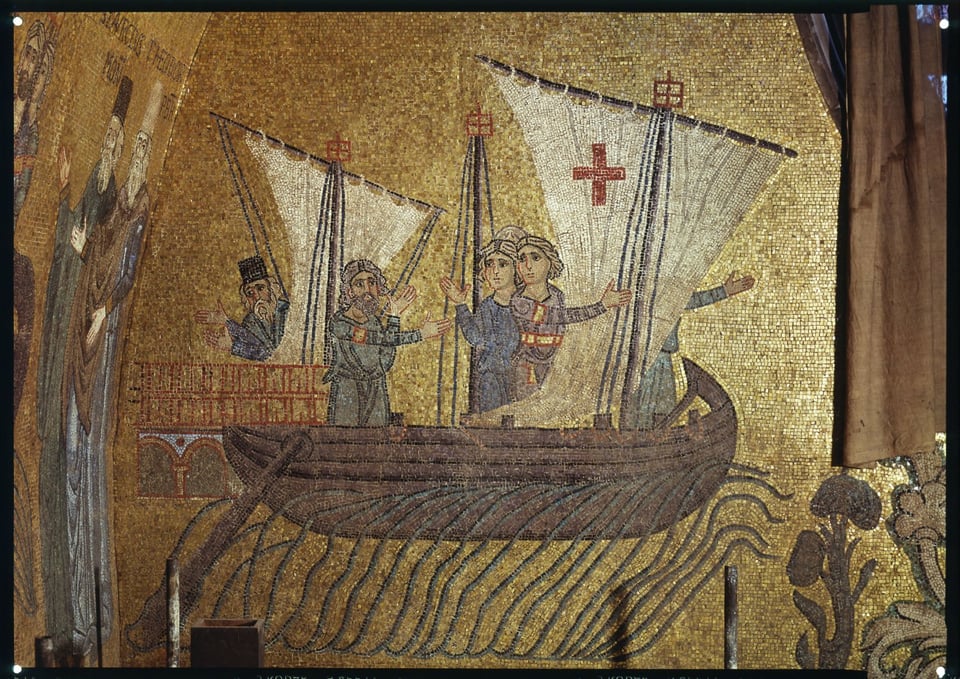
This agricultural change would necessarily mean problems with crop harvests and force the population of Europe to have to import grain from elsewhere, so the Italian maritime republics (Genoa, Venice, Pisa) looked to the Black Sea region and intensified their grain trade with the Golden Horde (a Mongol state). But Mongol grain supply included rodents carrying Yersinia Pestis, so ships carrying grain carried rodent and fleas with the Black Death.
As the scholar Monica H. Green told LiveScience:
“This study brings in new information on the 1345 volcano, which helps explain why the Black Death — that is, the epidemic well-documented in sources from 1346 to 1350 — happened when it did,” Monica H. Green, an independent scholar and expert on the Black Death who was not involved in the study, told Live Science in an email. “But it happened how it did — with a 'plague infrastructure' of rodents and insect vectors already established — because local reservoirs had already been established.”
Or, to put it another way, it was a number of things coming together at a particular moment that caused the Black Death to happen how it did. The volcano set the stage and created the conditions for the famine and acceleration of trade, but the plague wouldn’t have happened if the vectors of transmission - those “reservoirs” - weren’t already in place.
Now, all that being said, no piece of research is perfect and we have some quibbles with this one as well.
As is often the case with SCIENCE™ meets BLACK DEATH, the science-media infrastructure explodes with reporting that overstates what’s actually being found here in the academic research. Dozens of articles promoting this scholarly piece do a bit more than the study claims, which is too bad, as the actual finding is at once modest but NEW! And new is good.
The authors write:
A post-volcanic climate downturn and trans-Mediterranean famine from 1345–1347 CE forced the Italian maritime republics of Venice, Genoa and Pisa to activate their well-established supply network and import grain from the Mongols of the Golden Horde around the Sea of Azov in 1347 CE.
And the research behind it combines science — “state-of-the-art summer temperature reconstructions that used maximum latewood density (MXD) measurements from hundreds and thousands of core and disc samples from living and relict trees collected at near treeline sites in eight different regions across Europe … compared against high-resolution estimates of volcanic stratospheric sulphur injection (VSSI) derived from the geo-chemical analysis of ice cores collected in Antarctica and Greenland” — with written records, in the best kind of way.
Certainly, historians have known that (see this terrific Hannah Barker article) while trade embargoes limited grain trade in 1346, the lifting of embargoes triggered a rapid increase in grain trade (with rodents, fleas, plague along for the ride).
What we didn’t know was the specifics of the volcano that cooled the weather that depressed grain production in Europe that meant more active domestic markets in Europe for Black Sea grain! And this is important to know, to help us fill out the picture of what’s going on a meta-level at this time. So we get to add that volcano to the list of factors that meant the pandemic in Europe started in the late 1340s and not, say, a few years later. That’s new information (to us at Modern Medieval anyway, though surely not to others more closely engaged in this area of study) and is neat! But the danger in the reporting, and something we should always keep in mind with this kind of SCIENCE™ reporting, is that we don’t have to push the finding beyond the admirable humility within the findings themselves.
-
Thanks for the perspective!
-
If true, this little blip in the climate was superimposed on a longer term cooling that occurred in the 14th century, (one of the mini-ice ages, ) which was responsible for the decline of wine production in England and the extinction of the Greenland Norse.


Add a comment: