Hammers on Paper (and GenCon Schedule!)
Notes on typewriting, plus where you can find me if you happen to be in Indianapolis this week
I started working on “The Assumption of Maria” (out now at Lightspeed Magazine!) while I was in a longhand phase, but when I tried writing it out the prose didn’t feel right. The sentences unfolded, flowed, and transformed when I wanted something more terse and hammerblow. Shifting back to the computer, I faced the focus issues that dogged me with particular tenacity at the time—COVID, parenting, world-on-fire, you know, the usual—but even when I managed to dial in, the rhythm didn’t hit right. The writing felt too breathless, light and flexible and panicked. It felt like computer writing, and even (though I may be imagining this) like computer writing of a certain era. I might not have been able to spot the difference if I hadn’t just written three books and a novelette with a fountain pen, after having written eight or ten on a computer. But I could feel it in my bones.
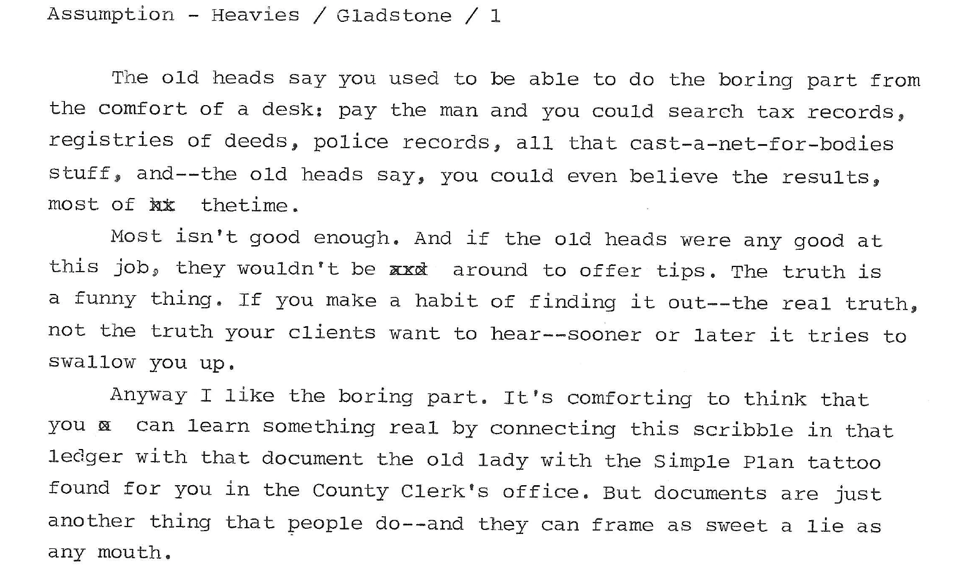
In the end, to get the rhythm right, I busted out my granddad’s old electric typewriter. The permanence of each choice, the .22 report of hammers striking the old textured paper he’d stored with the instrument—I had thought it would be a fun bit of cosplay but it was more than that.
We talk about style as if it were a choice and choices are certainly involved, but they are shaped by the affordances of our tools. When a sentence requires more commitment, when it is more of a sacrifice to revise, the quality of thought changes. Each keypress hits differently when followed by a sharp, almost painful crack. Working on the typewriter led to punchier, heavier prose, with more thought in the whitespace between the lines, and more room for the reader and the character. I under-wrote for what might be the first time ever.
I didn’t write one hundred percent of this story by typewriter and I certainly didn’t edit it that way, but when I sat with the draft on the screen and began to move things around, I found myself guided by the rhythm of that device.
I liked the typewriter so much that I wondered, could I write everything this way? But while fountain pens are extremely well-supported tech in 2026, and manual typewriters have plenty of adherents—you can still find ribbon for many and even make your own—electric typewriters like my grandfather’s (a Coronamatic 2500, a hilarious bit of synchronicity for a writing tool during COVID) require sealed and mass-produced ribbon cartridges, and are trickier to source. Some models are still widely used in the Japanese civil service, but otherwise you’re in for a hunt when it comes to cartridges. It’s funny how many inventions that shaped decades of the twentieth century were less a matter of arranging atoms and parts in a novel way, than they were a matter of arranging distribution and production mechanisms, and capital, to support, make, market, and sell those arrangements of atoms. (This is true of the mass market paperback as well.) A quarter of the way through the twenty-first century, that process is continuing. Accelerating, even.
I’m on the road to GenCon today, and will be out of pocket for the next few. I hope to see those of you who are at the con!
Here’s my schedule of panels:
Thursday July 30
11am, Ballroom 3: Story 201: The Mushy Midpoint
5pm, “Boston” (a room, not the city): Story 201: Setting as Character
Friday, July 31
11am, Ballroom 3: Beginnings, Big and Small
3pm, Albany (again, a room): Coffee Klatch
Saturday, August 1
11am, Ballroom 2: The Intersection of Games and Novels
Sunday, August 2
10 am, Ballroom 1: Read and Critique- All Genres
And that’s what I’ve got for now. Take care of yourselves, and work for the liberation of all sentient beings.
-
Have fun at GenCon!
I love this typewriter detail. I have only used one once, as a kid, and both loved and was terrified of it. It would be fun to try and write something on it...
I certainly relate to wanting different physical media for different stories. It's harder to write complex code narrative on paper, but I still itch for it, sometimes when the computer screen is a block!
Add a comment: