26:2 A Cage Went in Search of a Bird
Internet rewilding, technology, and our many possible futures. Dog pictures always.

Dear friends and readers,
This week I’ve been interviewing people building the new social internet, the rapidly brightening array of spaces and services contesting the toxic monoculture of Big Tech platforms. I’m furiously typing the words of people who make everything from the underlying protocols to micro-blogging sites to distributed ways to solve that thorniest of problems, content moderation. It’s both more heartening and worrying than I’d expected. The challenges are vast and the stakes are high. Right now we’re paying for the ‘free’ internet with democracy. Money would be so much cheaper.
My immediate problem is tiny but pressing. How on earth to put the thousands of words of reading and interviews* about a new and rapidly changing field into a chapter with a narrative arc that makes any sense? According to my book outline, this entire chapter was originally meant to be just a section of one chapter, so there’s no help from that source. Funnily enough, the overall argument I’m trying to make about the social internet is that we need to be more ok with friction, uncertainty, and feeling a bit lost, because we innately know how to get where we need to go. So, I’m doing what fiction-writing has taught me to do; press on with the gathering and thinking, take plenty of podcast-free walks, draft fast and loose, and trust that the story will reveal itself.
* Each hour of a subject talking comes in at 4-6,000 typed words. Having learnt piano as a teenager, I type at close to talking speed, with lots of shortcuts and misspellings. Afterwards I clean up the transcript, print it out to read, highlight important ideas or quotable bits, and print it out again. It’s a lot of work, and many people use transcription services for all this, but I like to type as I actively listen, and work with paper drafts I handle, scribble on, and mull over. I think ideas happen as much in the body as in the mind.
In the meantime there’s just. so much. scuttlebutt. Gossip. Loose talk. Gory details and hilarious human frailties. NGL, almost none of it will make its way into the final book, but this past week I’ve heard so much about dick pics, furries, wild behaviour in high-level political meetings, people whose shitty product is predictably failing who blame it on scurrilous state-actors, and all manner of individuals, organisations and even whole countries fucking around and finding out. I’ve also heard how some people making the new online spaces have discovered, in real world meet-ups with other builders, that their protocol community is the place and people they’ve been seraching for all their lives. Which is not, as many readers will know, the typical experience of technical standards meetings.
I started this book by wanting to tell the story of the present and future internet in a way that makes everyday people care about it as much as those who tend it do. Very quickly I learnt that the story of the internet is the stories of the people who build and maintain it. And those stories are so full! They’re bubbling right over the brim with colour, incident, purpose. So often in my interviews we get to talking about what the purpose of a life truly is. How can individuals and groups bend the arc of inexorable tech momentum toward justice? And how does it feel to sense that your moment has passed, and that you failed? That’s maybe not what readers expect from protocol engineers and software developers, but not a single person I’ve interviewed has wanted for meaning. They know their life’s shape and how it maps onto the struggle to make the internet connect us to the best of our selves, not the worst of our species. And not a single one has stopped trying.
That’s why this book is so hard to write. It’s trying to do several impossible, quixotic, and essential things. I’ve finally realised there won’t be a moment when it gets easier and quicker, when, as often when working on a story or (my one) novel, it finally teaches you how to write itself. I’m trying to make something that’s beautiful, useful, and true, a piece of work that matches the intent of the people I’m writing about. In no universe will that ever be easy, but I hope it will be worth it. In the army they often say ‘Train hard and fight easy.’ I hope this book will be ‘Write hard and read easy’, for readers. And in the meantime there are the interviews; conversations where I find myself, as I did last night, closing the window, turning around to my incredibly bored dog and saying ‘I can’t believe I get to talk people like that about their life’s work.’
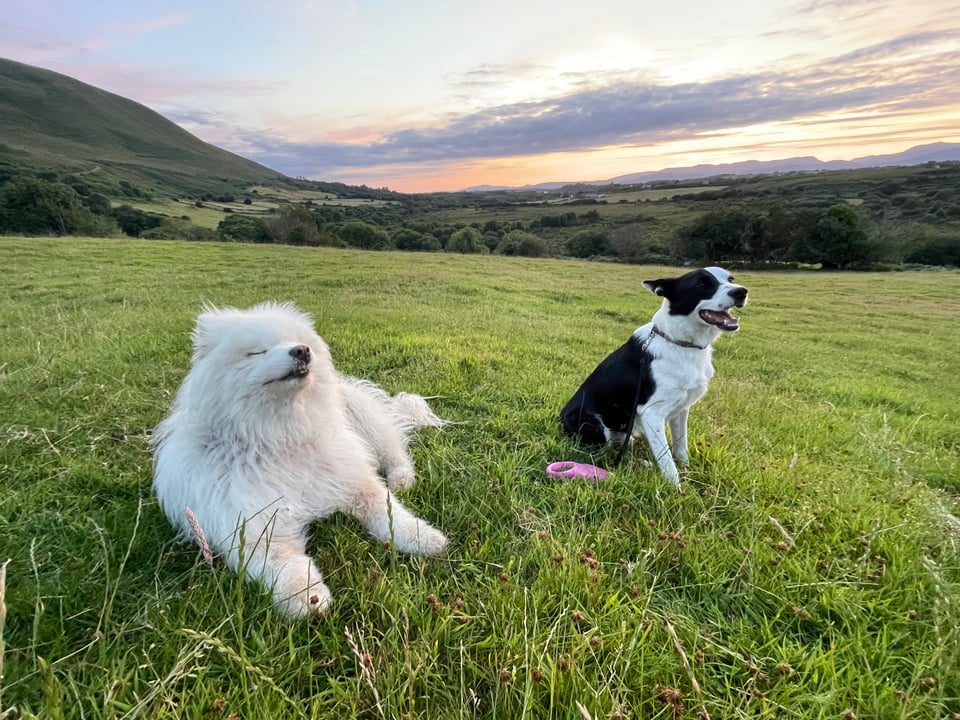
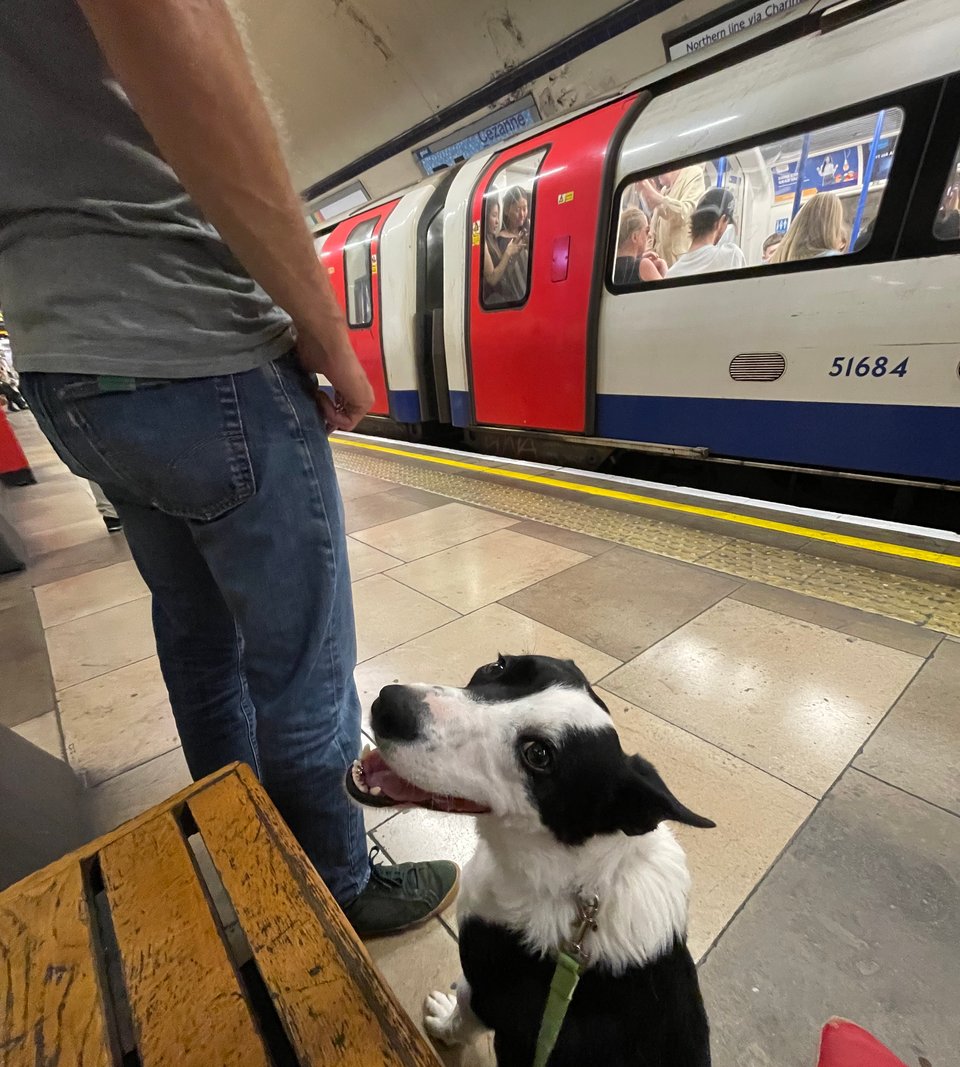
And so to the pupdate. We’re back in London. On Milo’s return to the café where his and Molly’s pictures hang behind the bar, Milo made a stately progress by each table and received what he felt was an appropriate amount of head scratches and compliments. I’d thought he was happier in Kerry with the cool, fresh air, and walks on the beach, but this is a city dog through and through. Chip is thriving, partly thanks to a daily dose of dog-Prozac which has made the world a slightly less alarming place. He takes sirens, buses and Tubes in his stride and has honed his squirrel-chasing skills. Let’s see how he copes with England’s endless fireworks season which starts around now and runs until Christmas.
No book recommendations as I’m in the Second Great Reading Drought of my life. But! The 40+ hour Penguin audiobook of The Brothers Karamazov, read by Bridgerton actor Luke Thompson, is my constant companion. He makes each character distinct without being stagey, and totally commits to the long chapters of Orthodox theology and lawyers’ speeches. They’re genuinely fascinating. As audiobooks go, this one is a masterpiece. It’s also constantly funny, both intentionally and in how wildly the “Karamazovian emotionality” - i.e. constant weeping and hysteria - of the male characters contrasts with every buttoned up, upper class man in any English or French nineteenth century novel I’ve ever read. The Karamazovs are messy.
Until next time, Maria
Subscribe here for email newsletters. You can also subscribe via RSS.
You just read issue #9 of Maria Farrell's Newsletter: A Cage Went in Search of a Bird. You can also browse the full archives of this newsletter.