Life Is Short and the World Is More Like 42% Terrible + A Cover Reveal!
I have been thinking about Maggie Smith’s poem “Good Bones” this week. It begins with the line “Life is short, though I keep this from my children.” A devastating move, to begin with a cliche, pause with a comma, and add, “though I keep this from my children.” It was something I noticed the first time I read it, something that made me pause immediately because I do that too. You have to.
“Life is short” becomes a refrain:
Life is short and the world
is at least half terrible, and for every kind
stranger, there is one who would break you,
though I keep this from my children.
I don’t believe this. I can’t. This can’t be the ratio. It is hard to believe at times but I do believe there are more good people than bad in the world, or more more-good-than-bad than more-bad-than-good.
I do believe this, what she says at the end of the poem: “This place could be beautiful, / right? You could make this place beautiful.” The way that “right, question mark” hangs, isolated, on the next line, undercutting what seems like a statement, a fact, breaks my heart but makes the line more true, more perfect.
My youngest son asked me a question yesterday: “What’s the point of school if we’re all going to die one day?” (He’s ten, and I gave him my old iPod over break, and so he’s just gotten in to Radiohead, so I just want to let the world know how proud I am of him.) I don’t know if I gave him a good answer. I said that’s a good question. You could say that about anything. What’s the point of doing anything? What’s the point of loving people? Only you can answer it. But I’d like to add, in the words of Maggie Smith: “You could make this place beautiful.”
I have a book cover to show you:
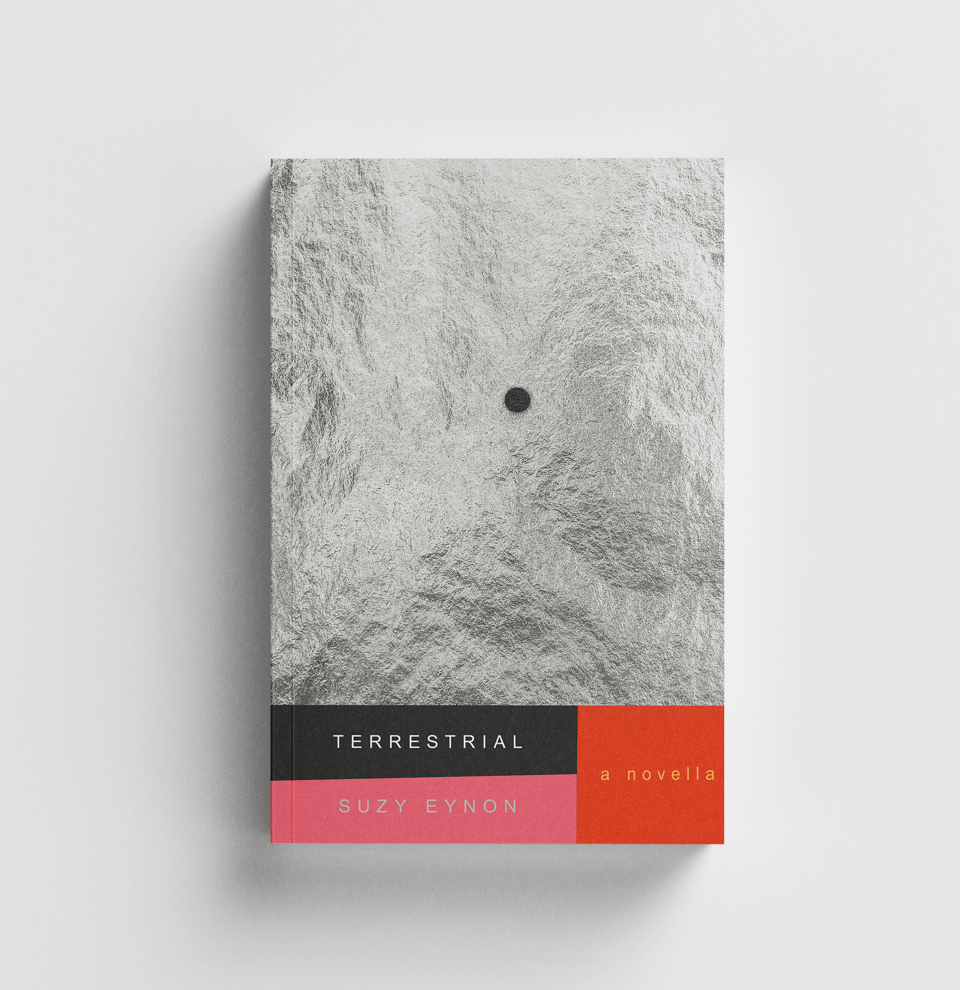
Angelo Maneage, an artist whom we have worked with on probably a dozen books at this point, designed the cover for Suzy Eynon’s forthcoming novella, Terrestrial. Angelo will usually give us three to five options, and usually the one I like the best is not the one the author prefers, but this time it was quick and immediately unanimous. No revisions, no tweaks. We both loved it. Here’s what Suzy says about it:
When Angelo started working on the cover design for Terrestrial, he asked if I could point him to any parts that I felt captured the whole text. I knew I wanted to focus on and bring a visual to the parts about the town where Daisy lives, the desert surrounding her, and the lights she sees. Angelo really got this, and designed a few covers that showed the mysterious-desert-versus-subdivision-block-houses vibe I wanted. He surprised me though: one of the designs showed something from the text I hadn't thought to point him to, an object from Daisy's childhood: a foil-covered paper tube used to view a solar eclipse. That someone read the book and came away with this image as one that stood out, made this connection between the object and the larger narrative, made me feel like I was able to communicate what I intended with the book. Like a message sent and received.
I don’t think I have ever thought of it this way before but a good cover is a close reading of a text. I’m sorry to turn this away from celebrating Terrestrial but Suzy’s note put into focus for me exactly what we get when we work with artists to design book covers, something that no AI program can ever replicate. An AI can generate an uncanny image of a dog with a human face, but it can’t close read a text. There has never been a moment where I thought, well, we could get these covers made a lot cheaper if we used AI, but a lot of people do have that thought, and act on it, and in doing so cheapen their work, and their lives, and all our lives. They make this place less ugly.
Back to Terrestrial, which deserves celebrating. As usual, this is a hard book to describe but here is a description: While skipping class one day, seventeen-year old Daisy finds a mysterious message in the girls’ bathroom. Though she’s not sure if it’s meant for her, she’s determined to find the sender. Every message has a sender. Soon she begins witnessing strange lights in the desert surrounding the small Arizona town from which she’s determined to escape. Before she can go far, however, she must face the parts of herself she wishes to rewrite. Inspired by the Phoenix Lights phenomena of the late 1990s, Terrestrial explores themes of isolation, communication, place, and the desert as both a home and a questionably inhabitable environment.
There were so many moments, beginning with the first paragraph, where I saw my young self in this book, desperate to connect with people, clueless about how to do it, wishing I was invisible, wanting to escape. It’s a quiet book, a beautiful book, and I want to thank Angelo and Suzy for doing their part to make this place beautiful.
Preorder a signed copy of Terrestrial
Everyone always says preorders are so important, but I can explain precisely why they are so important for us: We are hoping to print 250-300 copies of Terrestrial with Bookmobile, a printer based in Minneapolis (we were able to print four books with them last year). Not to disparage print on demand, but the Bookmobile copies are a tad higher in quality than POD, but even small print runs require a big chunk of money up front, and every preorder makes it more possible for us to get there. Book club subscriptions also help, so if you’re interested in a year of book mail, which comes not just with books but also a nice selection of zines, the Malarkey Book Club is the ticket.
Add a comment: