
Tongues, Volume 1
Ancient myth and modern language
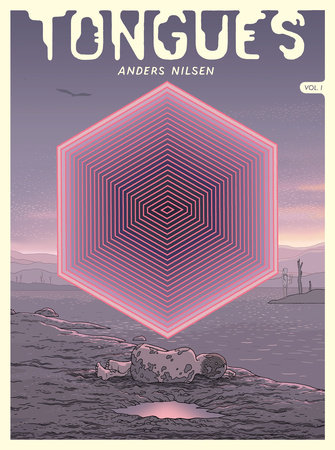
Anders Nilsen’s graphic novel Tongues isn’t a book I planned on reading last year; I only caught a glimpse of its cover a few months ago and didn’t remember the name. But that surreal image of concentric hexagons casting a spare landscape in neon purple stuck with me, and I’m glad I got around to identifying this modern fantasy narrative. Nilsen’s adaptation of Greek myth carries both melodic beauty and interrogation of the human condition on its palate.
Tongues follows three plotlines set in central Asia in a slightly fantastical present day. The Prisoner is a supernatural being who discusses his catalytic role in early human evolution and the advancements of modern humanity with the eagle assigned to his torture. An American youth known as Teddy Roosevelt, wandering the desert with his stuffed bear, finds himself embroiled in conflict between mercenaries and religious fanatics over a surreal cube. Kenyan orphan Astrid, released from cult captivity by a chicken, seeks the knowledge and skills necessary to assassinate the cult’s mythical leader called the Omega. Each protagonist must confront their own lack of understanding and decide whom to trust in a multi-faceted struggle between adversaries for whom humanity is just another toy.
The baroque art and polyphonic narrative grant Tongues an arresting, evocative reading experience. While much of the book takes place amid the desert’s drab tones, shocks of color in brief scenes of peridot mosques and golden hallucinatory geometry accentuate emotional high points. Intricate panel arrangements organize the action with visual motifs, emphasizing the connections between humans and their animal companions, that establish character voice. Likewise, interpolating the myth of fire-stealing Prometheus onto the evolution of human language and modern-day central Asia casts the story in a grounded, urgent light, setting the main players of an ancient belief system into a world that has mainly forgotten them. Nilsen’s protagonists may speak with animals or constitute Rorschachian blobs, but their world of car crashes, child trafficking, and skepticism toward nonhuman intelligence is much our own. This mythic setting enables Tongues to explore themes of knowledge and choice with helpful comparisons to the real world.
What I found less helpful was Nilsen’s burgeoning human exceptionalism; past boilerplate assertions that all animals “have full and complex minds,” Nilsen’s characters unanimously consider humans unique for our inventive language and ability to change our behavior. In fact, animals such as chimpanzees demonstrate similar aptitude for recombining signals to create new meaning, and animals from bumblebees to fish learn new practices from each other all the time. Still, a focus on our own development certainly fits for a Promethean tale of the consequences of language development, the far-flung connections of modernity, and the relationship between us and our environment. As well, given that this is only the first volume of the graphic novel, I look forward to a sequel extending the themes with more hypnotic art and intricate writing. I’ll be chewing on Tongues until Nilsen’s next Herculean effort.