
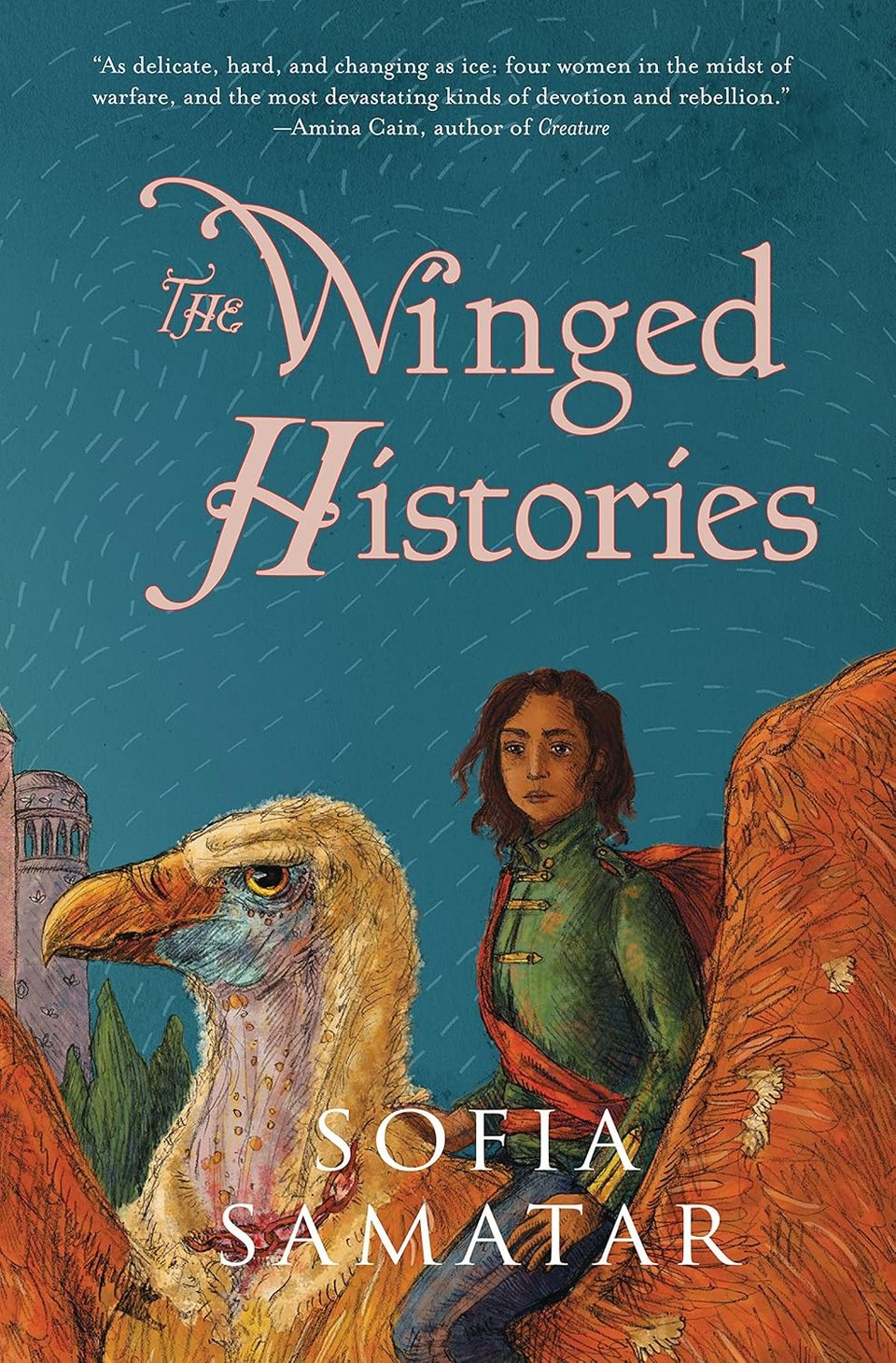
The Winged Histories
War and history on fantastic borders
Author’s note: I apologize for skipping last week; I wrote this post but, due to a scheduling error, failed to publish it. We’ll be back to regular Thursday updates going forward!
Besides giving a title to this newsletter, the notes and scribbles in the corners of manuscripts famously reveal interesting details about the creators, like Karl Marx’s classical influences and medieval European snail combat suggestive of differing ideas of masculinity. But hermeneutic dispute draws terrible violence from marginalia in Sofia Samatar’s magisterial fantasy novel The Winged Histories. Protagonist Tialon recalls how her father, the faith patriarch devoted to an ancient stone covered with esoteric wisdom, “raged at the scrawls for complicating” his priesthood’s efforts. Yet his companions in interpretation disagree, arguing “if we agreed that the Stone came from the Gods, that They directed the hands that touched it, then we must attend to even its smallest, most crooked lines” (139). This crisis of interpretation directly leads to persecution of “heresy,” but it also develops Samatar’s crucial questions of historical narrative: how do we sift out background noise from the main events of the past, and how do we choose which sources to interpret? In The Winged Histories, Samatar explores violent historical change through four women on the borders of a society uninterested in their voices.
Taking place in a fictitious, slightly magical world, Samatar’s first protagonist is Tav, who flees her noble family to become a swordmaiden for the Olondrian Empire but consequently realizes she’d rather fight for independence for her homeland Kestenya. Likewise, Tialon has been a prisoner to her father all her life, but new jailers force her to determine her own values. Meanwhile, nomadic musician Seren struggles with grief as she seeks peace for her war-torn people and her bellicose would-be wife. Finally, in the wake of historic bloodshed, noblewoman Siski must decide whether to remain cozy in her inheritance or risk her life for a strange and horrifying love. Each protagonist circles the issues of whose sacrifices are acceptable and whose stories will be told in beautiful but brutal world.
Indeed, Samatar spins out just enough detail in The Winged Histories to make her characters’ challenges personal while leaving parallels to the real world. Kestenya and Olondria overflow with copious conlang phrases and quirky customs like fig alcohol, but they are also filled with scheming kleptocrats, religious violence, and enduring sisterhood. The protagonists’ struggles aren’t just with abstract beliefs and governance but patriarchal family tradition, homophobic abuse, and childhood propaganda. Indeed, narrators glide through hazy recollections and dreams that connect their hopes to their life histories, illuminating their lives as those of multifaceted, realistic humans in a slightly unrealistic place.
A story this interwoven and nonlinear can be challenging to parse, as Samatar’s prose regularly straddles her protagonists’ past, present, and subjunctives page-to-page. Yet as a historian, I enjoyed how the psyche-trotting narrative connected the context of each protagonist to the sweeping historical changes they make. A family tree, glossary, and regular interludes by historians, together with a linear progression of events across protagonists, grant the story guide-rails among the more mystical sections. Admittedly, there’s a line or two that might require knowledge of Samatar’s previous novel A Stranger in Olondria for full understanding, which is also a lovely exploration of language via fantasy. But with its quartet of perspectives and steady pace, The Winged Histories soars all on its own.