
The Sane Vessel
Magic in a time of mercenaries
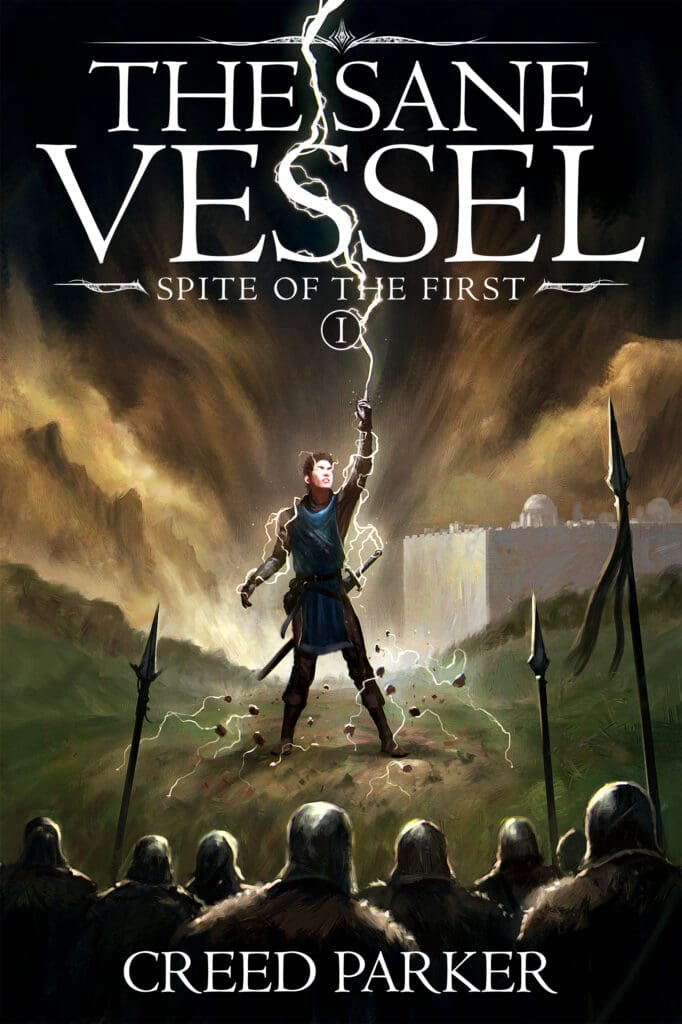
When I started this book review series a few months ago, I submitted my name as an advance reading copy (ARC) reviewer for indie authors on TBRindr. So I was pleasantly surprised to receive an ARC of Creed Parker’s debut novel The Sane Vessel, an inventive fantasy yarn featuring enslaved protagonists fighting their oppressors with elemental magic. This is a good story to check out for exploring a gritty, fantastic world, with some first-book caveats.
The Sane Vessel takes place in the fictional land of Kalnen as Ezlos, imprisoner of the elementally-empowered “vessels” with a revolutionary agenda, blows his cover to shepherd two vessels to freedom. While escapee Orun longs to return to his family, he soon finds that the system of “vesseltrade” runs through the idyllic farmland of his past. Fellow escapee Zarna seeks revenge on their imprisoners, but while Ezlos offers a simple plan to defeat Kalnen’s mercenary-lords, the vessels must choose their own moral boundaries.
As a longtime fantasy enjoyer, I appreciated Parker’s descriptive and plotting skills. Vessel powers are both terrifying and visceral, especially as Zarna pushes through the burn to fuel her vengeance. I also found Parker’s attention to detail in action sequences refreshing; when a guard holds “his sword in his right” hand, “the metal on his shoulder and wrist grating against the wall” on a narrow walkway, and Zarna perceives her advantage in “swinging in open space rather than against stone blocks” (180). The narrative note of the wall holding back the guard both grants the combat verisimilitude and gives Zarna some characterization: this is not her first swordfight. But although this is a book with a lot of violence and cruelty, moments of humor and kindness provide a counterpoint, and I found intriguing depth in Zarna’s brighter moments in particular. Intricate imagery and understated emotion give Kalnen some novelty as a lived-in world.
However, this same focus on imagery of action and suffering and understated expression sometimes inhibit emotional connection to the story. Kalnen is a continent uniquely ruled by a two-decade oligarchy of mercenaries after centuries of monarchy, yet the repercussions for religion, economy, and global politics remain scant; though Ezlos is well-traveled, for example, he dismisses the topic of Kalnen’s religions in one paragraph as either irrelevant former worship of the monarch or commoner folk religions. Kalnen therefore feels slightly less like a place filled with people reflecting the diversity and vibrancy of a lived-in world than a container for the story of the vessels, whose lore is comparatively tantalizing but esoteric. The ending throws this lack of exploration into relief when the final action culminates anticlimactically, skipping forward to several sequel hooks. As well, with little time afforded to characters grieving or gladdening and the narrative often bouncing forward in time and place, I found it was sometimes harder to stay invested in narrative outcomes. I also found some recurring room for improvement in punctuation use, which might be cleaned up to slightly improve readability. In general, I would advocate Parker provide more entry points for the reader when fire and lightning are not dancing on the page.
Still, I appreciate a book with an interesting new world, well-described magic, and tactical swashbuckling. Kudos to Parker for also problematizing mercenary government, as the work of private military companies today is certainly worthy of scrutiny (consider this article in The Guardian, by Nicky Woolf, about the private military Nisour Square Massacre). Put The Sane Vessel on your list if you enjoy slow-building fantasy stories with tight action, because this container’s full.
If you enjoyed this review, consider subscribing for more or buying me a coffee!