
The Ballad of Black Tom
Lovecraft and racism [and housekeeping]
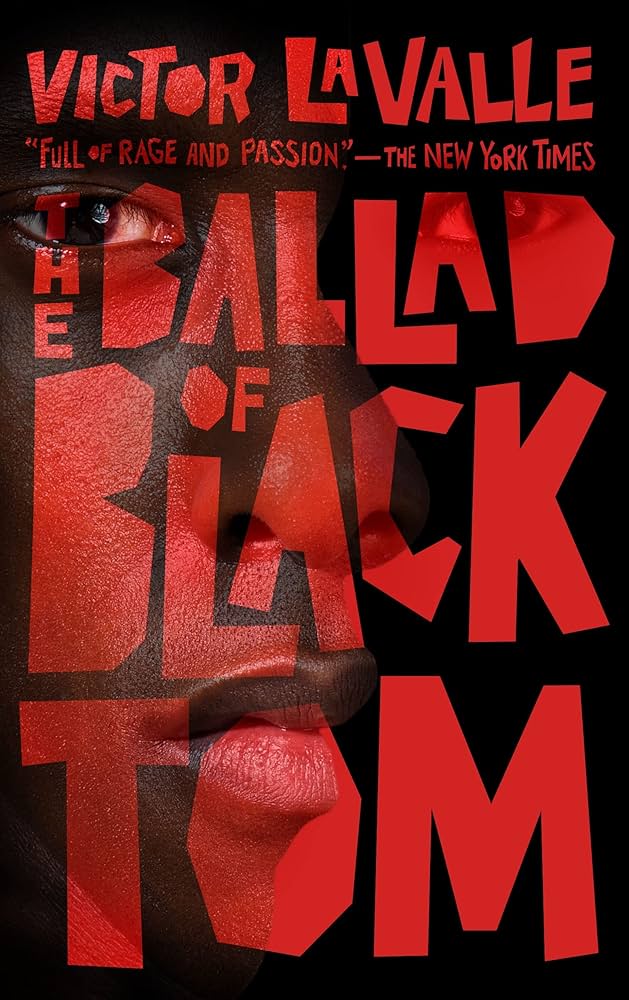
Early in Victor LaValle’s novella The Ballad of Black Tom, after titular character Charles Thomas Tester endures theft and threats to stay in Harlem from New York Police Department detective Malone and a private investigator, Tommy asks the detective, “You’re a cop. Can’t you protect me?” Malone only replies, “Guns and badges don’t scare everyone” (24-26). Tommy and Malone’s exchange both hints at the cosmic nature of the novella’s horror—weapons and insignia of human law don’t deter those with no consideration for society—while, in Malone’s callousness, demonstrating the tension between the ideal of impartial justice and the reality of police disproportionately killing Black people (see the statistics of Mapping Police Violence at this link). In The Ballad, Lavalle asks whether the cruelty of an indifferent universe is worse than systems that target victims with guns and badges.
The Ballad of Black Tom starts in 1924 Harlem with Charles Thomas Tester, a young Black musician and hustler making ends meet for himself and his work-disabled father by transporting antiquities and performing what little jazz he knows for whites in Queens and Brooklyn. Yet Tommy’s risk-taking attracts attention from both racists and forces beyond the veil of human comprehension. As he descends through interpersonal and cosmic tragedy, detective Malone pursues in his own quest for forbidden knowledge, but the various forces Tommy awakes do not always follow the law.
While LaValle’s style isn’t always elegant—the first few chapters in particular sometimes slide into ungainly exposition—it’s consistently atmospheric. The vibrant music, varied cuisine, and welcoming spaces of 1920s Harlem and the creeping chill of an environment gone slightly askew are opposite ends of the stage where LaValle’s characters struggle over the human concerns of family, race, and law. Dialogue develops organically, and while third-person narration occasionally limits knowledge of characters’ interiority, the perspective keeps up a steady pace and grants Tommy and Malone some ambiguity.
Speaking of perspective, The Ballad of Black Tom is a clear and self-admitted response to H.P. Lovecraft’s short story “The Horror at Red Hook.” “The Horror” shows both Lovecraft’s foundational cosmic horror ideas and his widespread racism (as discussed in a Brown University exhibition), and LaValle’s reimagining both acknowledges a literary influence and interrogates it with a Black perspective. It’s certainly not necessary to read the “The Horror” to understand The Ballad, but I appreciated watching this book reinterpret the first fears of cosmic horror. Lovecraft shows how guns and badges don’t scare everyone, but LaValle asks if they should.
On an unrelated note, I’m excited to inform you all that the first book I reviewed for this newsletter, Vajra Chandrasekera’s mind-bending novel Rakesfall, just won the Ursula K. Le Guin 2025 Prize for Fiction! Perceptive readers may have noticed that the first three books I reviewed were nominees for this prize, and I certainly have enjoyed something in each of this year’s books. Go check out the shortlist and Chandrasekera’s acceptance speech on the role of science fiction in society, or read the speech here! I look forward to reading and reviewing many more such thought-provoking narratives.