
Mad Sisters of Esi
Family and fiction across space
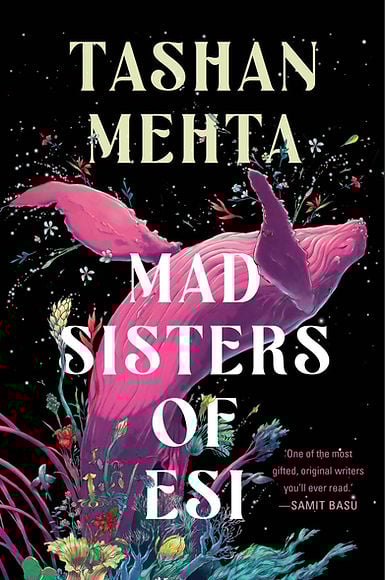
“Always look for the small things,” a historian advises his granddaughter in Tashan Mehta’s phantasmagorical novel Mad Sisters of Esi, “they are what matter” (308). In a book of big ideas—a museum outside time and space, a centennial festival of madness, and sapient islands with unique desires—Mehta probes how the small things of family and genre matter. This is a speculative novel about how the stories we tell determine the people we choose.
Mad Sisters follows two sisters, Myung and Laleh, driven by curiosity through the interior of a godlike whale outside of normal space and time. As they seek out the motives of their mythical creator Wisa, though, they encounter a hostile living island dedicated to Wisa created by her own sister, Magali. Ultimately, for Myung and Laleh to move forward, they must return to the beginnings of the original mad sisters of Esi.
For a book whose characters found their own universes, Mad Sisters stands out for the singular beauty of its writing and world-building. So many of the scenes stick out for their gorgeous imagery alone, and whether Mehta describes a claustrophobic descent through volcanic tunnels to the maelstrom of creation or scrambling up a mango tree to paint a new record climb on the trunk, the prose resounds with sensory detail. Similarly, the labyrinthine halls and lush islands of the novel provide memorable settings with touches of our own world’s stunning landscapes (depictions of jackfruit ecology on Esi deftly illuminate a climate change-mitigating productive tree, as The Guardian shows in this article by Suzanne Goldenberg). Mehta renders a striking, original world on every page.
What services the story slightly less is the sheer heft of the book’s digressions. Interludes of fictitious academic papers and lengthy endnotes, for example, sometimes feel like blunt authorial editorializing on the nature of stories, especially considering the placement of some essays at key points like the climax and an ephemera section after the epilogue. Certainly a reader who progressed 607 pages in Mehta’s fable might agree that fairy tales are “beloved” for showing “the possibility of change in our future...we seek potential, our wildness.” But given the position of this thesis among the tense final sections of the novel, I found myself pulled out of the narrative into critic mode (while I don’t have the time here, I would love to explore the limits of “wildness” in time-traveling speculative fiction more generally). The mad sisters provide a lot to ponder, but authoritative exposition sometimes also makes an otherwise neat plot ponderous in turn.
Regardless of miring exposition, though, Mehta offers a truly moving, thoughtful experience in the relationships between the mad sisters and their worlds. If you’re interested in rambling through a fairy-tale journey with analytical commentary by those mostly tangential to the action, characters concentrically circling the relationship between obsession and galactic familial love, or simply looking for new ideas of world-building and spacetime, read this book. If nothing else, read Mad Sisters of Esi for the small things: the bonds between family we choose over lifetimes.