
Light
Self-discovery across time and space
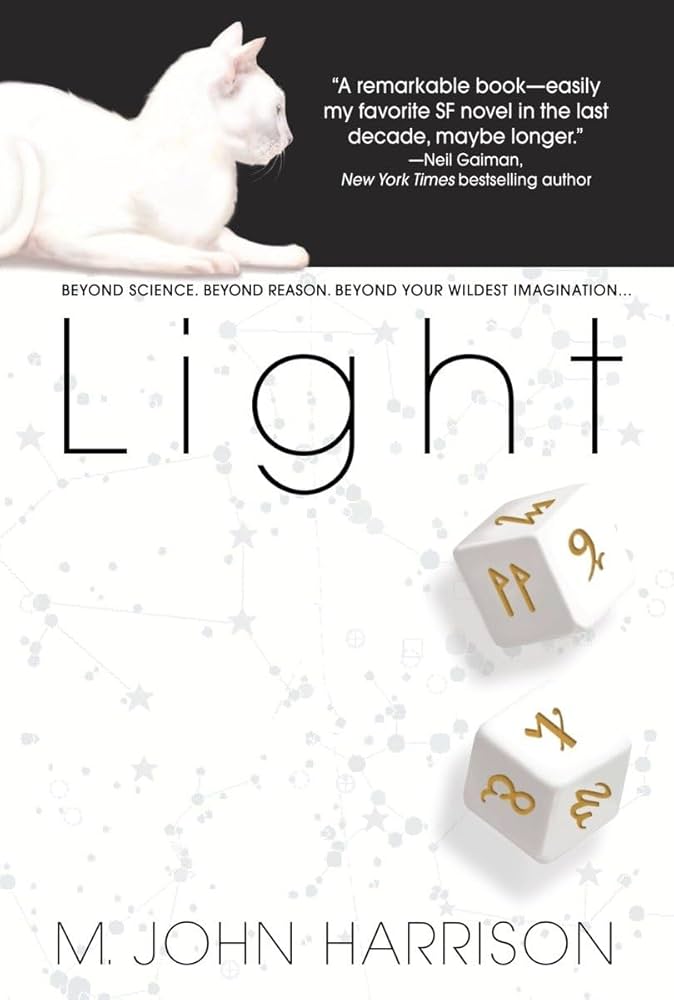
For the New Year in the culture I was raised in, I wanted to look back at some futuristic fiction. M. John Harrison’s 2002 science fiction novel Light is not only set both amid 1999’s millennium hype but also centuries later in the stars, with contemporaneous and fourth-wall-breaking commentary on futurism. Confronting his mentor in divination, protagonist Ed Chianese expresses existential despair: “If I’m predicting the future,” he asks, “why do I always see the past?” (203). While Ed’s struggle with divination is entirely fictive, the issue of inscribing the past onto the future is a historical phenomenon with deep cultural and psychological roots. In this labyrinthine and soaring novel, Harrison asks how our future stems from our past.
The 1999 plotline of Light follows physicist and serial killer Michael Kearney, whose haunting by both conscience and the cryptic, alien Shrander drive him to psychological decoherence during a quantum decoherence experiment. Meanwhile, in 2400, pilot Seria Mau Genlicher plumbs the mysteries of the Kefahuchi Tract lurking behind Kearney’s experiments, and virtual reality addict Ed Chianese flees his own past circling an inscrutable wormhole at the center of the tract. Each protagonist must grapple with the commodification of experience, perils of manipulation, and the power of love to understand the significance of their actions.
What drew me back to Light was masterful writing and worldbuilding. Harrison’s command of syntax vocabulary builds elaborate, clever paragraphs equally comfortable revealing the beauty of the Milky Way and casually noting a murder. Motifs of dice and white cats stitch together themes of self-knowledge, scientific advancement, and love to form a cohesive narrative from plotlines removed by centuries and lightyears. Indeed, for all the distinct character arcs, Harrison’s vision of the computational science powering interstellar travel and the delightful inconsistencies of the Kefahuchi Tract grant the story grounding in physics and wonder. Every page brings something different and awe-inspiring.
However, not all of Harrison’s diction has aged as gracefully (philosopher Edward Said convincingly demonstrated the flaws with “oriental” 24 years before Light, while “twink” seems entirely inapplicable as a slur for virtual reality addiction given its usage in gay subculture). For both these language choices and the occasional descent into masturbatory heterosexuality, I found myself put off on occasion, particularly in the overlap between these weak elements (there’s a page-long dialogue where a jilted woman accuses her ex-lover of being a “twink” that I found unintentionally laughable). While Harrison’s writing is usually bold, some of his words could’ve easily stayed on the other end of a wormhole.
Still, I enjoyed reading Light, and I expect anyone intrigued by spatial science fiction, nonlinear plots, and heady, subtle writing will find something interesting in this book. Some of Harrison’s choices belong to the past, but his vision cuts through to a revelatory future.