
Green Fuse Burning
Loss and rebirth in swampland
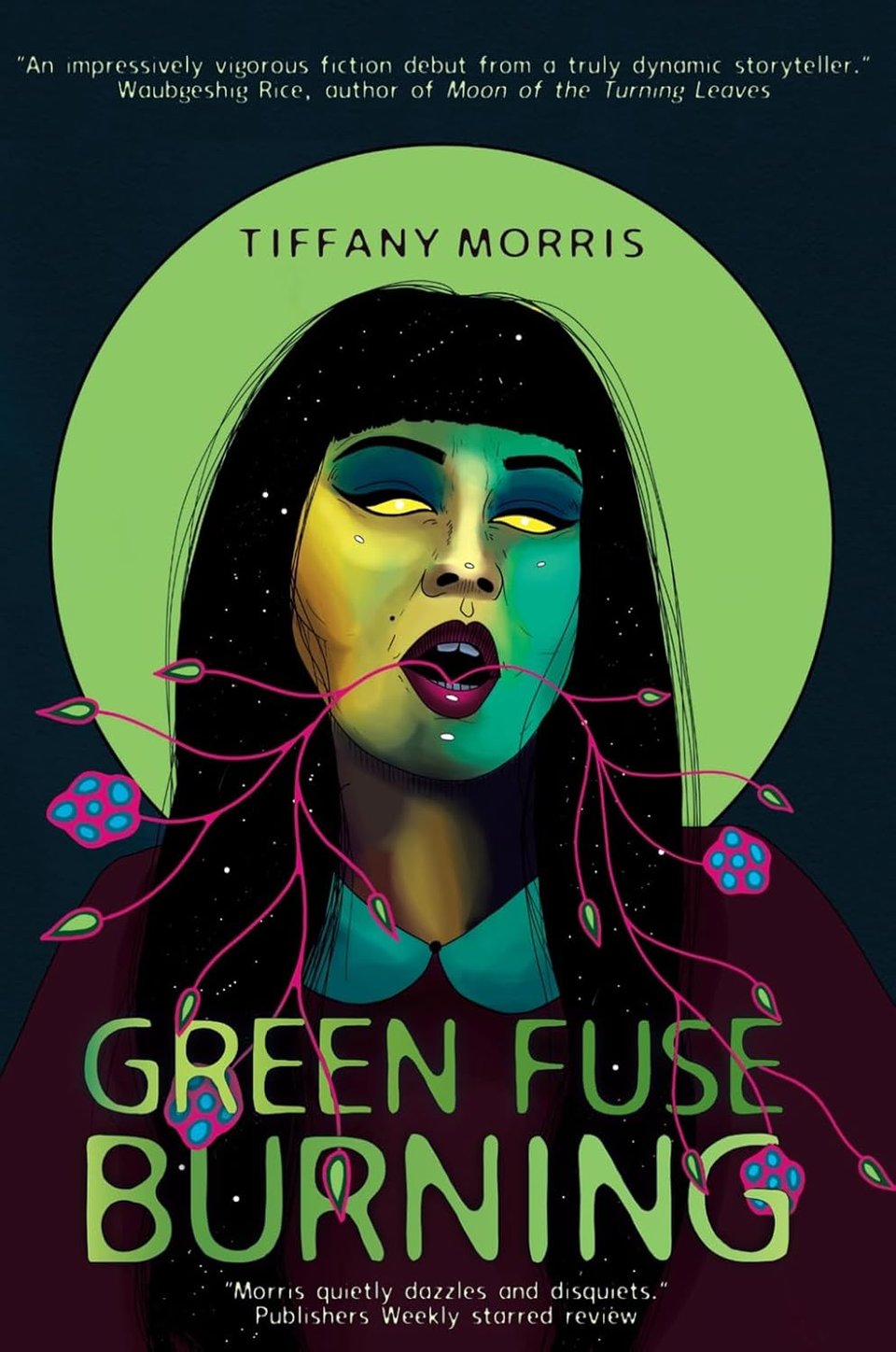
Tiffany Morris’s novella Green Fuse Burning starts with the old paradox of subjectivity: how can nature proceed so beautifully amid human loss? Observing “dark branches that would yield bright petals, soft blues and explosive pinks” in an early spring wrought by climate change, grieving protagonist Rita Francis only feels hopeless: the new weather is “unbearably hot and humid and wrong,” and “the hot weather made her feel wrong, too, like she didn’t fit in this new scheme of life, an aberration of rot in the blooming world around her” (19). The climate grief of mourning the orderly drawn-out budding of trees connects to Rita’s own feelings of bereavement, making her feel rotten for her gloom. In Green Fuse, Morris’s literally and metaphorically plumbs a northeastern Mi’kmaq swamp of life and the loss that nestles within it.
Green Fuse Burning begins in the present day with an art gallery exhibit label introducing Rita and her paintings, “recovered from the artist’s cabin following a mysterious disappearance” (9). The subsequent chapters start with further exhibit labels interpreting the art and hinting at Rita’s process before Morris dives into an over-the-shoulder narrative of Rita’s stay in the cabin and preceding events. Grieving her father and betrayed by her girlfriend, Rita at least hopes she can reconnect with her roots in the same forest where her father grew up. But when awoken by what sounds like a body being dragged through the woods, the landscape leads Rita into the uncertainties of the anthropocene along with her heritage.
Morris balances the analytical ekphrasis of the labels and the lush-but-uneasy romp in the swamp to thought-provoking effect. I enjoyed the interplay for how it builds suspense for Rita’s arc, but I also appreciated the ecological lacing between the sterile art gallery and the unfathomed swamp: resin, spores, waterlogged twigs, and other emblems of decay assemble in the gallery as Rita spirals in the cabin. Conversely, even ensconced down a dirt road surrounded by quiet woods, Rita finds signs of climate change and human interference like out-of-season loons and unidentifiable trees. Morris’s language commands attention to these entanglements with subtlety and lyricism furthered by Rita’s renewed connection with Mi’kmaq language. Indeed, introspection and human relationships are at the heart of the narrative, but Morris turns over their foundations to show the brackish water—literal and symbolic—at their feet: grief forms Rita’s “new reality, her new understanding of time, an invading force that occupied land and bodies in equal measure.” As much as imperialism has displaced Rita from her culture and homeland, her memories are also “colonized by trauma” that similarly frames her experience (33). Green Fuse Burning truly sifts new roots and shoots from the phrase “mired in grief.”
While Morris’s narrative is gorgeous, I felt slightly disappointed by the ending, which abruptly shuts out elements of the horror and states a glaring thesis. As one with many formative memories of swampland, I would’ve loved both a little more romping in the leaf litter and a little more ambiguity. However, the clear message also serves to underscore how the novella celebrates life, returning focus to the muck and mess of our only planet. And given wetlands’ critical importance as habitat, storm drains, and carbon sinks (as discussed in this Wildfowl and Wetlands Trust page), it’s hard to deny Morris’s point. The green fuse is short, yes, but it doesn’t stop burning.