
Black Brane
Spiraling through cosmic trauma
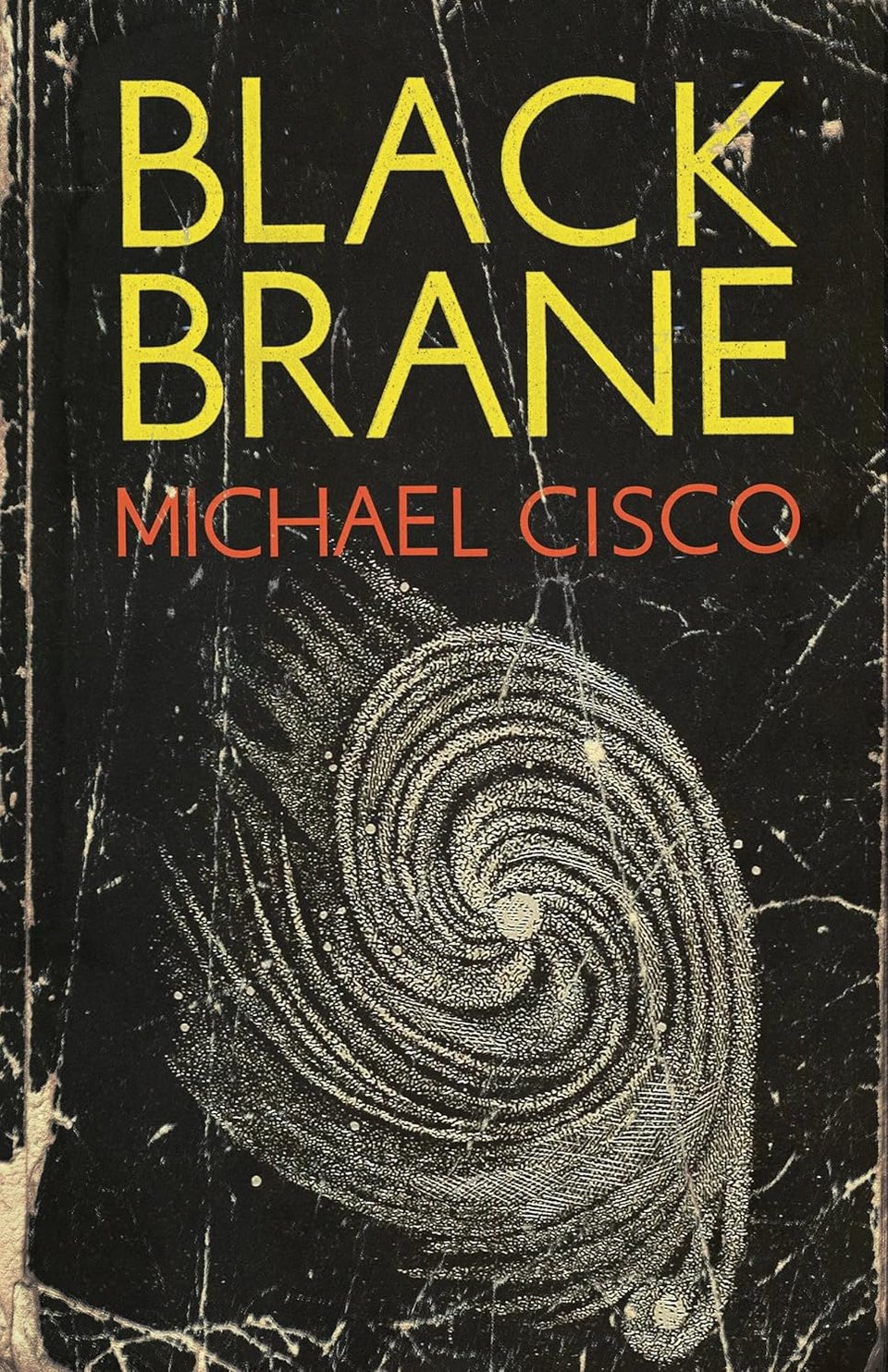
Michael Cisco’s novella admits to the title Black Brane deriving from the string theory concept, but it’s remarkably resistant to explaining why. Protagonist Gross defines “black brane” in fragments interspersed with his own related chronic pain: “A brane is where the strings begin and end. The black brane has its own horizon. It hurts. The black brane is not a point in space like a black hole. It hurts it’s a more elaborate structure. I know there’s a black hole or black brane in the center of the it hurts galaxy.” But he also defies deeper meaning to black branes, explaining “don’t you think if I were talking about death, pain, or sorrow, I’d just call them that instead of getting coy with symbols? I talk about the black brane—you tell me why” (22-23). Cisco hints at metaphorical significance through touches like associating the narrator and protagonist’s trauma with the black brane. But instead of a black brane’s horizon, structure, and location neatly matching to a specific “point in space,” Gross defies symbolism, pushing the reader to think deeper about the absurdity of life. This is a cosmic horror story that asks how we can make sense of what’s wrong with the universe on an intimate level.
Vaguely set in the modern day, Black Brane largely takes place between two periods. In the present, Gross endures private, dreamlike torment while sequestered from the joy of the outside world by the four walls of a room. But this is largely a framing device for the bulk of the book, which takes place during his previous work for the Temporary Institute for the Study of Holes (TISH). TISH founder Dr. Marilyn Shitansky, a researcher with an inexplicable hole in her brain, purports that its purpose is to help others with similar strange maladies, holding her employees to nonsensical duties like recording phone calls without responding and constructing engines based on quantum decoherence. But as Gross follows Shitansky and his colleagues through hole-derived research in physics, linguistics, and the occult, all threads drag him back to the black brane and the grief that lives in his own head.
Black Brane exquisitely straddles the line between disorienting and perturbing prose. As early as the third page, Gross acknowledges how his own imagination, “with perfect goodwill,” tries to assist his memory “by making stuff up.” But it’s difficult to keep confabulation in mind when he describes the recollection of “some performance outside” in an ornate landscape “down a green slope toward a ring of hay bales” and “all the air filled with a fragrance of grass, sun-baked pine needles, peppery eucalyptus, sweetly musty hay, and those buttery, pungent, sour little white flowers.” The vivid imagery only falls apart when considering individual details. Gross never can identify those “little white flowers that used to grow all over” nor self-contradictory “tall, white-trunked trees” with “sinuous black boughs,” and he also goes on to discuss oak and birch as well—an increasingly improbable combination of trees (3-4). It’s well-established that imagination can inflate our memories by engendering belief in wholecloth fabrication, and Cisco demonstrates this principle with alarmingly seductive prose. As Gross’s work with TISH descends to the serendipitous and vicious entanglements between people, Cisco suggests no detail of the plot can be trusted on the surface.
Cisco’s resistance to interpretation often veers into its own kind of nothing, however. Beneath all the layers of reality and subjectivity, it’s not always clear what Cisco has to say about the broader world; an early discussion of Shitansky’s former homelessness provides a fascinating discussion about the cruelty of class-based society that the narrative generally skitters past. Cisco’s writing strides through many miring layers of absurdity and surrealism on its way through Gross’s spiraling. But Cisco gleefully interrogates the concepts we use to frame our world, such as the restorative power of nature, the inexorable presence of grief, and the cruelty of pointed ignorance to suffering. I don’t know where the strings of my own relationships will lead me next, but at every birdsong outside my four walls, I’ll be untangling the black brane.