
Assorted Releases of 2025
Sovereigns, apes, and arms
For the last entry of the year, I wanted to highlight some interesting 2025 releases I haven’t discussed. I’ve already reviewed Michael Cisco’s Black Brane, Creed Parker’s The Sane Vessel, and Tashan Mehta’s Mad Sisters of Esi (admittedly first published in India in 2023), but as I usually avoid mid-series entries and focus on text-only fiction, I skipped some other books. Here’s a few series, nonfiction, and/or graphic releases I appreciated.
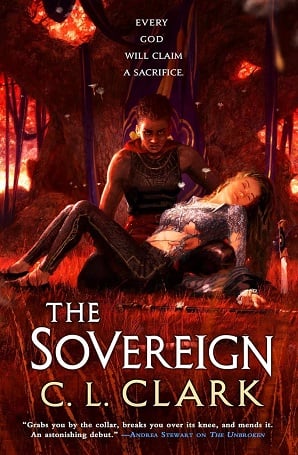
The Sovereign, by C.L. Clark, rounds out debut The Unbroken and its enriching follow-up The Faithless with a tumultuous capstone to her fantasy Magic of the Lost series. Queen Luca and General Touraine contend with epidemic, rebellion, and invasion while questioning each other and their place in the empire of Balladaire. Clark also continues perspectives from warlord Pruett and revolutionary Fili from The Faithless, which principally help balance Luca and Touraine’s rocky relationship by establishing consequences for their actions. While the pace slews through some last-entry rushing and Luca and Touraine’s romance runs through familiar hurdles, there’s plenty of interpersonal farrago and canny political jostling to provide a striking series conclusion. Intertwining these elements lets Clark ask once and for all why we make choices for others and who gets to make those choices.

While on the topic of making choices for others, primatologist Christine Webb’s nonfiction The Arrogant Ape asks whether humans are right to distinguish ourselves from other forms of life. Drawing on research in psychology, neuroscience, linguistics, ecology, and more, Webb plumbs the limits of human rationality and the cognitive, communicative, and empathetic capacity of organisms ranging from pigeons to the sensitive plant. In doing so, Webb pulls at the threads of scientific tradition, systemic oppression, and instinctive insecurity that inhibit empathy for our fellow lifeforms. Having read other recent, more narrowly focused books on cognition in other species, I found much of this book a recap, but Webb’s primatology insights and philosophical interrogation of human supremacy always kept the book engaging. This is a great book for those curious about whether animals feel sorry, how trees learn, or why attitudes to nature often reflect our attitudes toward each other.
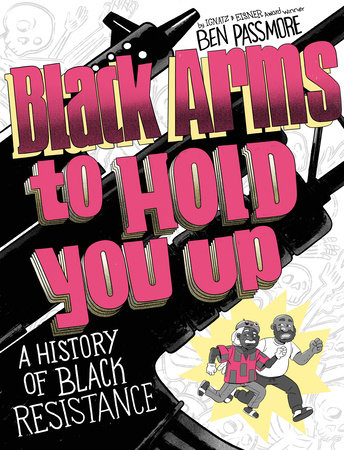
In another profoundly researched nonfiction, cartoonist Ben Passmore’s graphic history Black Arms to Hold You Up casts a kaleidoscope of funny, sad, and thoughtful perspectives through Black resistance in the United States. When a fictionalized 2020 Passmore expresses disinterest in the protests outside his Philadelphia window, his father takes him for a time-traveling tour spanning such events as the 1900 New Orleans race riots, the 1968 formation of the Republic of New Afrika, and the 1985 MOVE Bombing. In the process, Passmore illuminates complexities of liberation struggle, including reminders of the role of self-defense in the Civil Rights work of figures such as Robert F. Williams, illumination of the many lives of Assata Shakur, and interrogation of sexism in liberation groups like the Black Panthers and historiography about them. Indeed, while the plot weaves through its share of comedy and conventional perspectives, Passmore ultimately leads the narrative to a stark, unsparing climax that criticizes as much as it celebrates. Besides relating to Passmore’s real-life journey (raised in the Berkshires but residing in Philadelphia), his exaggerated style, judicious placement of magenta on black and white, and meticulous historical pluralism craft a definitive first place for my list of favorite graphic nonfiction.