
Newsletter - October 2026
👻 2026 OCTOBER 30 🧙♀️
In this month’s issue:
- Data integrity in the Age of Automation and AI
- 2026 ED138: a new Dwarf Planet Candidate and the Work Behind the Scenes
- 2026 QQ8: mini-moon (previously known as Sar2901)!
- Moving to ADES v2022: A Small Change for Better Data Quality
- Our Monthly Chat about Comets
- Reminders
1. Data integrity in the Age of Automation and AI
As automated tools and artificial intelligence become increasingly common in astronomy, we would like to remind our community of the importance of data integrity. Software tools such as Tycho Tracker, along with other automated and AI-assisted tools, have made it easier than ever to identify moving objects, extract astrometry, and submit observations to the MPC. These developments are exciting, and we welcome technologies that make minor planet astronomy more accessible and efficient.
However, automation does not eliminate the need for careful validation, nor does it remove the responsibility of the observer. Automated tools can make mistakes, including incorrect object identifications, inaccurate astrometric measurements, or the inclusion of spurious detections. Regardless of the software used, observers are responsible for ensuring that their submissions are accurate, reliable, and scientifically meaningful. Using an automated tool should never mean submitting results without understanding or verifying them.
The MPC performs extensive validation of incoming observations, but these checks cannot replace proper quality control at the source. Incorrect observations can have consequences beyond a single submission: they can lead to erroneous identifications, unreliable orbits, and significant additional work for MPC staff and the broader community. The integrity of the MPC database is a shared responsibility, and it begins with the observer.
As the volume of submitted observations continues to grow, the MPC is also taking steps to strengthen its procedures for assigning observatory codes and approving observing programs. We intend to introduce more rigorous requirements to ensure that observers and observing programs demonstrate an appropriate understanding of astrometric measurements, data validation, and quality control. Programs submitting archival astrometry already undergo a review through the Singletons and Archival Review Committee (SARC), and we will build on this experience as we develop stronger validation procedures.
We recognize that these requirements may introduce additional work for observers, but we believe they are necessary to maintain the quality and reliability of the MPC’s data. We welcome innovation, but innovation must go hand in hand with responsibility. As our tools become more sophisticated, our commitment to data integrity must remain just as strong.
How to write an effective MPC Helpdesk ticket
We would also like to take this opportunity to share a few recommendations on how to submit effective tickets through the MPC Helpdesk.
We have noticed an increasing number of AI-generated tickets that are unnecessarily long, contain extensive background explanations, and sometimes fail to clearly identify the actual problem. While we understand and appreciate that AI tools can be particularly helpful in overcoming language barriers, a longer and more elaborate ticket is not necessarily a better ticket.
Our recommendation is simple: write your ticket yourself first, then use AI to improve its clarity, grammar, or wording if needed. This helps ensure that the original question or problem remains the focus of the message, rather than getting lost in paragraphs of AI-generated explanations. (Or ask your AI agent to be more concise. Learning how to write proper prompt is very important nowadays).
When submitting a ticket, please try to:
- Clearly describe the problem or question.
- Include only the information necessary to understand or reproduce the issue.
- Avoid lengthy introductions, unnecessary background information, and AI-generated explanations that do not directly contribute to the request.
- Include relevant data, object designations, IP addresses or examples when needed.
As a general guideline, we encourage tickets to be no longer than 250 words, excluding any necessary supporting data. We recognize that some issues require more detailed explanations, and exceptions are certainly appropriate in those cases.
For now, this is simply a recommendation. However, if excessively long tickets continue to become a problem, we may consider introducing automated length restrictions in the future, with appropriate exceptions for submissions containing data or requiring additional technical details.
Our Helpdesk is intended to facilitate communication between the community and MPC staff. Clear, concise tickets help us understand issues more quickly, reduce unnecessary back-and-forth, and ultimately provide better and faster support to everyone. This is also true if you don’t use AI to write your tickets.
Remember: we’re looking for the problem, we don’t need to know the history of your pipeline!
This is an example of a prompt you could use to improve your Jira ticket without losing the original message (note: you still have to write the original message by yourself)
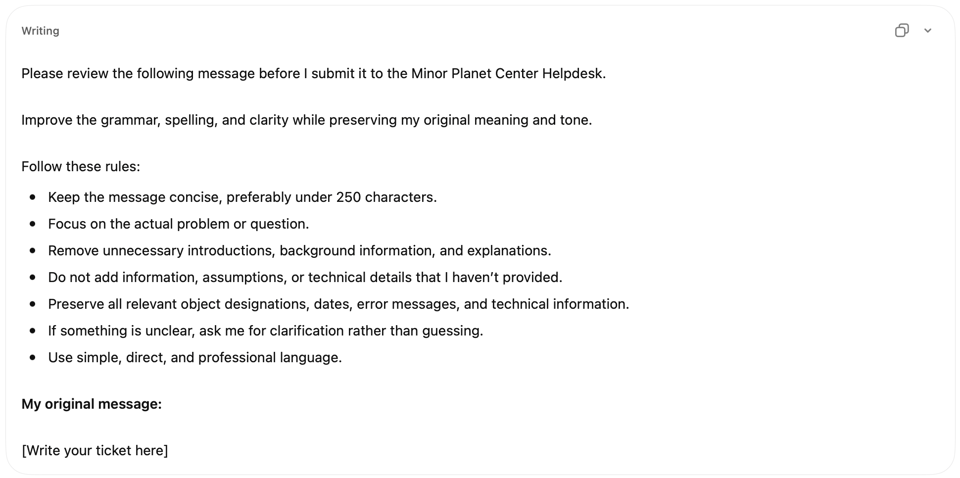
And if you think we can’t recognize an entirely AI-generated ticket… let’s just say we’ve read enough of them by now! 🤖 💻 👩
On the other hand, keeping your ticket concise doesn’t mean leaving out important information. If your ticket description consists of just a single sentence, consider whether you might be missing some relevant details. Providing the right information upfront helps us investigate and resolve issues faster, without unnecessary back-and-forth. For example, if you’re having trouble accessing an MPC service, please include your IP address; if your question concerns a specific submission, include the submission ID or the observations ID. The goal is not to write more, but to provide the information we need to help you efficiently.
2. 2026 ED138: a new Dwarf Planet Candidate and the Work Behind the Scene
October brought some exciting news from the outer Solar System! On October 27, the MPC announced the discovery of 2026 ED138, a large trans-Neptunian object and potential dwarf planet discovered by Matthew Holman (our former MPC director) using observations from the Vera C. Rubin Observatory.
The object, located beyond Neptune at approximately 46 AU from the Sun, is estimated to be between 600 and 1,500 km in diameter, making it one of the largest known dwarf planet candidates.
We would also like to take this opportunity to highlight some of the work that happens behind the scenes at the MPC.
Special thanks go to our own Mike Alexandersen, who worked behind the scenes to ensure that the observations were properly processed, the orbit was validated, and the discovery was published in time for the official announcement on October 27.
Coordinating the publication of an important discovery under a tight deadline requires careful work, attention to detail, and sometimes a little extra effort that doesn’t make it into the headlines.
This is a great example of the essential role the MPC plays in supporting astronomical discoveries, and of the dedication of the people who make that work possible.
You can read more about the discovery in Rubin Observatory’s announcement and the MPC publication (MPEC 2026-U85).
All the published observations and orbital information for 2026 ED138 are available through the MPC Explorer.
3. 2026 QQ8: mini-moon (previously known as Sar2901)!
In our September 2026 newsletter, we discussed Sar2901, a possible mini-moon whose nature was still uncertain. At the time, we could not confidently determine whether the object was natural or artificial, and we encouraged the observing community to provide additional astrometry to help resolve the mystery.
Thanks to additional observations, particularly those submitted by observatories G37 and T12, we were able to extend the observational arc and estimate the effects of solar radiation pressure (SRP) on the object’s orbit. These measurements provided the evidence needed to rule out an artificial origin and support the conclusion that Sar2901 is a natural object, most likely a temporary mini-moon of Earth.
We have now published MPEC 2026-U95, making the observations and orbital information available to the community.
We would like to extend a special thank you to the observers at G37 and T12, as well as everyone who contacted us through the Helpdesk, shared information, and contributed to the discussion.
4. Moving to ADES v2022: a Small Change for Better Data Quality
The MPC already uses ADES v2022 internally, but we currently continue to accept observations submitted in both ADES v2017 and ADES v2022 formats. This is about to change.
ADES v2022 introduced improved consistency checks that help identify potential errors and inconsistencies in submitted astrometry, contributing to better data integrity.
Starting December 30, 2026 (60 days from now), the MPC will accept only ADES v2022 submissions. This change affects only the format accepted at ingestion; our internal processing procedures will remain unchanged.
Please note that we will continue to accept observations in the legacy MPC-1992 format, although we strongly encourage observers to transition to ADES.
What does this mean for observers?
Fortunately, very little! For most users, the only required change will be updating the ADES version identifier from 2017 to 2022 in their submission files. Everything else remains the same, unless you wish to take advantage of the additional fields introduced in the newer ADES version.
We encourage everyone still submitting ADES v2017 files to update their software and workflows before the deadline.
As always, if you have any questions or encounter any difficulties during the transition, please don’t hesitate to contact us.
5. Our Monthly Chat About Comets ☄️
Automation of the processing of arc extensions
Over the past few months, we have made significant progress in modernizing the processing of additional astrometry for known comets. These observations have traditionally been validated and published in MPECs titled “OBSERVATIONS AND ORBITS OF COMETS AND A/ OBJECTS.” We recently updated this procedure to allow publication while the MPC is in PREParation mode, and we have now taken another important step: automating the validation and orbit fitting of newly submitted comet observations.
How does the new automated pipeline work?
New observations of known comets are now evaluated by our automated processing pipeline. If the orbit fit is successful and the observations pass our quality control checks, they are accepted and incorporated into the updated orbit. Both the observations and the new orbit become immediately available in the MPC database and MPC Explorer, without having to wait for the next MPEC publication.
Accepted observations are subsequently published in the regularly issued “OBSERVATIONS AND ORBITS OF COMETS AND A/ OBJECTS” MPECs. Similar to the Daily Orbit Update (DOU), these MPECs collect all observations and orbits awaiting publication since the previous issue.
During this transition, the MPECs may contain a combination of manually and automatically processed data. Objects processed by the automated pipeline can be identified by the orbit computer listed as MPCORBFIT, rather than the name of an MPC staff member.
Improving the pipeline
We are continuing to refine and expand the automated processing system. Currently, observations that fail any stage of the automated pipeline are redirected to our existing manual processing queue.
These cases are particularly valuable: by reviewing them individually, we can identify limitations in the automated workflow and develop improvements that will allow a larger fraction of submitted comet observations to be processed automatically.
Our goal is to reduce the time between submission and availability of comet astrometry, while maintaining the quality and reliability of the published data.
A few lessons learned
Despite extensive testing before introducing automated processing and semi-automated publication, we encountered a few issues in the initial MPECs.
- One issue involved the formatting of non-gravitational parameters, resulting in some values being incorrectly published as +0.00. We want to emphasize that the values stored in the MPC database were correct; the problem was limited to their representation in the MPECs.
- We also encountered a few zombie observations that somehow found their way back into an MPEC. Rest assured, we’ve taken steps to ensure the dead stay buried. 🧟
We believe both issues have now been resolved, and we are implementing additional validation checks to prevent similar problems in the future.
As always, if you notice anything unusual in our comet MPECs, please let us know through the MPC Helpdesk. Feedback from the community is extremely valuable as we continue improving these systems.
September by the numbers
September was an important month for the new pipeline. As of September 30, the MPC had received 6,860 comet observations, with data published across 8 MPECs.
Here is how those observations were handled:
Processing Status | Observations | Percentage |
|---|---|---|
Automatically processed | 4,463 | 65.1% |
Manually processed | 1,546 | 22.5% |
Awaiting manual processing | 851 | 12.4% |
Total | 6,860 | 100% |
Overall, 65% of the observations received in September were successfully processed by the automated pipeline. Even more encouragingly, improvements introduced throughout the month increased the automated processing rate to over 75% by the end of September.
The remaining 851 observations were queued for manual review, during which some may be rejected because of high residuals or other quality concerns.
What’s next?
We are excited about the progress made so far. Automating comet arc extension processing is an important step toward making new observations and updated orbits available to the community much more quickly.
There is still work to do, but the improvements achieved in September demonstrate the potential of this approach. We will continue refining the pipeline, expanding the fraction of observations that can be processed automatically, and strengthening our quality control procedures.
Faster processing, faster access to data, and the same commitment to data quality: that’s what we’re working toward! (with a few bumps along the way).
6. Reminders ⏰
- Starting November 12, 2026, submissions containing tracklets with duplicated observation timestamps will be rejected at ingest [See our September 2026 Newsletter]
🎃 👻 🧟 🎃 👻 🧟 ☄️ 🎃 👻 🧟 🎃 👻 🧟 🎃 👻 🧟 🎃 👻 🧟 🎃 👻 🧟 🎃 👻 🧟 🎃 👻
If you have any questions, please contact the MPC.
Add a comment: