
The sound of distant living
Unemployable
I’m back from a month away, in body at least. Dealing with jet-lag has been a doddle compared to remembering what work is. So I’ve been easing back into the swing of things: more reading than doing.
The first thing I read was Phil Dearson’s reflections on being unemployable. While I struggled to remember what work is, this was a perfect reminder of what work isn’t.
the modern employment machine, like a confused AI, can’t parse your signal. It reads seniority as cost. Independence as arrogance. And age? Well, that’s still quietly filed under “cultural misfit”.
You're no longer hireable in the traditional sense. And that’s excellent news.
Phil Dearson
It’s a love letter to independent consulting at a certain age. It puts into words how I’ve felt for at least four years now. I wish I’d written it.
It’s easy to tell yourself that you couldn’t go back to salaried work when it’s hypothetical. But, in the last twelve months, a couple of clients have let it be known that they’d hire me if I were open to the idea. Both clients were a dream to work with, but working for is a different matter. I couldn’t imagine a salary at which the loss of freedom would make sense*. The approaches, if you could call them that, were subtle and implicit. So were my demurrals. There were no formal conversations. But, had things gone further, I wouldn’t have been able to name my price because, for the time being at least, what I have is priceless.
*This might sound like hubris. But I earn less as a consultant than I did in my final agency days. I’d earn considerably more if I took a salaried job.
Exhausting
The second thing I read was Antony Mayfield’s field notes on the consequences of going all-in with AI in the workplace. Antony is a good writer. Like Phil D he has a knack for making technical subjects accessible, which you can only do if you know your stuff. The subject of this newsletter is hyperproductivity. But the undercurrent is conflict. Increased productivity is great in the abstract, but it’s usually pretty shit at the coal face.
And here’s the catch: once you can operate at that hyper-productive pace, the world quietly starts expecting it of you. The calendar doesn’t clear. The backlog doesn’t shrink.
Antony Mayfield
It left me feeling weary; also relieved that AI adoption is a choice that I can make - or not - on my own terms. With this new technology, I sense that many lessons can be learned the easy way, watching intently from the sidelines.
Chaotic
The first thing I listened to was Dave Dye’s two-part conversation with the brilliant (iconic?) copywriter Barbara Nokes. I could listen to Barbara all day, but had to settle for two and three quarter hours. Her style is candid, acerbic, but also whimsical. It’s quite intoxicating.
Early in Part 1, Barbara talks about what made BBH founder Nigel Bogle a brilliant account person.
I remember going back to Doyle Dane Bernbach and saying to Peter Harold, who I was working with at the time, “Pete I've just encountered an account man who actually earns his money. He's Nigel Bogle. He's absolutely brilliant.” “What was so good about him?” “Well, he was imaginative and decisive.”
Barbara Nokes in conversation with Dave Dye
She’s describing the quintessential strategist. Strategy is a combination of imaginative and singular thinking. Strategy is a point of view. I worked with Barbara a couple of times as a greenhorn account manager, but I worked quite a lot with Nigel. He was a stickler for having a point of view.
Barbara also mentions Nigel in Part 2.
he shut the door and he said, “I want to talk to you. I want you and I to work on a system where the brief comes in and the system is such that only great ads come out the other end.” I said, “Nigel, you're talking about art here, and art comes out of chaos actually.”
Barbara Nokes in conversation with Dave Dye
Agencies are hooked on selling process. They’ve convinced themselves that clients are buying order. Maybe a lot of clients are. They should be buying inspiration. And they should accept some chaos to get it.
These days agencies are selling process on AI steroids. They’re selling faster and cheaper when they should be selling better. It’s an ad industry cliché that you should sell the sizzle, not the sausage. But you should never ever sell the sausage factory.
Boring
One of the last things I read before I headed off was Tom Darlington’s weeknote: Do the boring thing.
John Willshire advised Tom to do the boring thing and buy some books to read around an idea that he was developing. The advice was second-hand but also well-timed. I’d been thinking - sometimes out loud - about the importance of style in positioning work for service businesses. I’d been thinking about the relationships between culture, character, and style. I’d been thinking about style being a more useful concept for brand strategy than tone of voice. And I was working to give some structure to these thoughts. So, with several long flights coming up, I bought some books.
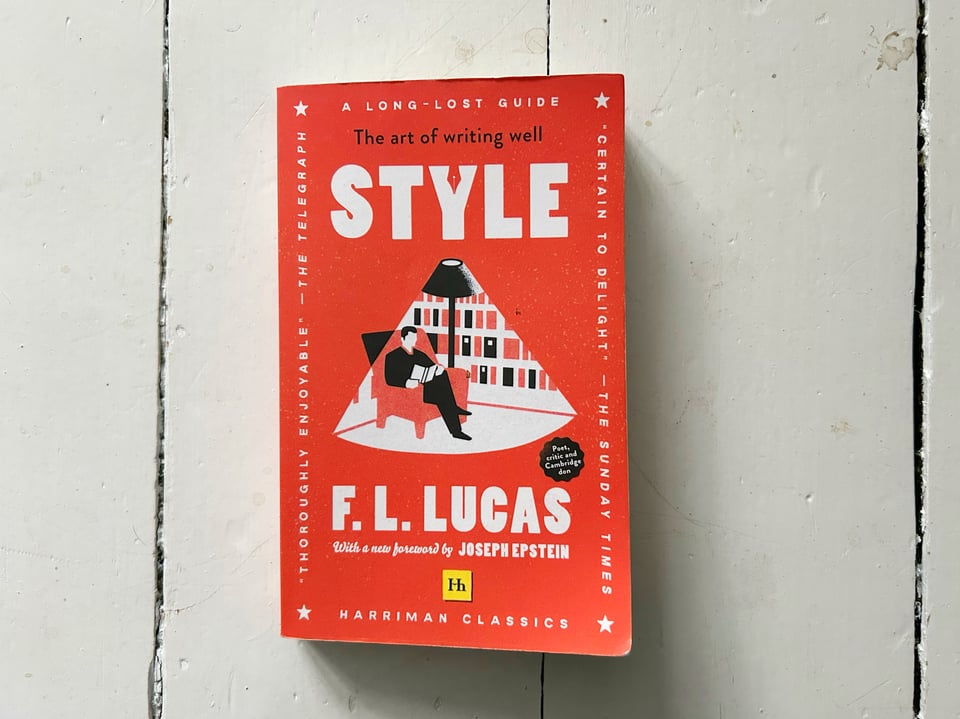
A review of Style by F.L. Lucas would be a whole post unto itself. I doubt I’ll bother. But boring it isn’t. And useful it is. The book directly addresses some of the things I’ve been thinking about:
Style is a means by which a human being gains contact with others; it is personality clothed in words, character embodied in speech. If handwriting reveals character, style reveals it still more.
F. L. Lucas, Style
Sadly, ironically, his style can be hard work. His language is too rich for my lowfalutin tastes. He’s fond of sentences with many clauses and words with many syllables. He’s prone to tangents and obscure references (for which pardon my ignorance.) The book is based on a course of lectures that Lucas gave at Cambridge University from 1946 to 1953. I imagine that he liked the sound of his own voice as he gave them.
However, his advice is excellent. I finished with at least two dozen dog-eared pages from which I’ve taken notes. For example, like Barbara Nokes, he has something to say about imposing too much order on the creative process:
A great part of the writer's problem, then, is how to catch the ideas that creep forth in the stillness, like magic mice, from their holes... It pays, I think, to meditate a good deal, both before beginning to write, and at intervals while writing. The process of creation may refuse to be bustled. The writer's reverie with a cigarette by the fire may not be as wasteful as Balzac suggests. It may not only turn paper into smoke; it may also turn smoke into paper.
F.L. Lucas, Style
Thank you Tom. Thank you John.
Indiscriminate
In between the last readings and the first readings, I went to Japan.
In Tokyo a lovely Japanese woman helped us to work out our Metro journey across the city. We chatted while we waited for our trains. She’s a curator of international art and architecture exhibitions. She’s worked with the V&A in Dundee and spoke fondly of Scotland. She deals with contemporary (living) artists, and part of her job is negotiating with them how much or how little to say about their work. The artists generally want to say as little as possible - ideally nothing - whereas the audience needs some help to understand and interpret the work. They need some context. To make things more tricky, artists are often unsure where the work comes from themselves. It kind of just falls out of them. They wouldn’t know what to say about the origin or the meaning of the work even if they wanted to. So, for a curator to do her job well, she needs to be both diplomatic and discriminating.
We visited several museums and galleries in the weeks following this conversation. And after the curatorial masterclass, I spent as much time admiring the skill behind the blurb as I did on taking in the exhibits.
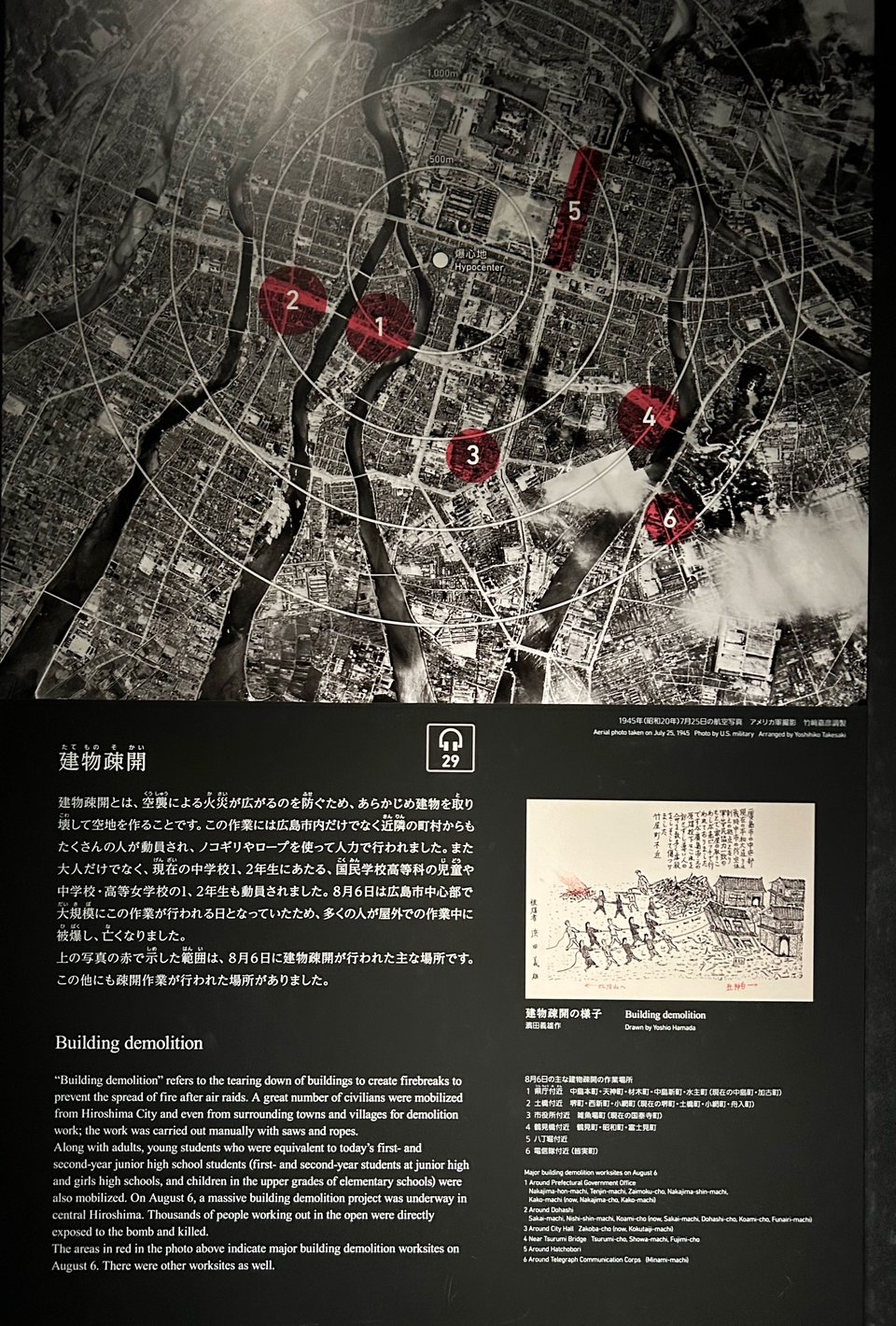
The storytelling at the Hiroshima Peace Memorial Museum is a lesson in economy and restraint. The horror of atomic weapons speaks for itself if you let it. To do this in practice the curators have used hardly any adjectives. They trust that the reader’s visceral reaction to the facts will be stronger than any descriptive language they could use. The explanation below of why so many children were out in the open when the bomb detonated above them is typical of the style (I’ve retyped the English text underneath the image, as well as in the alt text):
Building demolition
“Building demolition” refers to the tearing down of buildings to create firebreaks to prevent the spread of fire after air raids. A great number of civilians were mobilized from Hiroshima City and even from surrounding towns and villages for demolition work; the work was carried out manually with saws and ropes.
Along with adults, young students who were equivalent to today’s first- and second-year junior high school students (first- and second-year students at junior high and girls high schools, and children in the upper grades of elementary schools) were also mobilized. On August 6, a massive building demolition project was underway in central Hiroshima. Thousands of people working out in the open were directly exposed to the bomb and killed.
The areas in red in the photo above indicate major demolition worksites on August 6. There were other worksites as well.
Text from the Hiroshima Peace Memorial museum image above
In a context where adjectives are conspicuous by their absence, one adjective is conspicuous by its presence. The atomic bombing of Hiroshima is described as “indiscriminate”. This one word is used repeatedly in different parts of the museum. It’s the only opinionated word in the entire exhibition. It’s clearly the museum’s point of view. Classifying the bombing as “indiscriminate” is a deliberate, diplomatic, and discriminating decision. The strength of the message comes from its unarguable truth and the understated dignity of its sentiment.
The curators have taken a leaf out of F.L. Lucas’s book. He has this to say about sincerity and the power of understatement.
A prose writer should state exactly what he feels; or else - and this is often more effective - deliberately understate. But how difficult to persuade young writers of this! So often their impulse is to assume that talking big is the same as talking vigorously. As well suppose that the best way to sing well is to sing loud.
F.L. Lucas, Style
Sadly the ideas of understatement and dignity are lost on many tourists.
The Hiroshima Prefectural Industrial Promotion Hall was almost directly under the bomb when it exploded. Because the blast came down vertically here, this building remained standing while the surrounding buildings were completely flattened. The ruin is now called the Atomic Bomb Dome. It’s a prominent and poignant monument.
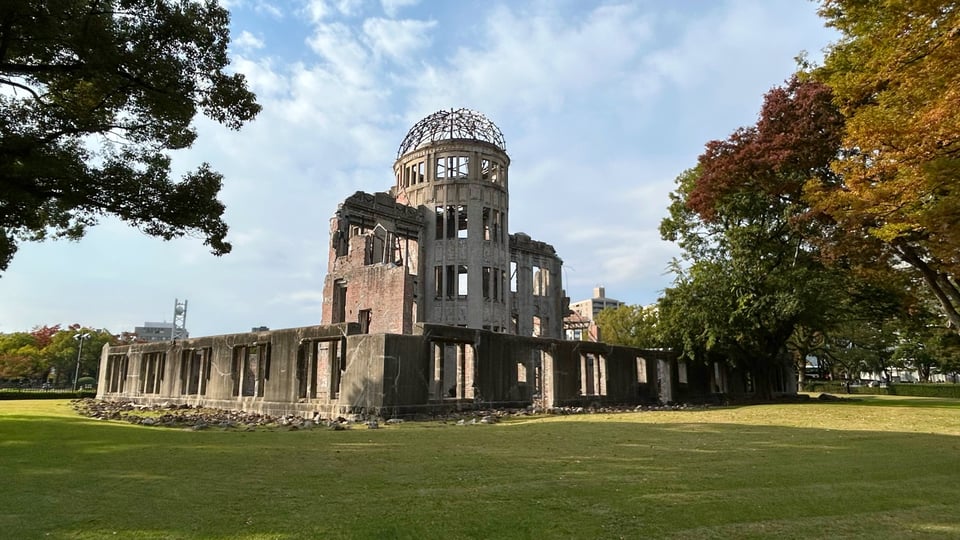
It’s not the place for carefully composed, faux-coy Instagram selfies. It’s not a suitable backdrop for making the V for victory sign. Eighty years ago, in this same spot, it would have been V for vaporisation. Some people have no style.
Somewhere the sound of distant living
Locked up in high society
It seems so artificial
Why should I care?Life in Tokyo by Japan
Add a comment: