
Interview with Cycling Batteries CEO Adam Black
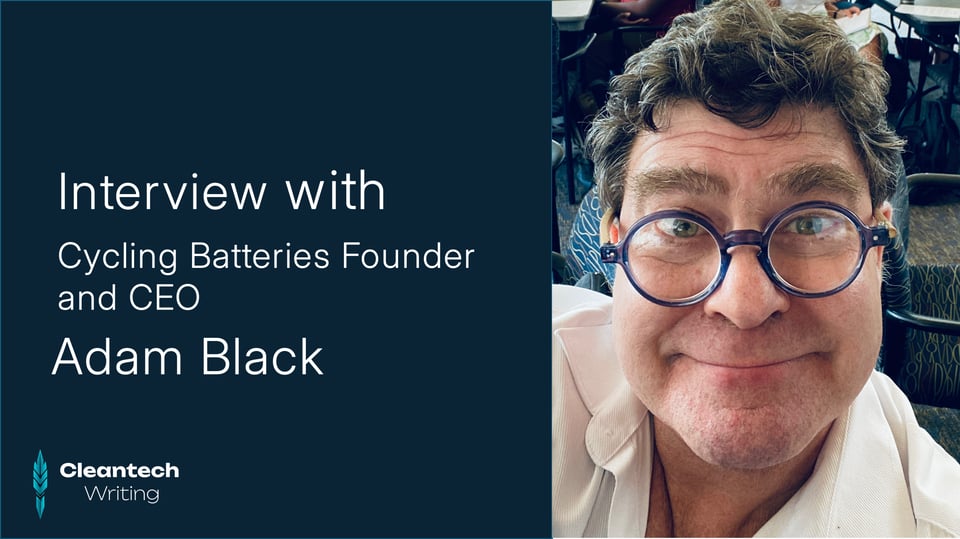
This week I’m delighted to share a conversation I recently had with Adam Black, CEO and Founder of the e-bike and battery startup, Cycling Batteries. A global citizen and passionate environmentalist, Adam believes that the e-mobility revolution has the potential to be a transformative force for decarbonization, especially in the developing world.
In our conversation, we discussed the need for innovation and how Cycling Batteries’ fast-charging technology and unique subscription business model solve some of the biggest challenges in the industry. We also talked about why he believes fast charging is more scalable than battery swapping, and how he wants the company to be known as the “Volvo of e-bikes” in terms of safety and reliability.
Lakis: Can you tell me a little bit about your background and how you came to start Cycling Batteries?
Adam: I’m English and Australian, but I’ve worked all over the world. I started my professional life studying biotechnology, as it was in 1985. We were trying to use plasmids and bacteria to generate hydrogen using genetic engineering.
I’ve always had a strong interest in clean technology. As a marine biologist and a scuba diver instructor, I’ve seen that the world has decayed and it needs fixing. I think my love for this planet comes from my great enjoyment of life under the waves with the coral and the fish and so on (some of my best friends are fish)!
I had a scuba diving hotel in Cozumel, Mexico, which, unfortunately, I bought the year before COVID and lost as soon as COVID hit. But along that journey, I got interested in e-bikes as a tourism resource for my hotel. At that time, the e-bike market was very new.
One of the things that happens with e-bike batteries is that they decay and die after about 700 cycles. And if you charge every day, that’s two years. What’s going to happen with all these old batteries?
Twelve percent of U.S. cell phones and computers are refurbished. You may have experienced this yourself. You get a refurbished phone – it’s got a new screen, it’s got a new battery, it’s got a year warranty. It’s as good as the latest one, but it’s $300 cheaper. So I realized we could take old e-bike batteries, take them apart, put better quality cells in them, improve them, and give them back to the customer. I looked at the maths and realized we could save people 30% of the cost of batteries by refurbishing them and keeping them out of the landfill.
So the original tagline for the company was “cycling batteries better than new,” because an upcycled battery is better than a new one – it’s got a bit more care, a bit more handcrafted work on it.
It didn’t take long before we realized that, rather than upcycling old batteries into slightly better batteries, we may as well just make the best batteries in the world. So through this journey of two and a half to three years, we’re now up to our prototype version four, which is absolutely the safest, smartest, and fastest charging e-bike battery anywhere on this planet. And it works on just about every single e-bike.
Lakis: Can you tell me a little bit more about that journey? You had this idea – how did you pull together your team? And why is nobody else doing this?
Adam: I came up with this idea because I was trying to get a new battery. I had bought a second-hand e-bike, and within three months, the battery died.
And I thought, okay, let’s find out where I get one. It didn’t take me long to find out that batteries are really expensive – the new battery was going to cost me about $750. The whole bike that I bought second-hand only cost me $600. So it was a big shock.
Then I found a guy who said he could refurbish the battery – take it apart, put better cells in it – and it cost me a lot less. And I thought, this is fantastic. I saved myself 30% of the cost. So I called up this guy and said, “You want to start a business? Let’s do this on a big scale.”
As it turned out, this guy wasn’t really interested. He was sort of semi-retired. But the idea was there. Eventually, I found another couple of battery engineers online, and we started doing this successfully. We developed a big network of engineers and others in the battery business. These people love what we’re doing. There are a lot of people on this planet who want to develop clean technology, because it’s simply a better, safer, smarter, long-term solution for all our energy needs.
Lakis: In the United States, especially, there’s a lot of interest specifically in moving to electric cars to decarbonize and increase energy security, but there are a lot more options – e-bikes, e-scooters, e-mopeds. Can you give us a sense of the potential scale of the global market for this transition and where e-bikes fit in?
Adam: The market is huge. Have a think about the scale of the disruption of the iPod when it came into common use. Everybody was using CDs. Within a matter of six months, the whole CD industry and every single music shop on the planet died. Not because they weren’t selling music, but because a better solution arrived. The assumption that music had to be sold on a solid substrate was dramatically changed by the invention of the iPod.
Assumptions create radical business opportunities when they are changed dramatically. The assumption with e-bikes is that batteries are big and heavy and take a long time to charge. We are in the assumption-demolishing business. When you demolish an assumption, you get a huge opportunity.
Assumptions create radical business opportunities when they are changed dramatically. The assumption with e-bikes is that batteries are big and heavy and take a long time to charge. There are over 400 million e-bikes on this planet. Every single one of them has a battery that takes two to six hours to charge, and the assumption is that they always will – because a lot of people in this field don’t think out of the box.
We are in the assumption-demolishing business. When you demolish an assumption, you get a huge opportunity.
A lot of people think that climate change is about people getting wet feet – it isn’t. There will soon be as many as 200 million climate refugees desperately trying to survive, leaving areas of arid desert where once there were green fields. The droughts, fires, and catastrophes are not just hyperbole. They are real. And we have about five or ten years, predictions say, before a high likelihood of millions of climate refugees causing destabilization on a scale we haven’t seen.
There are about 8 billion people on this planet, and most of them go somewhere every single day. For the vast majority, their wages are around about $500 a month – about 85% of people across the whole planet are earning something like that. Sure, there’s 25% of rich people in Europe, Asia, and America who are earning more. But they’re not the ones that are going to determine the future.
What we wanted to do was not come up with the latest, greatest, most expensive billion-dollar eco-house that powers itself from sunshine and wind, sitting on a hilltop for millionaires, looking glorious.
We believe that the survivability of your favorite planet depends on the decarbonization of transport for those living at the base of the global economic pyramid – because that’s the majority of humanity.
The vast majority of people on the planet will never own a car, even if they could afford it, because cars are big and they get stuck in traffic jams, and city centers are small … we believe that the survivability of your favorite planet depends on the decarbonization of transport for those living at the base of the global economic pyramid – because that’s the majority of humanity.
The e-mobility market is the fastest-growing transport sector in the world. Two years ago, there were about 200 million e-bikes in the world. Today, there are over 450 million. There are only 50 million EV cars – all the Teslas, BYDs, and the rest – and 70% of those cars, for 80% of the time, have one person in them. Compare that to e-bikes and e-mobility, where 75% of all journeys have more than two people on them. That means that 500 million e-bikes are transporting approximately 1 billion people every day. Compare that to the measly 50 million being transported in EV cars.
The vast majority of people on the planet will never own a car, even if they could afford it, because cars are big and they get stuck in traffic jams, and city centers are small. Consequently, advanced transport solutions involve a lot of smaller vehicles. In Holland, the centers of cities like Maastricht, Amsterdam, and Rotterdam have highly developed integrated transport systems where you can take your e-bike on the tram or on the bus. When you’re really looking at the future of transport, forget about suburban transport on a highway in a nice car to your air-conditioned car park to your office – that is a niche case. The vast majority of the world will not experience that.
The scale of the e-mobility revolution is stratospheric – 10 times bigger than the EV car revolution – and very few people are talking about it. Huge opportunity for anybody who is like us.
Lakis: Can you describe the differences between the various e-mobility devices?
Adam: Okay. So you’ve got a car, it’s got a petrol engine. You’ve got a motorbike, it’s got a petrol engine. Great concentrated fuel source, huge range, no problem – except for the fact that you’re going to kill your planet. And the asthma of kids in urban areas. But generally it’s a pretty good transport solution, apart from the planet thing.
So you’ve got a car, it’s got a petrol engine. You’ve got a motorbike, it’s got a petrol engine. Great concentrated fuel source, huge range, no problem – except for the fact that you’re going to kill your planet.
E-mobility – why is it good? It’s fundamentally more efficient to use electricity. You don’t need to transport the oil in tankers, you don’t need pipes, you can put electricity down wires, you can generate electricity at the point of use. Electricity is just a simpler, cheaper solution – fewer moving parts, fewer things to go wrong.
An e-bike is recognizable because it has pedals. An e-bike gets you where you want to go at about 20 miles an hour and has between 15 and 30 miles of standard range.
An electric scooter is basically an e-bike without a chain — two wheels, you stand on it. These are very good for running around town. The light, small-weight versions you can actually carry with you. The long-range ones are heavy, but we’re going to change that. We actually have a plan to make electric scooters a lot lighter.
An e-motorbike is a different machine – no pedals, goes 60 miles an hour for maybe 100 miles, with a massive 72-volt battery or two of them and a 1,500-watt motor on the back. But you can’t take the battery off the bike because it’s too heavy, so you always have to charge at ground level – which is a problem because most people in cities don’t live at ground level.
There are also one-wheels with self-balancing systems – fantastic, but my grandmother is never going to ride one, so those are niche markets. In China, they have 200-mile electric skateboard races, which is incredible. And there are three-wheel tuk-tuk [auto rickshaw] style mobility devices.
There’s a massive space between a car and walking, and it’s only just started – e-mobility has only been around four or five years.
Lakis: In New York City now, you’ve got all these delivery people with their e-bikes, and I was just thinking – how did they do it before?
Adam: Bikes and mopeds. Do a search for Domino’s pizza delivery, and you’ll find these blue and white little 90cc scooters they used to use.
Electrical transport is just better than fossil fuels. It’s cheaper. Electricity goes down wires. You don’t need to transport it anywhere. It’s available all over the place. And it reflects the sustainability of the grid. Spain is now producing 100% of their electricity renewably at various times of year. Uruguay, Denmark, Holland – there are four or five countries on this planet at the moment that have 100% renewable energy. Anybody in those countries that powers themselves with electricity is powering themselves with zero carbon. That’s an amazing thing.
Lakis: So, tell me a little bit more about how your solution actually works and how that’s different from your typical e-bike.
Adam: When you charge a battery, and it takes six hours – for an e-bike, for a car, for an electric motorcycle – so the smart thing is to charge it overnight. Everybody does that.
But slow charging has all sorts of problems. Take municipal e-bikes – New York Citi Bike, any city in the world. There are hundreds of cities now that have e-bike or bicycle municipal rentals. So say Citi Bike in New York has 5,000 bikes – but they don’t really have 5,000 bikes. They’ve got about 4,000, because 25% of every bike’s life is spent doing nothing but charging. If you change the battery to a fast battery, suddenly you’ve recouped 25% of that lost asset. And why wouldn’t you change your battery for a battery that literally makes your company 25% richer overnight if you’ve got to change the battery anyway? That’s a massive business, and we’re the only people doing it.
If you can charge a battery quickly, then you can produce a low-cost solar charging device that gives you virtually infinite range and can store energy overnight and charge the battery quickly, day or night. You put it together in 30 minutes, and it delivers virtually infinite transport for the rest of your life for anybody on the planet at a price point of around $25 per month.
If you can charge a battery quickly, then you can produce a low-cost solar charging device that gives you virtually infinite range and can store energy overnight and charge the battery quickly, day or night. Suddenly, for any local community anywhere in the world – a hospital in South Africa, a farming village in Morocco, maybe off-grid – you deliver a solar charging system, an e-bike, and a fast battery in a box. You put it together in 30 minutes, and it delivers virtually infinite transport for the rest of your life for anybody on the planet at a price point of around $25 per month. The cheapest, smartest, safest, most sustainable, net-zero, off-grid, independent transport solution on the planet.
Thanks for reading! Stay tuned for Part 2 of my interview with Adam next week.
If you’re working on e-mobility, I’d love to hear your perspective. If you found this conversation valuable, please share it with anyone who might be interested.
Found this article interesting? Check out past editions and sign up to get it delivered to your inbox.
