
Fix the grid, save the planet
Cleantech Insights | cleantechwriting.com
Cleantech Insights — September 9, 2025
Hi there,
This month, we're changing things up with something different: an interview with McGee Young, founder and CEO of WattCarbon.
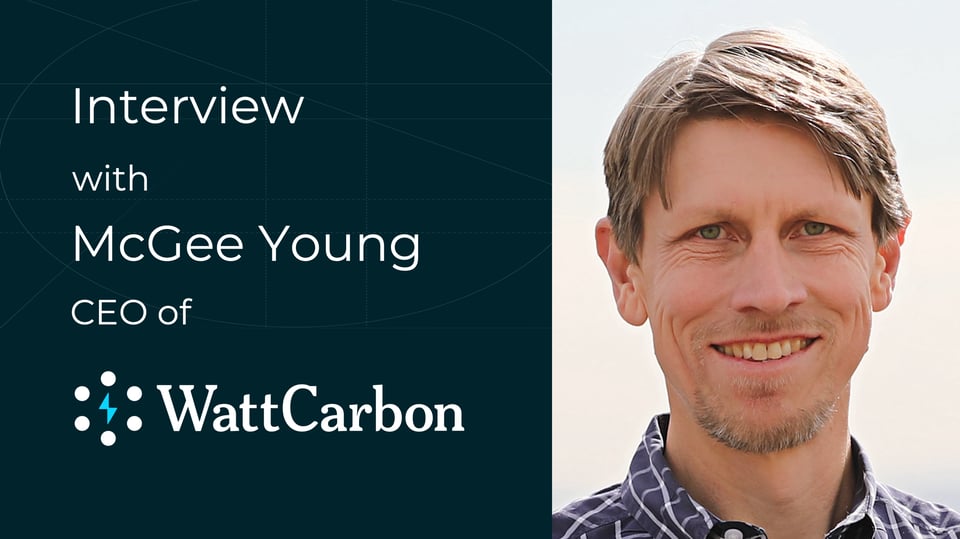
McGee is a prominent voice in the world of demand-side energy resources. A former professor of political science, he left academia to co-found MeterHero, a platform that tracked water and energy usage and paid people cash rebates for conservation. He later joined Recurve as CTO, where he helped develop the open-source OpenEEmeter that became the industry standard for meter-based measurement of energy consumption.
In 2021, McGee founded WattCarbon with a mission to transform carbon accounting for distributed energy resources. The company has built systems to track the hour-by-hour carbon intensity of buildings across the US and quantify the real-time carbon savings from technologies like heat pumps, batteries, and rooftop solar. Their energy attribute certificate (EAC) marketplace enables project developers to monetize these environmental benefits.
Having worked with McGee at Recurve, I was interested in exploring his contrarian perspectives on energy accounting, utility program design, and climate tech messaging. Our conversation covered a lot of ground. This is part one.
The conversation has been lightly edited for clarity.
As always, I would love to hear what you think.
I think the subject of carbon accounting is pretty opaque to a lot of people. Could you tell me a bit more about why you think it is flawed?
Carbon accounting - as it is currently practiced - is failing us. We set it up in a way that makes everyone feel terrible about destroying the planet. And then we ask for self-sacrifice for the greater good, while others continue to profit from fossil fuels. You mostly end up with token gestures and offsets - a bad combination for the planet.
To make things worse, instead of fixing the more fundamental problem, we’ve paired doom and gloom carbon accounting with prescriptive policies imposed from on high. It's a quasi-religious mindset that reminds me of the way Adam Smith described Catholicism. People (especially in the United States) don’t want to be told what to do. They want to get a better deal than everyone else. So far, decarbonization has mostly seemed like a bad deal.
If you want further proof that this approach isn’t working, look at the fact that the oil companies and petro states literally took over the COP, the organization behind the Paris Accords that set global net-zero goals. When the foxes are running the henhouse, you know the system has failed.
But here's what frustrates me: climate change is a real problem. And the energy transition - the lever that we can actually pull to limit global warming - faces colossal political headwinds. If we don’t figure out how to stop burning massive amounts of fossil fuels in a very short amount of time, the resulting environmental catastrophe will cause human suffering of unimaginable scope.
We need to change the entire purpose of carbon accounting!
Okay, that sounds good, but what would you do differently?
Because I was trained as a political economist, I see the problem of carbon emissions not as a moral failing, but as a market failure. The pollution impacts of burning fossil fuels aren't priced into the commodity. We love fossil fuels because we get to enjoy their benefits while only indirectly paying for their effects, which makes this an especially hard problem to solve.
Carbon accounting tries to capture this externality, to measure how much of the world's pollution you're responsible for. But then it gets punitive, shaming people about their carbon footprint, which was an oil industry construct in the first place. We've been playing their game by their rules, and surprise, we're losing.
Here's the fundamental shift we need:
Internalize the market externality to create value streams for decarbonization. I love getting paid. I hate feeling bad. It's basic human psychology that our entire climate strategy somehow forgot.
The good news is that the energy transition has made clean energy available and affordable. We know how to make solar panels, wind turbines, batteries, heat pumps, and they're all getting cheaper. Seventy percent of emissions link to the built environment, forty percent from buildings alone. We have the technology to decarbonize. What we lack are good mechanisms to incentivize the switch.
We just need to make people feel like they’re getting a deal instead of making a sacrifice. We already do this on the supply side with RECs, renewable energy credits. Build a solar farm, and you get two revenue streams: selling power to the grid, plus RECs representing the environmental benefits of clean energy.
This is where our current approach needs updating. The energy transition isn't just about new supply. It's about unlocking demand-side resources as well.
Are you suggesting that we need RECs for energy efficiency?
Consider this: we install 20,000 gas furnaces and water heaters daily in the U.S. Each one burns fossil fuels for 15 years, emitting five tons of carbon annually. A heat pump eliminates 90% of those emissions, but the only available value stream is the potential for bill savings. Without credit for the environmental benefits, and with minimal (at best) bill savings, you end up doing an expensive retrofit project entirely out of the goodness of your heart, which works for some people, but won't drive widespread adoption.
A REC is specific to renewable energy generation, but in a way, this is exactly what we need. Our EACs are a comparable environmental credit for demand-side resources. Demand-side clean energy resources shouldn’t have to compete with legacy fossil fuel equipment on bill-savings potential alone.
The great thing about demand-side energy resources is that not only do they directly reduce emissions, they also indirectly reduce emissions by enabling more renewable deployment. Think virtual power plants that help us use solar during peak production and avoid dirty peaker plants in the evenings.
So, how does carbon accounting solve this problem?
Our vision for carbon accounting is to properly account for and value the environmental benefits of the energy transition. There's massive untapped potential in every building for value that could be realized.
We like to use the analogy of the California Gold Rush. The 49ers hacked away at hills, knowing gold was somewhere in there. We're in those early days with demand-side energy resources. We don't know exactly where the value is or how to price it, but if we can unlock markets for environmental benefits, we'll accelerate capital deployment into demand-side resources. Not just because they save money or compete with fossil fuels, but because they're instrumental in saving the planet.
That's WattCarbon's theory. The energy transition is happening, but we don't know how to measure, value, or transact demand-side resources for their carbon reduction benefits. We're building that capacity.
That's it for Part 1. Stay tuned for Part 2, where McGee and I talk about how a shift in the way we think about energy attributes can make the grid cleaner and more reliable.
Thanks for reading, and please forward this newsletter to anyone working on the demand side of energy! I'm curious to hear your thoughts on McGee's approach--are financial incentives the key to scaling decarbonization?
Until next time,
