
Beyond the monthly bill — rethinking energy accounting
McGee Young on the Future of Energy Accounting
Cleantech Insights | cleantechwriting.com
Cleantech Insights — September 16, 2025
Hi there,
In part one of my interview with McGee Young, founder and CEO of WattCarbon, we explored why traditional carbon accounting is broken and how a market-based approach could unlock real value for decarbonization.
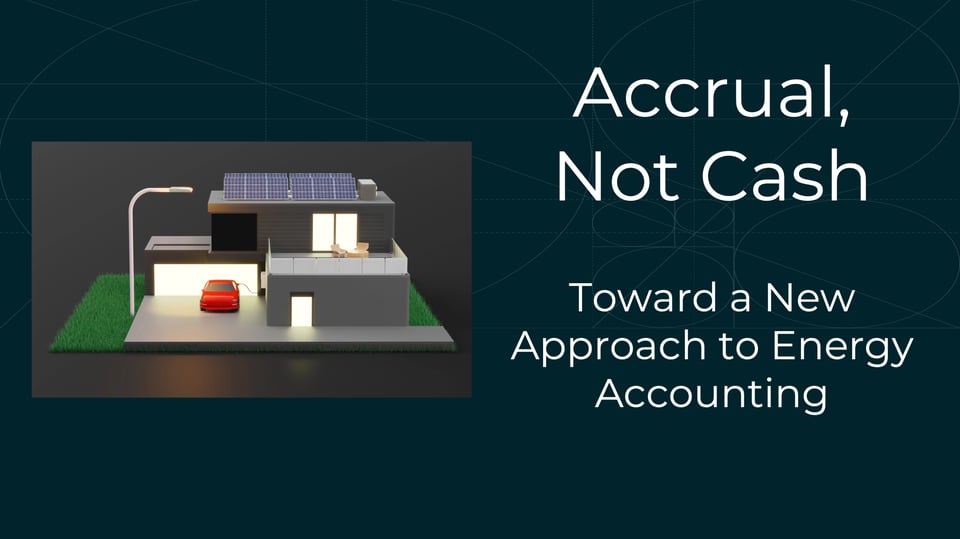
In part two, McGee makes the case that energy is less like cash in a checking account and more like an asset on a balance sheet. Using a cash vs. accrual accounting analogy, he explains why decarbonization only makes sense if we start thinking in longer timeframes—and how that shift opens the door to valuing demand-side resources in new ways.
You wrote a post recently that was interesting, in which you made an analogy between cash versus accrual accounting and how we think of energy. It hit home for me because I think a lot of people have the wrong mental model about how the energy system works. I was wondering if you could talk about that analogy.
The nature of electricity shapes how we think about it. It's instantaneous, existing in a harmonic state. You can't store energy in the wires; you can only have what you're using at any given moment. Production and consumption must match in real time.
This confuses people about energy flows. It's not like a river; it's a circuit. Everything has to balance. I’m not steeped in the physics, but the key point is that production and use happen simultaneously. We account for this like cash accounting: how much did I make, how much did I use? Settlement happens every five minutes, or hourly. Your monthly bill just aggregates these micro-settlements.
In business, cash accounting means settling cash in, cash out daily. You pay vendors, customers pay you, and at month's end, you hopefully have more cash than you started with.
But accrual accounting sees the world differently. It recognizes investments that pay off over time. If I get paid today for six months of future work, accrual accounting recognizes that payment over the entire period. From a power systems perspective, where everything settles instantly, thinking in longer timeframes seems strange.
But what if you're investing in the attributes of the power, not just the power itself? Install a battery that dispatches every evening, creating grid capacity. You pay $10,000 today, but that capacity lasts 10 years.
Think of that battery in accrual terms. You're paying a little bit over a long period and getting paid over that same period. The emissions reductions, the energy payments, they accumulate over time.
We already think this way in parts of the energy world. We sign long-term PPAs. These are assets, not just transactions.
But most people still imagine instantaneous settlement: "How much did my bill change this month?" Not: "Am I making a good long-term investment in an asset?"
Here's the reason why this matters: decarbonization doesn't pencil out with real-time thinking. If there's no immediate payoff, it seems difficult to justify. But that's wrong.
If we think in terms of assets, what matters? Not just the kWh delivered at any moment, but the attributes that give those assets value: how clean was the energy? What time of day was it made? What direction did it go? These characteristics will define the value of energy in the post-transition energy world.
We've built our EAC accounting framework around this. Every watt-hour of electricity has attributes beyond just being electricity: time of day, direction, cleanliness. These become the basis for valuation in the new energy economy.
So that's what the WEATS registry does?
Exactly. The registry is designed for transacting energy based on all its attributes, not just kilowatt-hours. We assign each watt-hour a unique serial number. We're talking billions of them.
If I sell you energy savings with associated carbon reductions, and I want to claim those reductions, I need to prove two things: first, that my claim is unique and not double-counted; second, that the savings actually happened.
How do you verify carbon savings? You need to trace back to the measurement and verification of the energy savings. Having a system of record that documents the M&V becomes crucial.
That's the registry's purpose: creating a digital paper trail. As markets become more complex and arm's-length, counterparties need enough information to trust the market rather than relying on personal relationships.
Right. So, explain to me what your new platform, Aristotle, does.
Let me go back to Gold Rush mining towns. Two jobs really mattered: the tavern owner, think Al Swearengen from Deadwood, running the saloon, hotel, and brothel where everyone congregated, and the second - and arguably more important job - the assayer.
You'd mine gold all day and bring back a bag of nuggets. But you couldn't use them as currency because nobody knew their worth. The assayer would weigh them, verify they weren't fool's gold, melt them into blocks, and stamp their value. Then you could take them to the bank or tavern.
The energy transition requires a similar assaying process. You have heat pumps, batteries, efficiency upgrades, solar panels. What value are they generating? Measurement and verification is our industry's assaying process.
Aristotle automates this. Historically, M&V meant someone with a spreadsheet and clipboard taking measurements. It was expensive, tedious, and imprecise.
We said, “let's eliminate that.” Using the work from Recurve, including OpenEEmeter and CalTRACK, we've built systems that automate M&V. Done at scale with hourly granularity, we can give anyone deploying demand-side energy resources instant access to their value.
Get your resources stamped with an EAC, then take them wherever you want. We're agnostic about what happens next. Some sell carbon credits, others certify green products, others structure energy services contracts based on verified savings.
So it's not necessarily just carbon that you're looking at. It's the energy you save at particular times of day.
Exactly. Carbon is the easy example and top of mind for many people. But, for example, with data centers coming online, capacity is equally critical.
We're now structuring PPAs for VPPs, power purchase agreements for virtual power plants. The concept is simple: I can buy savings, "negawatts," from demand-side resources cheaper and faster than building new power plants or grid infrastructure. Need 50 megawatts? Why not source it from the demand side instead of building new supply?
I was going to ask you about markets. Something we always used to talk about was programs versus markets.
Programs have fundamentally misaligned incentives. Program implementers want guaranteed revenue because every company wants to de-risk. The program world is pure pre-transition thinking: top-down solutions.
Introduce uncertainty, where payment depends on actual delivery, and they panic. It's an immune response: "Must revert to familiar territory!"
We saw this with California's Market Access programs. When it became clear implementers would face uncertainty and accountability after 20 years of doing things the same way, they banded together in revolt. Now they're back to upfront rebates and deemed savings because they can't tolerate being held accountable for actual grid benefits. They don't see themselves as delivering grid value.
That's why PPAs for VPPs work better. What's the grid value? What environmental benefits can we bundle with EACs? Just like bundling supply-side PPAs with RECs, but payment only happens for actual grid benefits delivered. This makes many people uncomfortable because they want flat, guaranteed payments.
Honestly, their days are numbered. California is talking about scrapping its entire energy efficiency portfolio. Over a billion dollars annually from ratepayers, half going to administrative overhead, and we’re still nowhere close to meeting our goals. We need to approach this from first principles.
I prefer a Presbyterian approach, and I know I'm pushing the religious metaphor here. Let’s give flexibility to the market for developing their own solutions. Sign PPAs for the delivery of demand-side energy, and pay for results. That's great!
If you're a data center operator needing capacity, go procure it your way. If you need net-zero credentials, pay for heat pumps based on actual delivery. Let these experiments happen. Stop micromanaging from the top, and we'll massively accelerate demand-side decarbonization.
All right, so this is my last general question. We've entered this political moment when some people hesitate to talk about climate change and carbon. I'm wondering how you address that. First, is that true? And then how do you address that given that your whole company is centered around carbon emissions?
After the election last fall, everyone gave me the same advice: "Reinvent yourself as an AI company. Don't talk about the environment."
We just closed a seed extension. The investors who participated did so because of our mission, not despite it. Nobody wins by becoming a lesser version of themselves.
The fossil fuel industry made an effective argument: Based purely on cost and convenience, renewables are annoying. Solar only works half the day, wind varies, you need batteries and transmission, and people resist wind farms in their communities. Why go through all that trouble for benefits that seem hard to grasp?
There's literally only one answer: renewables don't kill us. They're good for the climate; burning fossil fuels is bad for the climate.
You can squint and argue that renewables are cheaper now, but we lost the political argument because we pretended it wasn't about climate.
Look at Gavin Newsom now, talking about drilling more oil, being "realistic and responsible," sucking up to the fossil fuel industry. It’s why people are so cynical about climate because at the first sign of hardship, politicians run for cover. They don’t believe their own white papers.
Yes, there are trade-offs to clean energy. It's more complex and sometimes more expensive. But if we can't be honest about why we're making these trade-offs, like the fact that your mom can't enjoy an evening concert because it's 100 degrees outside, we'll never make political progress.
My position is clear: climate matters. Burning more fossil fuels threatens humanity's future and quality of life. It might be unpopular to say "I'm a climate tech company." Investors might prefer AI data centers for better returns.
We must be firm in our commitments and clear-eyed about trade-offs. When I ask you to install a heat pump in California, your bills might increase. That's why environmental attributes matter: they can internalize externalities so the secondary revenue from 90% emission reductions offsets higher bills.
If we deny that climate matters, we'll never progress towards the energy transition because climate is what gives the energy transition meaning in the first place.
That wraps up my conversation with McGee Young. Thanks for reading this two-part series, and please forward it to anyone working on demand-side energy projects!
What do you think are the biggest barriers to scaling demand-side resources? And what other energy transition topics should I explore next?
Until next time,
