
What Empire Taught Me About Time
Reflection
There are many phrases in the English language about time. "No time to lose." "You're wasting time." "Time is of the essence," "No time to waste", "Time is money". "I'm just killing some time." These phrases represent a specific relationship to time, they capitalize on time as a commodity to be bought and sold, rather than lived through and marked, noted for its fleeting nature. Essentially, you as human being alive and breathing, are not the primary experience holder of your space in time, but rather those around you are constantly watching to see if you are using it correctly. There is money to be made, a imaginary concept, and if you are not producing, you are wasting time. Some times these phases are positive, "please take your time." But how often to we hear them? How often are we encouraged the say them to each other.
"The time is now."
But what does this mean when many of us workers, African, Latino, Asian, Arab, Indigenous the global majority, but all workers across racial and class lines are overworked, underpaid, chronically stressed and ill. What does this mean when we as barely supported "citizens" but predominately workers, suffer moral injury from witnessing countless wars, violence both personal and structural, genocide and yet live? Many of us want to be alive and find connection. There are those among us who fight against the constraints that are placed upon us, and want to reconnect to ourselves in a way that allows us to show up aligned with our inner authority. The time is now, but our time has been stolen, taken, wiled away. Worst of all, Empire's use of capitalism and imperialism forces us to reinforce its killing of us and our most precious commodity, our lives; the time spend on Earth.
Historical Grounding
A key understanding in fighting Empire is that the goal is not to end individual strife, disagreement, and dysregulation, to create a sameness. It is to end the control of a few, that only seek to prop up the interests of a few capitalists who create a system of a permanent underclass. This underclass will work as long as humanly possible for the one end goal of maximum profit. The working class which is most of us are not free to decide and live within our own time frameworks. That this is the only possible way to live is the wool that is pulled over our eyes. One aspect of this struggle for self-determination was the creation of the 40 hour work week and the 8 hour working day, with two days for leisure. At this point in time it seems like a fact of life. Eternal. The creation of this structure was the result of a series of movements led by communist and socialists among the working class across the United States, and especially in Council of Three Fires (Chicago, IL) where local employers faced labor strikes, and crises of capital throughout the 19th century.
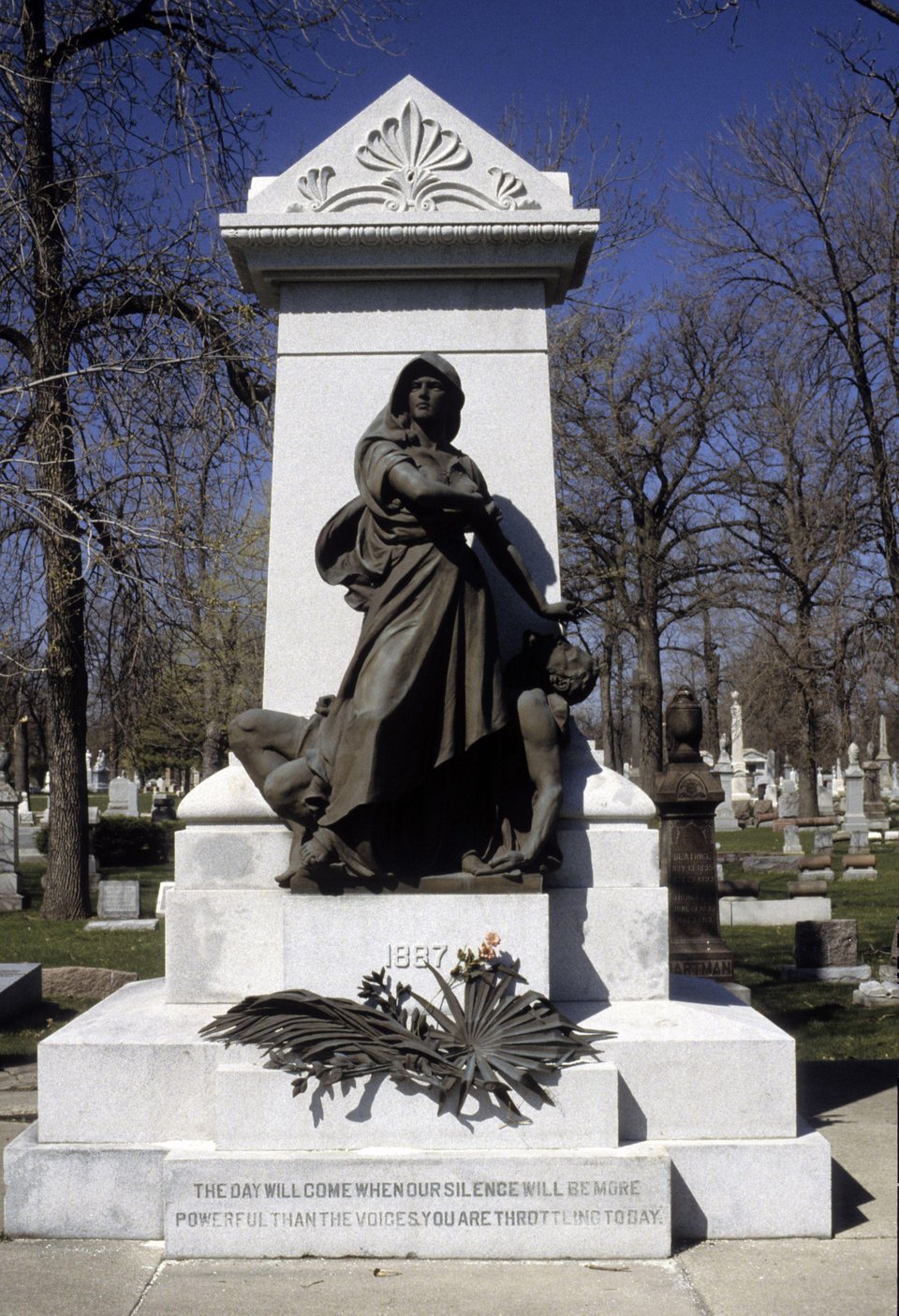
The federal government worked to curb immigration from China, while an influx of European workers arrived to compete for wages as sectors that were previously staffed by enslaved Africans are faced with having to actually pay their workers after the end of the Civil War. It is within these societal shifts and fluctuating job market that the Haymarket Massacre, or riot depending on who you ask, occurred. May 1, 1886, 21 years after the abolition of the enslavement of Africans in the United States, 35,000 workers walked off the job, followed by a rally on May 4th. At the action, an unknown person threw a bomb into the crowd, killing one police officer instantly, at which point the rest of the contingent opened fire, killing and wounding an undetermined amount of workers, and six officers in the melee.1 Eight prominent anarchists and socialists were convicted without a conspiracy charge for the bomb in an abdication of even an appearance of justice, with seven sentenced to death. Ultimately four were executed by hanging with two dying in prison by their own hand.
Poem
The Honor of Arriving
Break your clock
and spend some time with me.
watch from my eyes the
reflection of the candle light
the pop of my freckles in the
sun.
She invited
breath, slow and deep.
Hear the hawk overhead,
the quiet of arriving
of laughter without pretention
no where to go
no where to be
nothing needed.
Practice being here.
You are not in trouble
perpetually, like those others said
you are here with me now.
The honor of your presence sustains
me and I miss it when I'm not near you
if each moment is now and not the future
do us the honor of greeting this new world
between us with intention.
Do you feel the popping, fizzing, crackling
of new Earth full of possibility being
born?
This is what that feels like.
So sweet it could be denied (am I worthy?)
So small, it could be dismissed (will I know how to welcome it?)
Welcome the arrival in between glances of the purple sky, the yellow leaves, and the crispy air, she told me.
What a horror it is to deny the true home
of being with the fake security of belonging
I am the true home.
Yet I am homeward bound too, to the eternal time.
I will spend more time dead than alive.
One Question
What is one way you can replace Empire's narratives about the role of time in your life?
Source:
- https://www.chicagohistory.org/haymarket/
If you would like to support my work, please consider a one time donation to access the archive, or a monthly sustainer. Let’s create liberated communities where we are, together. -LJ