Cellular automata as a brand
It’s been more than ten years now since Melbourne’s rebrand, and it definitely brought the concept of a flexible identity to the spotlight.

Well-executed work of this kind is fascinating – it’s much harder to design something like this, compared to the usual “rigid” brand, with prescriptive usage guidelines.
Last week, I discovered a project that is flexible like this, on top of intersecting with mathematics and digital art.

The work is Corpus IT School, by Voskhod, and it’s based on cellular automata.
Small note: I did a bit of research to attribute the project properly, and it leads me to believe the following is a branding exercise. Otherwise, it could be that this technology school does not consider an Internet presence necessary 🤷♂️
Do you know about Conway’s Game of Life? The game itself is more of a toy, really, but there’s a vast amount of theory and knowledge behind it. Cellular automata is a very academic-sounding name, but anyone can grasp its core concepts.
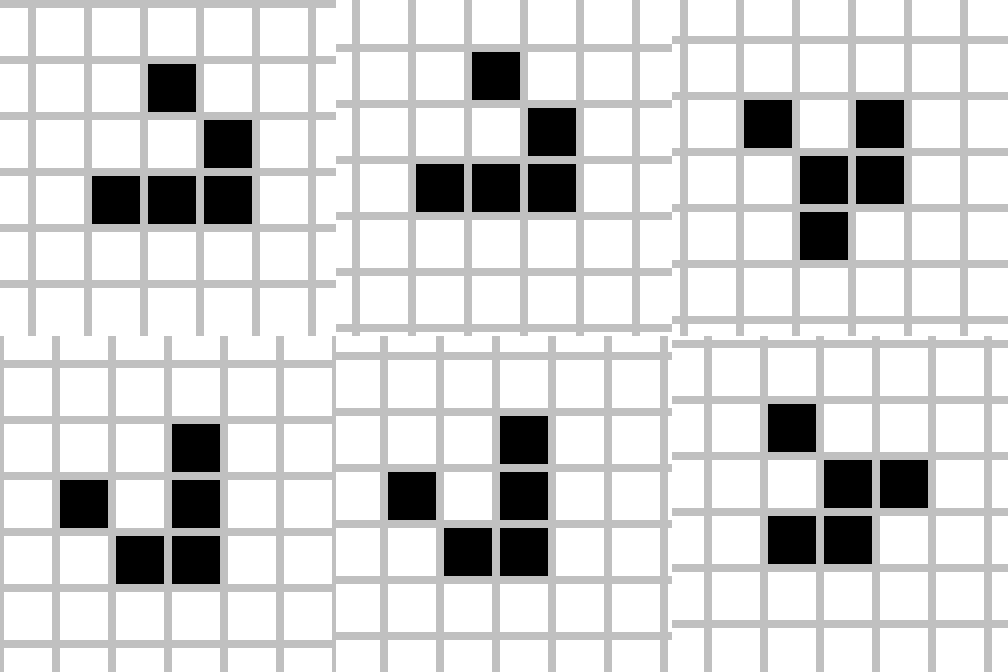
The way it works is fairly easy to reason about: Picture a simple grid. In it, each cell is given a starting on or off state. By counting how many of its eight immediate neighbors are on, the cell decides if it will stay the same, turn off, or turn on for the next turn.
The original Conway rules are as such:
An off cell with exactly three on neighbours turns on.
Any on cell with two or three on neighbours stays on.
Any other combination makes the cell turn off for the next turn.
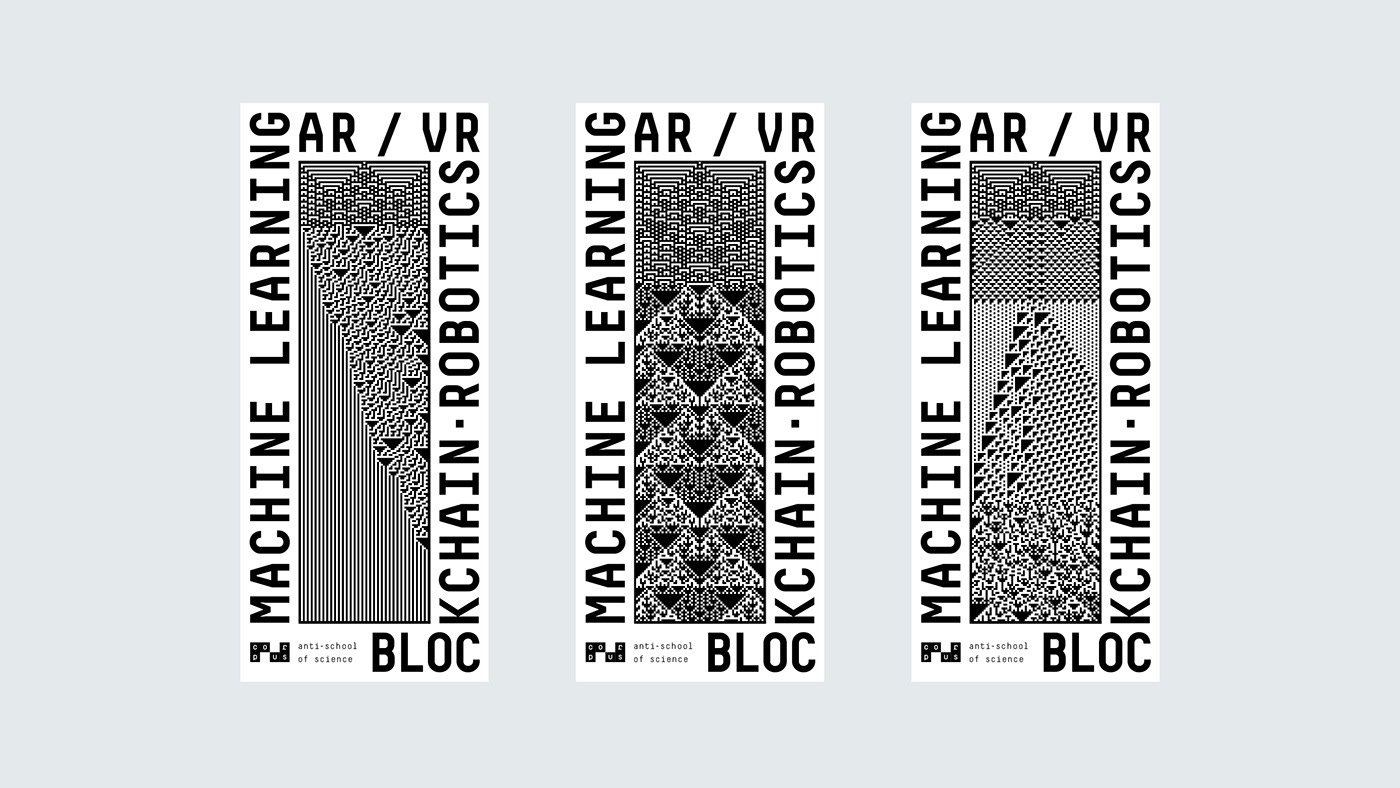
This a set of rule in two dimensions (three when you count time) – the cells exist among X and Y axes, and change as we move forward in time. Another form of automaton uses just one axis, and then we usually map time as going “down” the representation. Each line is the resulting “step” from the one above it.
Vokshod are making use of the latter automata as well, by transforming words into a set of rules that change as the pattern grows.
While the logo and some motion graphics are based on Conway’s three-dimensional ruleset, I’d argue the heart of this branding exercise is this two-dimensional automata generator:

And while we’re at it
Mathematical models are great ways to get patterns we can’t readily create by hand (or at any reasonable speed, at least). If you want to meet another popular model, here’s a design darling: the reaction-diffusion system, great at balancing space into specific proportions of two surfaces:

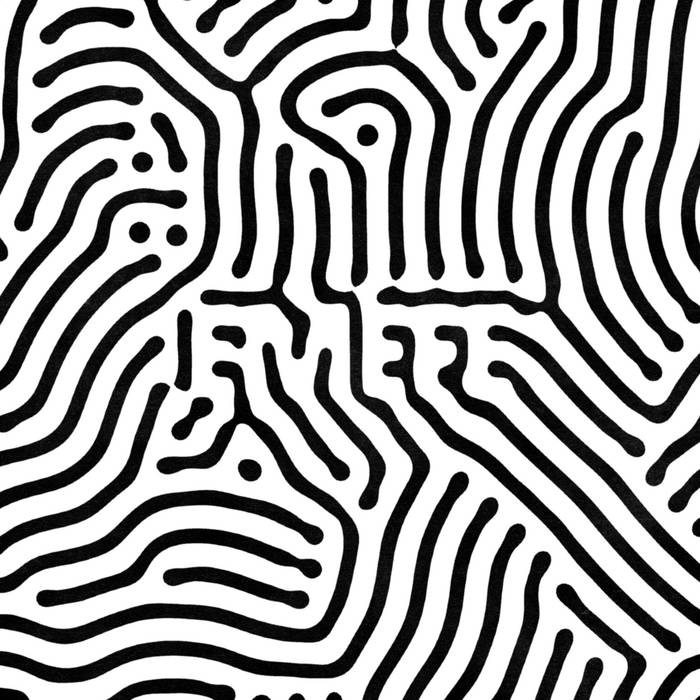
If you didn’t know about it already, you’ll find reaction-diffusion is used in a lot of places, and naturally occuring too!