Ode to a big old body
Brian, Botox, and Buoso
Because I am a woman of a certain age and size, my YouTube feed is stuffed to the brim with commercials for “tai chi walking” as well as some dance fitness thing with an AI-generated theme song (it’s the same music in Tokyo as in Texas, with different robot lyrics). These adverts assure us big old ladies that nought but a chill month of gentle walking or moving our arms as if we are enthusiastically cleaning the French doors of our balconies stands between us and firm booties. “In a month, you’ll be proud of your body again!” asserts the tai chi walking avatar - imagine an Asian Bratz doll with Kardashian-ian glutes and wrinkles straight from the 2018 Facebook aging app - and then real people appear with purported evidence of their four-week transformations as though none of us know how AI works.
Watching these tight, saggy ads over the last few months with an ice pack on my elevated knee, waiting for the “skip” button to appear, has been uncanny. At sixty-two, I can still do a lot of things, including heal from a meniscus tear, and I know damn well how long those things take: longer than they used to. Stretching my hamstrings, learning a sonata, speaking a new language, eating more betacarotene - every new practice onboards more slowly, and regresses faster when my efforts wane.
Rehabbing from my injury, I’ve felt a lot of frustration. Staying patient (not my strong suit, shocking I know) with tiny daily increments of progress has been a challenge. More than that, I’ve been contending with the fact that the cause of my injury was me. Not because I stepped up on to my porch, an absolutely routine thing that one evening resulted in a pop that stopped my husband mid-sentence. No, it’s on me because I slacked off on stretching, got heavier, did and didn’t do a bunch of small things every day for some long period until that pop and the sudden knowledge that everything was going to suck for a while.
Thus owned by lack of consistency, you’d think I might forgive the shitty AI and appreciate an ad extolling the virtue of doing a little something every day. Any musician knows that small, consistent effort leads to better results than infrequent practice binges. So why was I so put off by a lazily spun up visual stereotype? So much unreal stuff passes my eyeballs on the regular, these predictable images hardly seemed worth elevating to the status of essay prompt.
Yet I have so elevated them! Let’s go! To get started, I’d like to turn back to an inspiring artist of my youth, a time before bad joints and algorithms. This is a job for Brian Eno.
More than this, you know there’s nothing.
IYKYK.
If Y don’t K, stay with me.
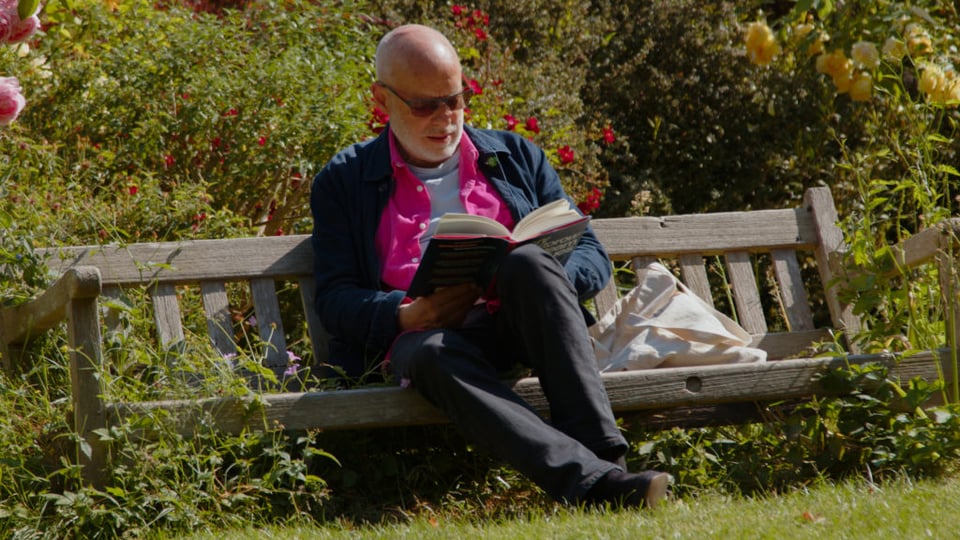
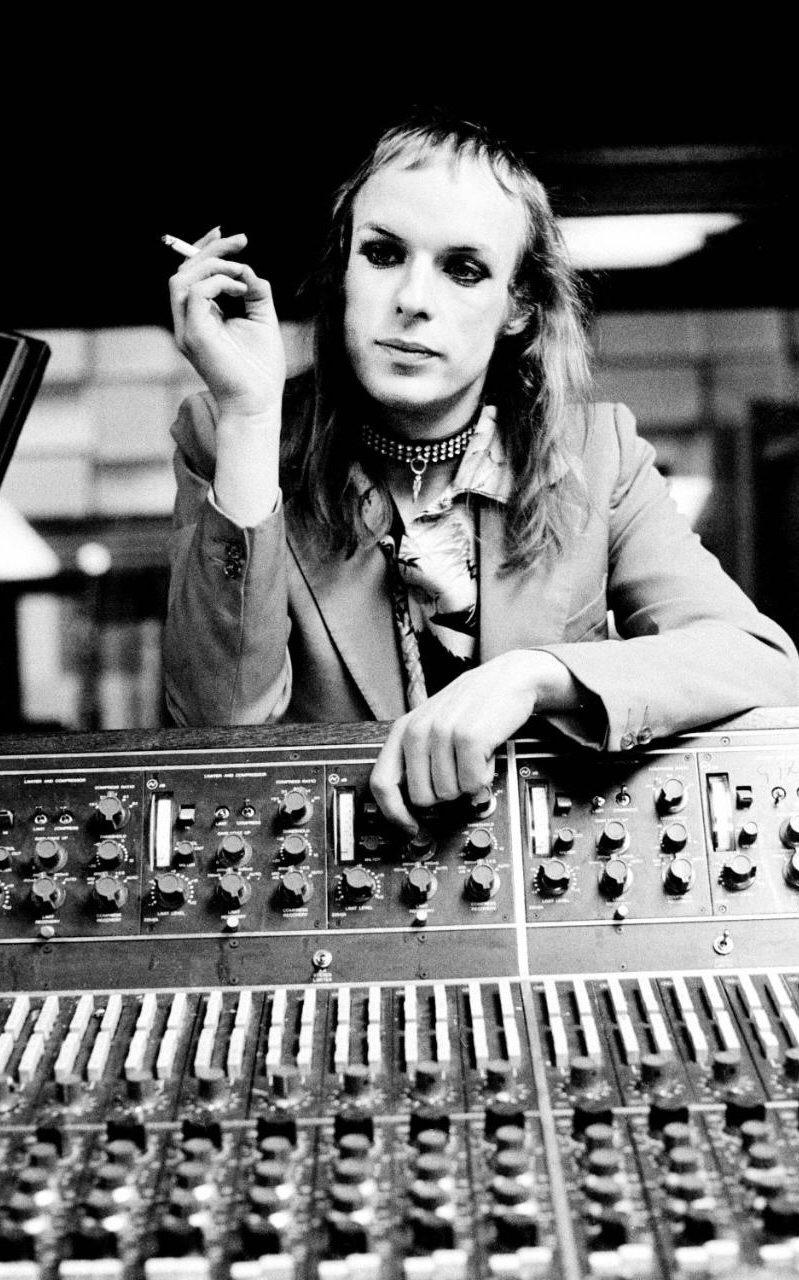
When I got to college in 1981, everyone was talking about Eno’s Music for Airports. Ambient music was a brand new idea, if you didn’t count Eric Satie; Eno and Philip Glass were on our minds as the celebrity president ranted about an evil empire and we argued about whether tape loops counted as real composition (gosh, the more things change…).
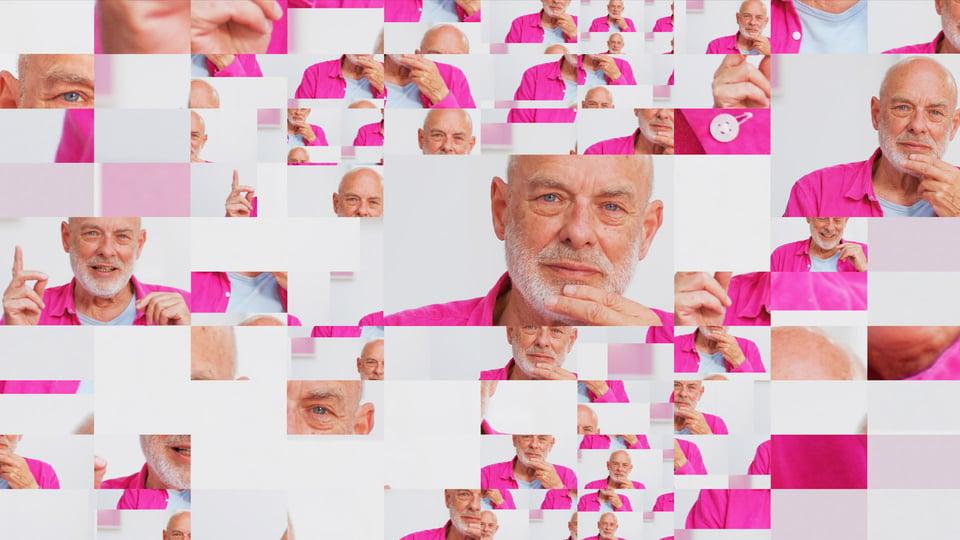
I watched Eno a few days ago. The 2024 documentary (fully available on YouTube) is generated by a software program called “Brain One” - maybe the cutest lil anagram ever - so when you order up the film online, the software assembles it out of the 30 or so hours of interviews and 500 hours of archival footage. Even as an AI hater, this idea intrigued me. Just as each of us experiences another human in a totally discrete, personal way, we each see Eno in a completely different configuration. Additionally, this way of making film exposes the film-making itself, subverting the traditional heirarchy of decision-making. You’ll never step in the same film twice - very zen, Brain One.
The biggest delight for me in watching the film was encountering a man fifteen years my senior who so comfortably inhabits his own skin. Eno talks about his professional life, experimentation and computers and generative programs, with total engagement and curiosity, then fully turns that same open energy to gardening and casual choral singing with his friends. In fact, nothing seems so important to him as these grounded activities - preparing food, tending to plants, assembling a circle of amateurs to blend their voices for pure pleasure. As the film shifted from interviews with the present day old man to footage from the Roxy Music days, I saw a person eager to experience all of this world, from asters to anthems to algorithms.
The tai chi walking ads on my computer were AI slop, but it wasn’t the fake grandma and her fake abs that got me. It was that “having pride in your body again” was embodied by a grayhair in a crop top, a computer-generated Old with the high ponytail of a Young, the image improving your aging boady denying and negating the very reality of aging. But then on that same screen I could find old Brian Eno, loving his plants and his programs, curious about the whole world and as comfortable an elder as I have ever seen.
It made me feel like equilibrium in the shifting world was possible. It might not even be that hard to find.
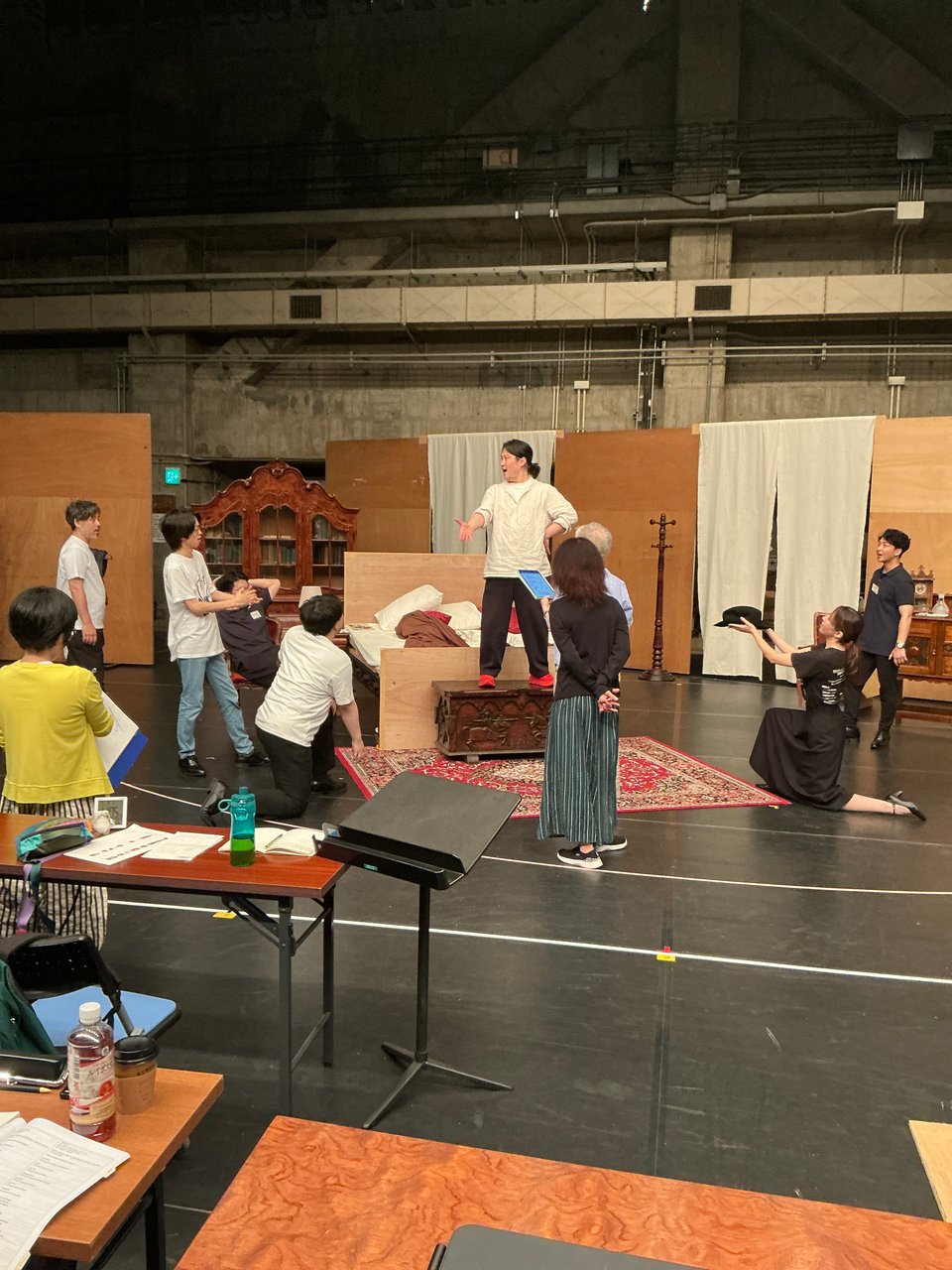
Today, we had our first run of Gianni Schicchi in Tokyo. No women die or even get abused in this popular show, setting it firmly apart from the bulk of the operatic canon. That’s just one of the many reasons working on Schicchi is such a joy. I love its humor, its precision, its gorgeous love theme which Puccini treats now with reverence, now with side-eye. And I love old Buoso Donati, the rich uncle who dies. His greedy relatives can’t wait to walk off with his fortune, but have to contend with multiple interruptions. When the avarice on their faces melts into politeness for the visitors, we chuckle in rueful recognition at their hypocrisy regardless of how well we understand the Italian lyrics.
The only thing I love more than performing this opera is rehearsing it, and so I felt a very slight melancholy as the cast coalesced this afternoon. While the dress rehearsals and performances will be a blast, I’ll miss these days of experimentation, awkwardness, failure, and stumbling. There is more joy in the process than in the product. This is a gig, so the product is the point, but it’s the process that shapes the artists.
For musicians, practicing is a kind of optimization. We spend hours in practice rooms, working to make our bodies obey our minds. Practice is ultimately an attempt to maintain technical prowess gained over painstaking years. But old me knows that the hours in the practice room are light years more significant than any resulting achievements. If all your daily work results in Airport Music? Gianni Schicchi? awesome abs? Great! But these products are secondary, and nowhere near the major reward. The work itself is what shapes us, regardless of result.
Many musicians experience meaningful technical advancement when injury forces them into a period of rest and rehabilitation. That happened to me years ago as a pianist. Now I find myself grateful all over again for this latest recovery period. My knee injury made me slow down, pay close attention, and learn new, specific things about my body. In a few weeks, I’ll do a sprint triathlon with my sister. Last year, I was one of the slowest participants in the race, and this year I will most likely be slower. Unoptimized me will still walk away with the whole experience - the effort, the camraderie, the Minneapolis locals in lawn chairs cheering us on, the beauty of the course, the family celebration afterwards. Those things are worth my time, energy, and heart. Anyone else’s better results are worth admiring, and just like mine they are secondary to participation in a large, joyous community.
I started “The Small Stuff” by Ian Bogost this week (he writes for The Atlantic but I will try not to hold that against him, it’s not like I have any claims to purity through my employers). I’m drawn these days to writers who seek words to push back on the cultural forces driving us to optimize (and monetize) everything about ourselves. I listen to the book while striding through the Tokyo streets, checking my phone app to monitor step length, symmetry, and speed while the author describes the sensory joy of cooking as a beautiful journey to the destination of dinner.
The meat is the message (apologies to McCluhan). This thought was already floating around in my mind after reading two New Yorker pieces about faces, Jia Tolentino’s “Our Plastic Surgery Nightmare” and Cal Revely-Calder’s “What Happened To Your Face?” (these are paywalled, sorry about that). Both essays explore contemporary versions of physiognomy, the long discredited but never totally abandoned belief that a person’s moral character can be discerned in their face. Is it a coincidence that, as facial recognition becomes the price of admission, people tweak their features toward Instagram sameness with increasing frequency, trying simultaneously to nail the algorithm and fly under the radar?
Revely-Calder writes:
Social media needs the face because it burns attention for fuel, and the face is where I go when I look for you. But I can’t look to these platforms. I find it all so unsatisfying: the resculpted faces, the curated lives, the naked grabbing of my gaze. Something uncertain, something human, has been drained like blood from this world. There’s evidence that Botoxed people become worse at reading other people’s emotions, because when you engage with others you simulate their expressions in your own facial musculature. It’s as if we were commodifying the face, putting it under glass, turning it into a transactional token rather than a pliable living thing.
That paragraph stayed with me. Botoxed people become worse at reading other people’s emotions. What happens to our communication skills as we interact less and less with one another, and more and more with simulacra - when we are simulating the expressions of our simulations?
When I return after a long gig, our dog Minnie runs to greet me as though I never left. When I’m away and FaceTime my husband, Minnie doesn’t react to the screen or to the sound of my voice. Absent my physical presence, her creature’s mind doesn’t begin to conceive that I could be there. It takes a human mind to fill in those blanks. This human ability to imagine and extrapolate is miraculous. We are born storytellers, our greatest blessing and most perilous curse. Humans are always ready to be rendered pleasurably - often dangerously - credulous by a great storyteller. That’s theater, and church, politics, and most of what we do together.
Theater taught me that our meat is magic - okay, our bodies, that sounds more polite. Data builds knowledge, but it isn’t knowledge. Pattern recognition is part of language acquisition, but it isn’t communication. What happens in our brains, in and through our faces, in rooms filled with our voices and our big old bodies, is the completest and richest text of our shared life. We don’t understand it because it isn’t quantifiable - yet, you might say, but I am more optimistic, and say never. I have no desire or ability to transcend the mystery and mess of my meat.
I hope we keep turning away from an unimaginative story of people whose bodies and activities can be endlessly optimized. That story doesn’t send us upward, but rather toward a barely differentiated middle ground, emphasis on the mid, where there are precious few rewards for us. Instead, let’s get a room full of stumbling actors, a bunch of raised human voices, big old bodies with torn up knees. Let’s learn from our mistakes and our healing.
Look into my face and I’ll look into yours, and we’ll imitate one other toward an imperfect and magical understanding.
Nothing more than this.
One question…
Would you consider sharing this newsletter? Now that I’ve left the big platforms, I do need your help in spreading this writing around. Thank you for considering this!
Lastly, let me know your thoughts in the comments. I want to hear from you!
-
Love this
-
Have fun on the triathlon
-
Thank you!
-
Fantastic! I adore your writing.
I’ve also been thinking about these things a lot as I turn 54 this summer. Those fake ads drive me crazy. And I was saddened to discover recently that 4 of my friends that I thought were aging gracefully along side me were actually using Botox and fillers. Although one friend claims it’s just “baby Botox” to soften the forehead wrinkles. I want to look into others faces and see the years and the knowledge and the joy and the heartbreak. We are all going to get much more wrinkly and die so why try to pretend we aren’t. Why not own each passing year as precious. I’m trying my best but so many are jumping ship that I’m not sure which faces to believe anymore. 😔
-
I am so with you on this! On one hand, body autonomy is so important - you do you, you know? - but if these treatments are chiefly tools to keep imposing toxic standards of conformity on us, particularly in a an increasingly neofascist environment, I’m not for it.
(We still need to figure out when to connect in person!) K
-
This is all so right on. Miss you, and especially miss collaborating with you. Our Michigan shenanigans are among my finest memories. Schicchi / lheure Espagole was so amazing and with such star-studded casts. Especially George Shirley as Buoso! Please keep sharing your insights with us! It is helping my pursuit of happiness.
-
I’ve thought of that production so often! We did good work together :) and those were some fine, fine students. It’s wonderful to see you here, friend.
-
Facial plasticity is also soooo important for vocal technique, and therefore for all verbal expression, right? Will we lose our ability to teach singing over time, too? What horror! Makes me think of online vs in-person teaching, and how they differ. Shared on FB! Love you KK xxx
-
Thank you for the share! Several new subscribers - I’m really grateful! And yes re: facial plasticity - language is so much more than words and grammar, which is the whole LLM problem. I think about this all day every day living and working for a few months in a country where I only have a few sturdy phrases of Japanese. Most of my communication with people is through eyes, smiles, and all the little ways we try to show apology, patience, humor, and thanks with our faces. Love you lady - talk soon!
-
Hi Kathy I've never met you, I'm 81 years old today, and I am long retired from the classical music world, but I get a big kick out of your discoveries, réminiscences, writings, humor - all that! Un gros bisou de la France where I live now. As for Botox - if they could Botox my muscles to do what they used to do, I would sign up. But appearance - je m'en fous! And I'm working on the muscle thing. It's quite a trick at my age to find what moves/disciplines will help and what will be too much. Trial and error but the process is fun. Don't dread the future! It's not so bad. Not sure I know any of your subscribers but I was priviléged to coach with Eileen Cornett back in the day in Maryland - we did a récital together in Pennsylvania when I was still able vocally. In fact I am still able vocally but not above the staff. Singing along with French variété is one of my gréât pleasures here - kind of like sitting on the garden banc reading. Hugs to you. Sara
-

it’s great to meet you here, Sara! bisous KK

Add a comment: