
Issue #9: Spider Woman's Web
The empowering tales of Spider Woman/Spider Grandmother, encouraging unexpected personal reflection
Book Review
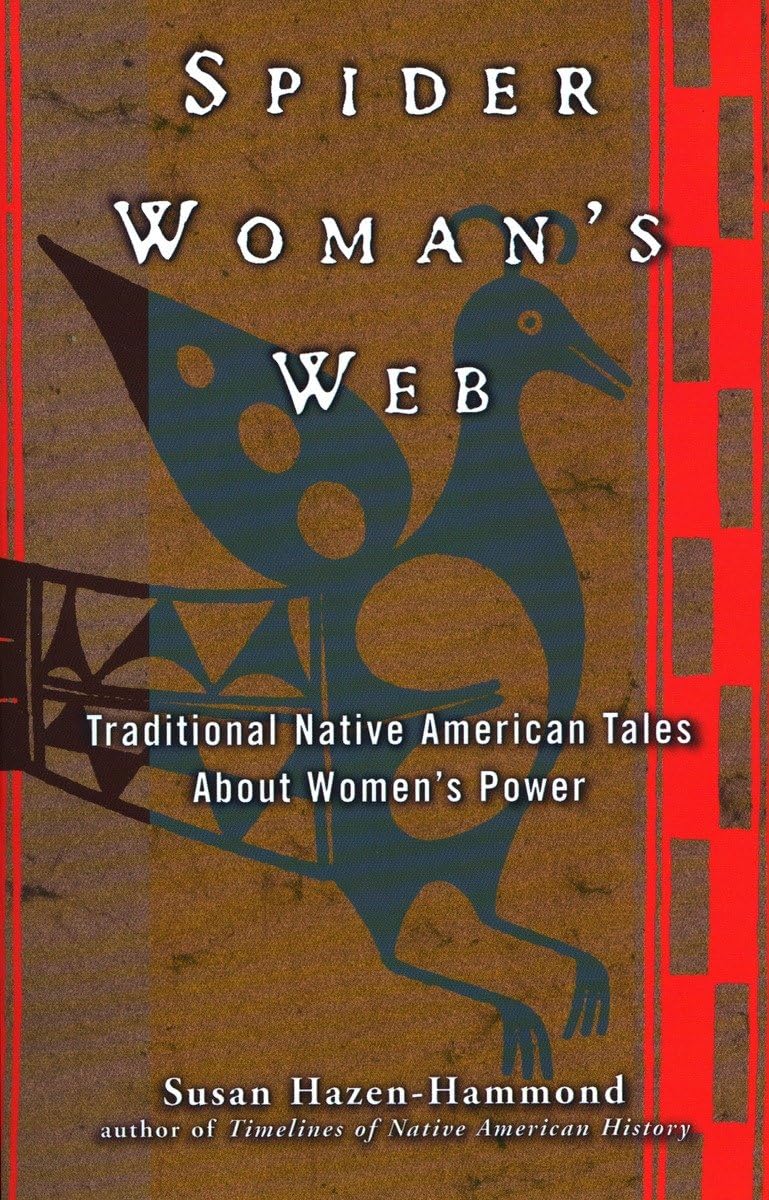
Spider Woman’s Web: Traditional Native American Tales About Women’s Power by Susan Hazen-Hammond
May the spirit of Spider Woman, White Buffalo Woman, Nomtaimet, and all the other ancient Women of Power stay with you. May they protect and guide you. May they encourage you and give you faith in yourself. May they help you feel connected with all those who have gone before. May your life become a dance of joy that celebrates your womanhood, your personhood, yourself. (p 223-224)
Audio version: Kate reads this article to you!
Book information and ratings:
Spider Woman's Web | by Susan Hazen-Hammond, 1999 | |
Genre: | Nonfiction |
|
Subject: | Folklore, Native American mythology | |
Rating: | Worth the investment | |
Read as: | Print copy | |
Readability: | Accessible | |
Subject Weight: | Moderate | |
*Please note: This article by the Smithsonian shares: “Native Peoples often have individual preferences on how they would like to be addressed.” Because the author of this book is of Abenaki descent and uses the term “Native American” in her writing, I will do the same in this review.
How I found this book:
I was reading Women Who Run With the Wolves, and it mentioned an important and powerful figure in Native American mythology called Spider Woman (Spider Old Woman/Spider Grandmother). I had never heard of her, and spiders seemed to be a theme for me lately (article coming soon...)–so, I was curious!
I ordered a bunch of books about Spider Woman, (I know. You’re shocked!) and this one was exceptional.
About this book:
The myths and stories from my background are European fairy tales (Grimm’s, Andersen’s, Disney’s), Biblical stories, and Mormon myths (which are refashioned Biblical stories). Most of these traditional tales have had the original points ground down to seem innocuous and/or resharpened to pierce in unnatural ways.
As I matured, I realized that these stories largely “[...] depicted women as weak, helpless, sinister, or untrustworthy” (p 1), reduced them down to the “prize” to be won, or simply excluded them altogether. I thought that recognizing the harmful messages was it; pulling out the residual barbs was the work! I did it! I’ll just stop giving these stories power in my life–I don’t believe in them.
But, I didn’t know I was so HUNGRY. I didn’t know I harbored an unfed appetite, until I read this book. Here, I tasted stories seasoned with spirit, aged with wisdom, and built with the staples of humanity and nature, such as tears and corn.
Along with the nourishment, there are instructions and options: You can grind the corn yourself, gather the grit in your palms, and breathe the fragrant dust. You can drink it brothy-warm from the pot until pleasantly full. You can salt it to taste, bake a little cake on a hot stone, and put it in your pocket for later. You can smooth the cool mixture over your face like a mask and then rest, absorbing with your eyes closed…
Now, the tales from my childhood seem a thin, bland gruel for my soul’s voracious appetite.
I don’t think I’ll ever consume enough of this soulfood.
****
This book shares 25 Native American tales about women’s power.
Native American women grew up hearing tales about the powers and strengths of women. They heard stories about women healers, women warriors, women artists, women prophets. But above all, they heard stories of woman as the divine creator, woman as a supernatural power, woman as a force of transformation in the universe. (p 2)
Also,
This book is meant not to create gaps between men and women [or our beautiful non-binary friends], but to heal them. It is written in the spirit of Spider Woman, whose many powers include the ability to restore harmony to humankind. It is written in the hope that we may all know the courage, wisdom, and love of White Star Woman. May we all, in our hearts, inhabit White Star Woman’s garden, where the flowers are always blooming and the grass is always green. (p 7)
****
Each chapter follows the same structure:
Introduction of the story with the origin, any trigger warnings, and advice or instructions on what to pay attention to as you read
The story itself
Any variations on the tale from different regions/tribes
A “Connecting the Story to Your Life” section
I loved learning the histories of the myths, like the significance of the number four: the four colors of corn (yellow, black, red, white), the four seasons, the four directions, the “four elements of weather–thunder, lightning, clouds, and rainbow” (p 18). I enjoyed the stories themselves with figures such as Spirit of Reason, Double Woman, Great Star Man, and Dream Helper. I was drawn in by the variety of settings in the different regions: the cliffs, the oceanside, the frozen tundra.
Perhaps if that was all the author included, I might have tallied it up with the other folklore books I have read–after all, all myths share similar elements and are just as terrible and terrifying–but it was the last section of each chapter, “Connecting the Story to your Life,” that struck me.
I was unconsciously planning to skim this section–who really enjoys a bunch of “introspective” (a.k.a. patronizing) questions or assignments at the end of a chapter? I have an English degree–I know how to analyze stories!
But, I found that I don’t know all the ways to consume these myths–how to let them nourish me.
In this section, the author teaches the lost art of assimilating a story into your person, your life. Reading through, at least one thing in her list of suggestions would grab my interest while unfolding a spectrum of self-care/self-healing options.
Some of her suggestions are more expected, such as:
Identify with a specific character and/or other characters.
What patterns do you see?
Take a trip to the wilderness and reconnect with nature.
Seek additional help or professional therapy.
And also includes more unconventional ideas, such as:
Retell the story and change the ending.
“Make a song, chant, or prayer of thanksgiving for all that is holy, sacred, and good in your life.” (p 86)
Create a timeline of your life
Make a list of what is draining your energy–make a one year plan to eliminate them and a 5 year plan.
And, some of her most poignant suggestions include:
“See if you can use these [narrative] elements from your own life, to produce a story so overdone that it triggers laughter rather than feelings of frustration.” (p 63)
“For the next week, practice catching the fleeting intuitions that flit in and out of your head. Keep a list of them. What patterns do you see? Do you trust your intuitions? Why or why not?” (p 78)
“Next time it rains, take a long walk in the rain and meditate about the healing power of tears, the healing power of rain. Pay attention to the images that come to mind as you drift along. Use them in a painting, a sand painting, or some other creative project.” (p 158)
“Make a list of ten things you could do to increase the nourishment to the starved parts of yourself. Choose two that appeal to you most, or are easiest to implement, and begin.” (p 212)
Some of these options, bringing the mind and body together through intention and creativity and nature, were new to me and some were not. But, it didn’t feel like an overwhelming “to do” list. It felt light, free, and meaningful; an invitation to accept the knowledge however and whenever suited me.
****
I learned many things about Spider Woman–how tangible she is as a character and how intangible she is as a force–and I’ll keep exploring her mythology. One ritual, which the author mentions several times through the book and which will stay with me, is this:
You might also use a technique borrowed from the Navajo tradition. Go outside and find a spiderweb. Sit beside it. Let your eyes wander up and down its intricate connections. Cut your mind loose from the day-to-day world and let it float with the web as it weaves back and forth in the breeze. Feel the wind caress your skin. Perhaps it is Messenger Wind, sent from Spider Woman herself, to give you some insight before you begin. (p 6)
****
I wish I knew these story-recipes by heart–that such tools and teachings were a part of my culture! It will take work to memorize the stories, lessons, and skills presented here–although, I won’t walk in the rain or view a spider web the same way again!
I am grateful to Susan Hazen-Hammond for making this wisdom available to the masses–that we all might share the traditions of truth and healing handed down by the magnificent Native American peoples.
****
May the spirit of Spider Woman, White Buffalo Woman, Nomtaimet, and all the other ancient Women of Power stay with you. May they protect and guide you. May they encourage you and give you faith in yourself. May they help you feel connected with all those who have gone before. May your life become a dance of joy that celebrates your womanhood, your personhood, yourself. (p 223-224)
About the author:
SUSAN HAZEN-HAMMOND (1946-Current) is a former professor at Peninsula College, and the author of Timelines of Native American History and seven other nonfiction books, numerous articles, short stories and poems. She has received high praise for her writing on Native American subjects and has also taught a wide range of psychology courses. Her ancestors include Abenaki men and women. Penguinerandomhouse.com
Sources:
Hazen-Hammond, Susan. Spider Woman’s Web: Traditional Native American Tales About Women’s Power. Perigee Books, 1999, New York.
*This is issue #9 of The Book Moth Newsletter
Add a comment: