
Issue #5: The Gregor the Overlander Series
A terrific and imaginative Hero's Journey, punctuated by an unexpected and wildly important theme

Book Review
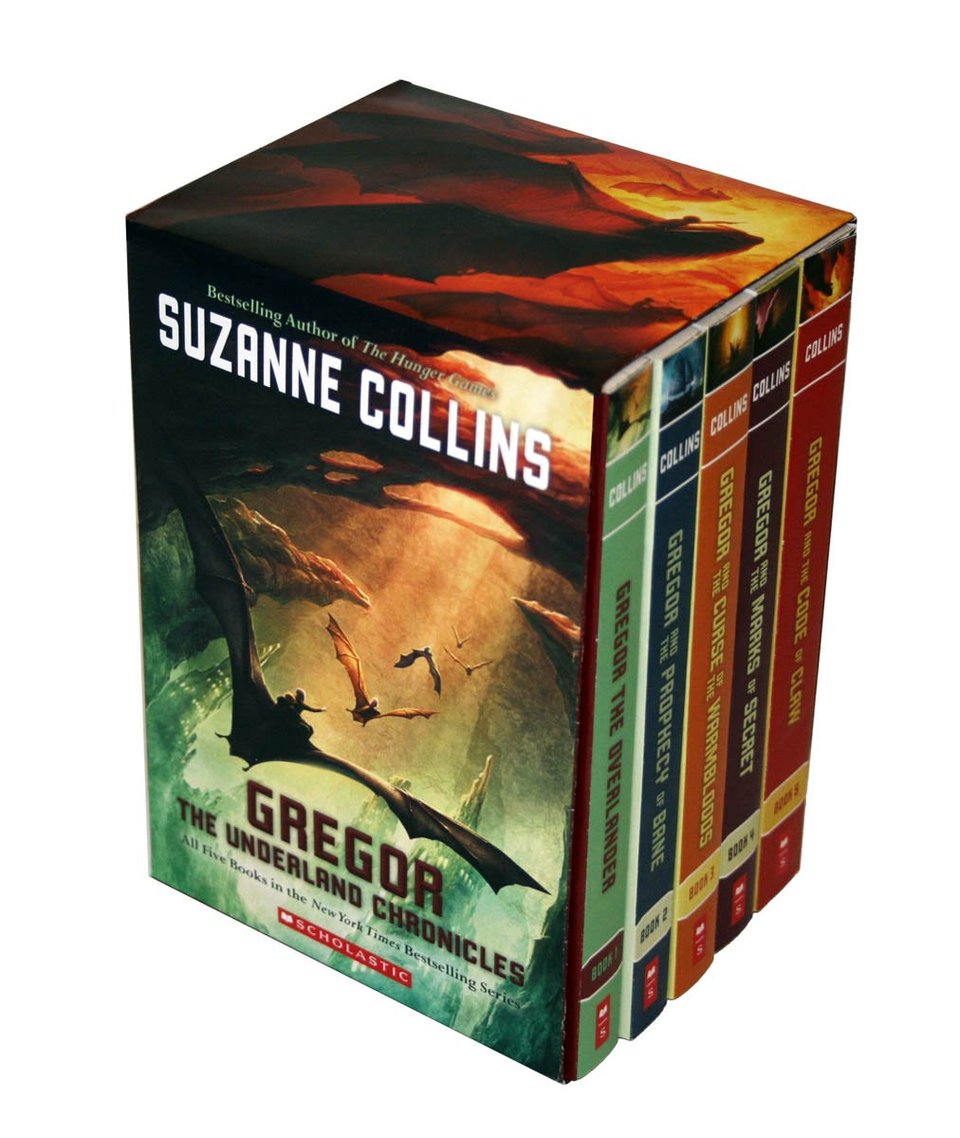
The Underland Chronicles, Books 1-5, by Suzanne Collins
Underneath my admiration and astonishment, I found myself fighting with a *little bit* of resentment: Why didn’t I (the experienced adult reader) see this coming? Why weren’t there more obvious clues? I was ranting…and Julie thoughtfully said: “Well, maybe it couldn’t be an obvious theme, or your boy might not have found it in the school library.”
She is so right.
I have brilliant friends.
Audio version: Kate reads this article to you!
Book information and ratings:
The Underland Chronicles (AKA The Gregor the Overlander Series) | by Suzanne Collins | |
Book 1: Gregor the Overlander | 2003 | |
Book 2: Gregor and the Prophecy of Bane | 2004 | |
Book 3: Gregor and the Curse of the Warmbloods | 2005 | |
Book 4: Gregor and the Marks of Secret | 2006 | |
Book 5: Gregor and the Code of Claw | 2007 | |
Genre: | Fiction, Young Adult (YA) |
|
Subject: | Self-discovery, hero's journey | |
Rating: | Worth the read | |
Read as: | Print copy | |
Readability: | Accessible | |
Subject Weight: | Moderate | |
How I found this book:
My oldest discovered this series at his school library. He had to return the first book before he was finished with it, so I jumped on Amazon and ordered the entire set for him to read at his leisure. He just grinned at me. “I knew you would buy it–you buy any books I want!”
Ahh haaaa….true. Too true.
(It is lovely to feel that my child knows me and sees me, and we can connect with books! On the other hand, what else is this little mastermind capable of? Well, anyway...)
This series ended up as our nightly read-aloud books for my 12-year-old and 9-year-old boys.
About this book:
There’s probably someone out there who wasn’t enamored with The Hunger Games trilogy, but I’m not sure who. In that trilogy, Collins creates a dystopian world, complete with perfectly horrific and horrifically effective mass-population control tactics. Then, there’s the multifaceted heroine and the inevitable revolution.
Having read all The Hunger Game books (minus the newest prequel–I haven’t gotten around to that one yet) and watched all the movies, I was looking forward to similar meaningful and interesting themes in this series. I was surprised to learn that she wrote The Underland Series before Hunger Games, and I had never heard of it.
****
Suzannecollinsbooks.com gives some background on the origins of Gregor the Overlander:
Thinking one day about Alice in Wonderland, she was struck by how pastoral the setting must seem to kids who, like her own, lived in urban surroundings. In New York City, you're much more likely to fall down a manhole than a rabbit hole and, if you do, you're not going to find a tea party. What you might find...? Well, that's the story of Gregor the Overlander, the first book in her five-part fantasy/war series, The Underland Chronicles, which became a New York Times bestseller.
****
The main character in this series is an 11-year-old boy, Gregor. He and his family live in New York City at poverty level. The story opens with the fact that their dad has been missing for almost 3 years, putting maximum strain on every aspect of their lives.
One day, Gregor and his 2-year-old sister, Boots, are doing laundry in the apartment building’s basement when they accidentally fall through a grate to an underground world.
This world is dark and populated with giant talking bats, rats, cockroaches, mice, lizards, spiders, and normal-sized, violet-eyed, pale-skinned humans. The author (of course) does a beautiful job leading you through this world, describing: where the light comes from, how warm or cold it is, how the currents of wind and water work underground, what they eat, how they farm, echolocation, etc.
The Underland creatures are huge, grotesque, and terrifying! The adventures are varied and exciting and all revolve around an ancient prophecy from Sandwich: the first man who fell into the Underland, established the human population, and left a stone room covered in his obscure prophecies. These prophecies are religiously studied and followed by the human Underlanders.
****
With this structure, Collins leads you through Gregor’s multiple Hero Journeys. Books 1-3 each follow their own journey. Books 4-5 encompass one journey together (which, I felt, made it too drawn out–but I get it at the same time). Also, each story necessitates him bringing along and caring for his younger sister, Boots. I really loved how the author made it normal and admirable that this young boy took such serious and tender care of his sister. It is a strong element throughout.
True to other YA novel series of this nature (Harry Potter comes to mind), the themes get darker and more serious as the series progresses (eventually including heavy/harsh situations like pandemics and genocide) and also includes a romantic relationship element towards the end.
One character, a giant, intelligent, brutal, and ugly rat named Ripred, is “the guide” or “mentor.” (I must say, I hated reading that name aloud! What a mouthful! Ripred, Ripred, Ripred…it's even a mouthful in my head…) This character is massively complex. You gradually understand his background…and you’re never sure if Gregor should trust him or not…but there isn’t really any other option…and it seems to be a good thing each time he does…
****
The books were great! I wasn’t blown away by the stories (the hero’s journey just kept circling around and around again), but it was imaginative and fun. My boys were enjoying the adventure, and I was enjoying reading to them. Although, I still looked for some important themes besides standard character growth, relationship dynamics, and war/politics, etc.
I finally found it in Chapter 23 of the very last book–and it knocked me over!
“The thing is…” said Ripred. He glanced around to make sure everyone else was still sleeping. “The thing is, I don’t believe in Sandwich’s prophecies.”
Gregor was floored. “What? But you…always do what they say.”
“No, I don’t. If I really believed them, would I have run after the Bane and tried to kill him myself? It would have been pointless. I pretend like I believe them, even try to convince myself I do for short periods, because everybody else down here does. So If you want to make them do something, it has to fit the prophecies, you see?” said the rat.
“Not really,” said Gregor. What was Ripred saying?
“Look, there are hundreds of prophecies predicting all kinds of things. If you wait around long enough, numerous events that resemble each and every one of them are bound to come up. Take that plague. We’ve had loads of plagues down here. Might have been interpreted to fit any of them,” said Ripred.
“But you’re always trying to interpret them,” Gregor said.
“I have to. If I don’t come up with some reasonable interpretation of them first, someone else comes up with a foolish one,” said Ripred. “And that’s a whole lot of extra work changing everyone’s minds.”
Gregor starts throwing out questions in confusion, and Ripred explains:
“Maybe you only leaped because that prophecy suggested that was the thing to do,” said Ripred. “Maybe that children’s song about killing the mice really only was a children’s song. Maybe Sandwich was a madman who locked himself up and wrote crazy poems on the wall. And maybe–you’re not going to die.” [...]
Gregor’s head was spinning with this new way of thinking. That they were really fulfilling Sandwich’s prophecies on their own. Basing decisions on what his words said. “I thought you were going to tell me good-bye.”
“No such luck,” snorted Ripred. “But keep this under your hat. If everyone finds out what I really believe, I’ll lose what little credibility I have. [...]” (p 263-266)
As Gregor digests this information, he realizes:
“[Ripred] had manipulated Gregor repeatedly with [the prophecies...] But the rat was always doing whatever it took to get his way.” (p 267)
And,
“[...Gregor] loathed Sandwich. Ever since he had learned about how he had murdered the diggers for the land that is now Regalia, Gregor had wanted to distance himself from the man. To discredit him. To reject his guidance. Now Ripred had given him a way.” (p 267)
As the binding beliefs fall, the saga ends with Gregor empowered to choose his own beliefs, his own actions, and his own destiny.
We also learn that Ripred had altruistic intentions with his schemes all along…but we are left with the niggling terror of: what would have happened if his intentions were otherwise?!
****
Gregor and I were both floored by Ripred’s revelation. This idea…THIS idea…is included in a YA novel? It is so profound, so adult, so out of the blue, so…wow.
Just, wow!
****
Underneath my admiration and astonishment, I found myself fighting with a *little bit* of resentment: why didn’t I (the experienced adult reader) see this coming? Why weren’t there more obvious clues? I would have to go back and read the entire series again to get all the nuance of this new plot element! (And I didn’t want to.) Was this an oversight on the author’s part? Or intentional?
I was ranting about this to Julie on one of our Sunday morning coffee dates, and she thoughtfully said: “Well, maybe it couldn’t be an obvious theme, or your boy might not have found it in the school library.”
She is so right.
I have brilliant friends.
****
I can think of lots of people who would be upset by an overt and/or repeated message of:
“Ancient prophecies” only have the power you give them,
Prophecies can be interpreted/manipulated in different ways by different people for different purposes, and
Entire populations can be controlled with collective belief in them…
So, now I get it. Leaving this element as a sly turn at the end was genius: it might hit some people (like me) right between the eyes OR it might be sort of overlooked or pawned off altogether as problems other people have…
****
As it was, I was able to have a brief discussion with my kids about the power of the stories we believe in and the power we have over stories we tell ourselves. I doubt this totally sank in, but it is at least an introduction to these ideas and also serves as a solid reference point for later.
Essential life skills. A dozen high-fives, Collins!!
****
I will not be reading the series again, and I dearly hope they don’t turn it into a movie (it would be so dark and ugly!...or maybe super cool...idk!), but it was thrilling to be caught off guard at the end. And I am so glad that books like these, with covertly included meaningful messages, are available to our young people.
About the author:
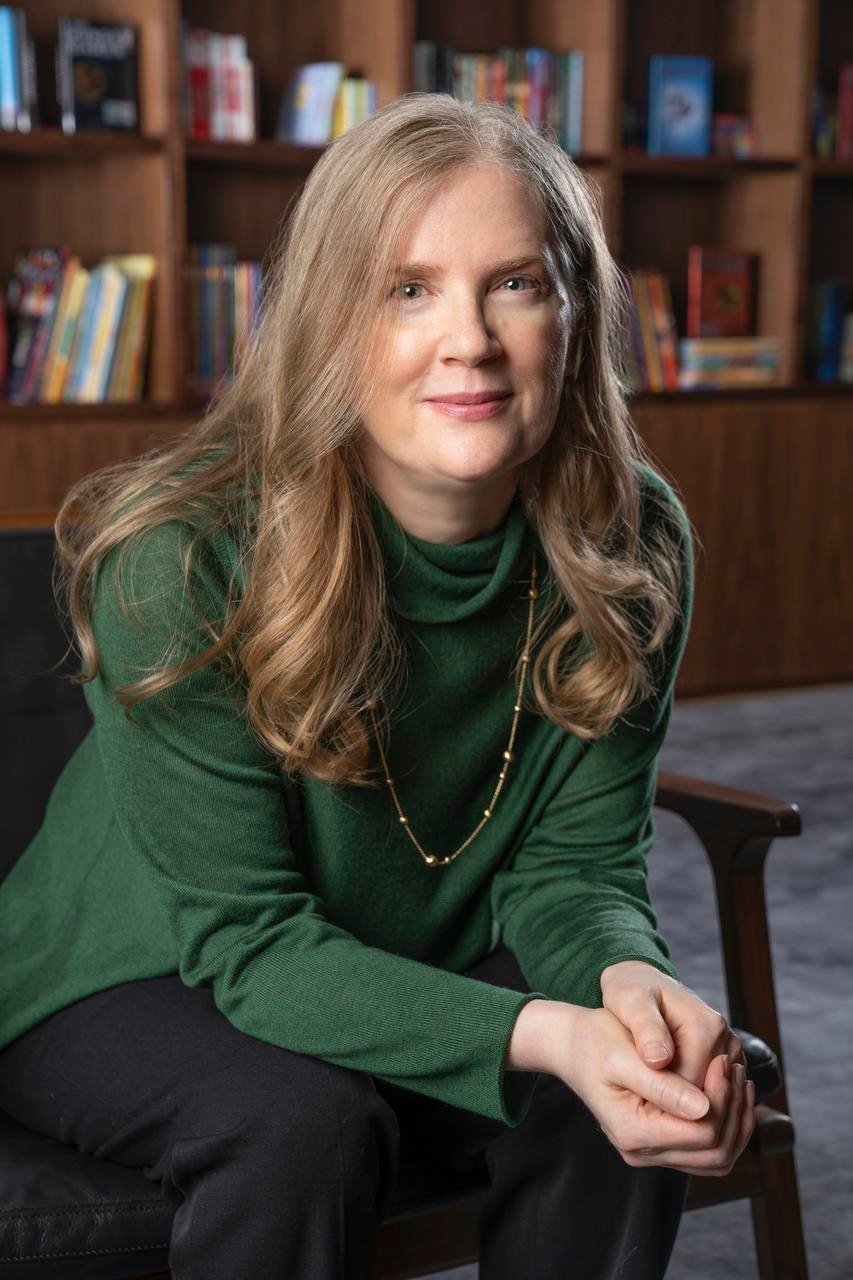
SUZANNE COLLINS (1962-current) started her career in 1991 in professional writing for children’s television. She wrote the Gregor series first and the Hunger games trilogy (young adult dystopian) first published in 2008 with film adaptations starting in 2012.
“In 2016, she was presented the 2016 Authors Guild Award for Distinguished Service to the Literary Community for exemplifying the unique power of young people's literature to change lives and create lifelong book lovers. It was the first time the Guild presented the award to a YA author.” suzannecollinsbooks.com
She has since written 2 children’s books and a prequel: The Hunger Games: The Ballad of Songbirds and Snakes (2023).
Sources:
Collins, Susanne. Gregor and the Code of Claw: The Underland Chronicles 5. Scholastic, 2007, London.
*This is issue #5 of The Book Moth Newsletter.
-
I enjoyed reading this Kate. I do love the Hunger Games Trilogy and hope you have by now read the prequel. I am really looking forward to ready all about Gregors adventures.
Add a comment: